|
Getting your Trinity Audio player ready...
|
The year 2025 will be remembered as a period marked by uncertainty, job losses, and the rapid rise of artificial intelligence (AI). Layoffs across industries, unstable career paths, and persistent inflation have once again diverted our attention towards one harsh truth:
- You cannot rely solely on your paycheck!
Yes, and as we move into 2026, financial stability may largely depend on how strong your “secondary sources of income” are. Okay, but how to develop them?
One of the best ways is to build a monthly income portfolio. These portfolios are a collection of debt-based financial instruments which offer monthly or periodic passive income. Want to learn more? Read this article to learn how a fixed income portfolio in India works, which instruments are commonly used, and how monthly payouts are generated.
What is a Fixed-Income Portfolio?
It is a mix of interest-paying instruments, such as:
- Government bonds
- Corporate bonds
- Fixed deposits
- Debt mutual funds
When you build a fixed-income portfolio in India, your goal may be to choose debt products that let you meet your financial priorities. These priorities usually fall into three simple categories:
- Safety: How secure is your principal?
- Yield: How much interest can you earn?
- Liquidity: How easily can you access your money?
Remember that every investor’s mix looks different because each person values safety, yield, and liquidity in different proportions.
How to Design a Fixed-Income Portfolio in India?
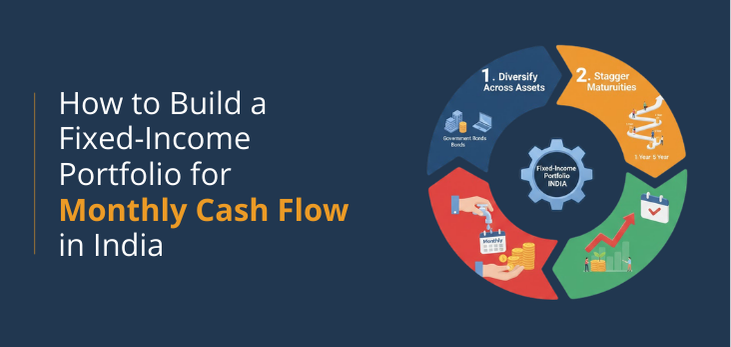
Do you think building a fixed-income portfolio is just about picking a few debt products? Nope! Before selection, you must understand several core ideas, such as:
- Are you balancing safety, returns, and liquidity?
- Are your interest payouts aligned with monthly needs?
- Are you diversifying across issuers, ratings, and tenures?
- Are you using laddering techniques to stagger maturities?
Once you understand these fundamentals, choosing the right mix of products becomes far easier. For more clarity, check out the primary principles you may follow while developing your fixed-income portfolio in India:
| Principle | Explanation |
|---|---|
| Balance Safety, Yield, and Liquidity | You may combine a mix of different instruments, such as:
|
| Match Payout Structures to Income Needs | You may choose products that offer monthly, quarterly, or staggered interest payouts. |
| Spread Risk | You may diversify across different issuers, sectors, maturities, and credit ratings. |
Disclaimer: The information above is purely educational. Individuals should conduct their own research and assessment before making any investment decisions.
Which Instruments are Commonly Used for Monthly Cash Flow?
A fixed-income portfolio in India uses multiple debt instruments that behave differently but complement each other. For example, one may offer safety, another may offer higher returns, and another may offer liquidity. Together, they create a diversified portfolio that is stronger than relying on any single product alone.
For your reference, below is a list of some debt products you may include in your portfolio:
A) Government Bonds
Government bonds could be the “backbone of stability” in any fixed-income portfolio in India. Why? That’s because they carry a sovereign guarantee, which means you may get 100% of your principal + interest back in case of a default. Some common options in this segment are:
- Government Securities (G-secs)
- RBI Floating Rate Bonds (FRSB)
Both instruments provide regular income, though liquidity and payout frequency depend on the bond.
B) Corporate Bonds and FDs
Corporate bonds and FDs are issued by companies, banks, and NBFCs (Non-banking Finance Companies). Their yields vary depending on the issuer’s credit rating. Usually, AA or AAA-rated bonds and corporate FDs offer higher safety and lower returns as compared to lower-rated (say A, BBB, BB) financial products.
If you are looking to invest in FDs or monthly income bonds in India, you may visit the GoldenPi platform. Here, you can find a variety of options, along with important details like coupon rate, credit rating, current yield, and more.
C) Debt Mutual Funds
Debt mutual funds do not pay monthly interest directly. Instead, investors commonly use Systematic Withdrawal Plans (SWP) to create a monthly cash flow. In this setup, a fixed amount is withdrawn from the fund at regular intervals (such as once a month).
Some common types of debt funds are:
- Liquid funds
- Short-term funds
- Corporate bond funds
- Target maturity funds
They may offer the advantages of diversification + professional management. However, remember that SWP amounts are not pre-determined and can fluctuate every month.
D) Government Schemes
Besides G-secs and FRSB, there are also government-backed schemes that carry a sovereign guarantee. Some of the investment options you may consider while building your fixed income portfolio in India are:
- Pradhan Mantri Vaya Vandana Yojana (PMVVY)
- Post Office Monthly Income Scheme (POMIS)
- Senior Citizen Savings Scheme (SCSS) (offers quarterly payout option)
4 Common Risks in Fixed-Income Portfolios in India
Even though fixed-income options are generally more stable than equity instruments, they are not completely risk-free. To develop a better portfolio by picking the right products, learn about some common risks carried by most debt instruments:
| Risk Type | What Does it Mean? | How Does it Impact You? |
|---|---|---|
| Credit Risk | The issuer may face financial stress or fail to repay on time. | It can delay or reduce interest payments and affect your capital. |
| Interest Rate Risk | Bond prices may fluctuate when market interest rates change. | Your bond’s value can fall if market interest rates increase. |
| Liquidity Risk | Some products are harder to exit at fair value. | You may not be able to withdraw money when you need it. |
| Concentration Risk | Too much money is invested in one issuer or product. | If that particular issuer faces financial distress, you may face capital losses. |
In Summary, A Fixed Income Portfolio in India May Contain Bonds, FDs, and Debt Mutual Funds
So now you know that to build a strong secondary source of income, you may develop a portfolio that balances safety + yield + liquidity. But how to achieve this balance? You may mix different types of instruments (as per your risk appetite), such as, invest in:
- Government bonds for a secure base + safety
- Corporate bonds and NCDs to earn competitive returns
- Debt mutual funds for relatively high liquidity
If you’re looking for debt products such as bonds and corporate FDs, or want to apply to the latest NCD IPOs, you can find them on the GoldenPi platform. Here, you can explore a wide range of options and even invest online from the comfort of your home.
Fixed Income Portfolio in India FAQs
1. How to develop a bond ladder in India?
A bond ladder in India can be created by buying bonds with staggered maturities (say 1, 3, 5, 7, and 10 years). Now, as each bond matures, you may reinvest the principal into a new long-term bond. This approach reduces “reinvestment risk” by giving you multiple opportunities to invest in a high-interest-rate environment.
2. Can I get a pre-determined return from SWPs (Systematic Withdrawal Plans)?
No! The returns generated by SWPs are market-linked and not based on any coupon/ interest rate. As an investor, you can withdraw a pre-determined amount from your SWP plan monthly, but remember your returns are entirely dependent on the market performance.
3. What does a sovereign guarantee mean?
A sovereign guarantee means the Government of India backs the investment. If the issuer cannot repay, the government will step in to repay your principal + interest. This makes such instruments among the “safest” or “risk-free”, as the repayment risk is low.
4. How to review credit ratings of corporate bonds and FDs?
You may check the ratings issued by reputed agencies, such as CRISIL, ICRA, CARE, or India Ratings. To achieve high safety, you may look for AAA or AA-rated bonds and FDs. Additionally, review the rating report to understand the issuer’s financial strength, debt levels, and cash flow positions before investing.
Disclaimer:
This information is for general information purposes only. GoldenPi makes no guarantee on the accuracy of the data provided here; the information displayed is subject to change and is provided on an as-is basis. Nothing contained herein is intended to or shall be deemed to be investment advice, implied or otherwise. Investments in the securities market are subject to market risks. Read all the offer-related documents carefully before investing.
Bonds or non-convertible debentures (NCDs) are regulated by the Securities and Exchange Board of India and other government authorities. GoldenPi Securities Private Limited is a registered debt broker and acts as a distributor and not as a manufacturer of the product.