|
Getting your Trinity Audio player ready...
|
Retail investors in India often lose money in bonds not because bonds are “unsafe”, but because they misunderstand risk, liquidity, and product structure when buying through online apps and platforms.
Many skip basic checks, chase high coupons, or assume they can exit anytime. The result? All of this leads to poor investment decisions and unexpected financial losses. Don’t want that? Below are 5 mistakes in bond investing in India, you must avoid in 2026.
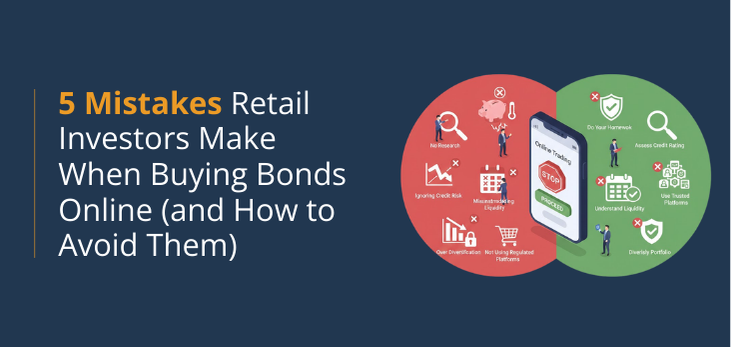
5 Common Bond Investing Mistakes India in 2026
One of the most common mistakes in bond investing India is skipping independent research and relying only on a platform’s summary or marketing card. Many investors do not even read the Information Memorandum or even a short product note.
The negatives? You may miss hidden risks such as:
- Weak financials
- Low ratings
- Unusual clauses
- Poor security
This can lead to buying high-risk bonds or facing surprise losses you were not prepared for. Want to avoid this? Always check the issuer’s financials, rating rationale, risk factors, and payment schedule. To further improve your investment choices, check out some common mistakes in bond investing India, you must avoid:
1. Big-Picture Mindset Errors
Many online bond buyers think “fixed income = no risk” and chase the highest coupon or yield without a plan. Please realise that bonds are loans you give to issuers. The risk depends heavily on:
- Who are you lending to
and
- The instrument’s structure
Two of the most common mindset mistakes in bond investing India are:
| Mindset Mistake | What It Means | Why It Is a Problem | What You Should Do Instead |
|---|---|---|---|
| No clear goal | Many investors buy bonds without knowing whether they want:
|
You may end up with bonds that do not match your needs or risk appetite | Before choosing a bond, you must decide your purpose:
Without this clarity, you may invest in bonds that do not match your needs. |
| Over-concentration | Many beginners get attracted to a single high-yield product. Usually, they put a large share of their money into:
or
|
If that issuer fails, a large part of your money is at risk. | You may spread your investment across:
|
2. Chasing Yield + Ignoring Credit Risk
Nowadays, several online platforms highlight “X% yield” or “Y% above FD”, which tempts investors to ignore why a bond is paying so much. As an investor, you must realise that high yield usually signals:
- Lower credit quality
- Weak security
- Poor liquidity
Many beginners look only at the interest rate (coupon) or YTM and ignore all other factors.
But remember, a high interest rate does not mean the bond is safe. You must also check:
| Credit Rating | Leverage | Cash Flows |
|---|---|---|
| Shows the issuer’s ability to repay. | How much debt the company already has. | Whether the bond is secured (backed by assets) or unsecured. |
If you ignore these points, you may buy a bond that carries high risk + weak repayment strength.
3. Ignoring Structure, Clauses, and Fine Print
Retail investors often do not read term sheets carefully when buying online. Some common blind spots are:
A) Call/Put Options in Bonds
- Some bonds come with special features like call or put options.
- A call option gives the issuer the right to repay your bond before maturity.
- If interest rates fall, the issuer may “call back” the bond and refinance at a lower rate.
- This stops you from earning the higher coupon for the full period.
B) Subordination (Tier II, Perpetual, etc.)
- Not all bonds from the same company have the same seniority.
- Subordinated, Tier II, AT1, and perpetual bonds sit lower in the repayment order.
- These instruments can face extra risk during stress events.
- In a severe crisis, subordinated bonds can be used to bail-in (your money can be converted to equity or written off).
- This risk is higher in bonds issued by banks and NBFCs because they follow regulatory capital rules.
C) Security Level of the Bond
- Bonds have different levels of protection based on what backs them.
- “Senior secured” bonds are backed by specific assets and get repaid first in case of bankruptcy.
- In contrast, “junior secured” bonds are backed by assets but rank lower than senior secured.
- Additionally, there are “unsecured” bonds, which carry no asset backing. The repayment depends only on the issuer’s financial strength.
- Always remember that the higher the security, the higher the chance of recovery in a default scenario.
To avoid this mistake in bond investing India, you should always check whether your bonds are:
- Secured or unsecured
- Senior or subordinated
- Presence of call or put options
4. Liquidity Traps in the Secondary Market
On many online platforms, a bond may appear with an attractive yield, but its actual tradable volume is “thin” or low. As a result, in stress periods, you may not find a buyer at a fair price. Some common mistakes made by new bond investors in this segment are:
| A) You Believe You Can Exit Anytime at the “Screen Price” | B) You Put Large Money into Illiquid or Unlisted Bonds Before Important Life Needs |
|---|---|
and
|
|
Okay, so what’s the solution? Always check if a bond is listed or unlisted, and what its trading volume is (a high volume may be preferred). For major goals or emergency funds, use G-Secs, SDLs, liquid PSU/bank bonds, or debt mutual funds where selling is potentially far more liquid.
5. Operational and Settlement Issues When Buying Online
As per the latest SEBI rules, nowadays trades are settled on a “T+1” basis. This means if you buy a listed bond today, it gets delivered to your demat account tomorrow. Now, even with this faster system, many retail investors make these common online bond platform errors in India:
| A) Accrued Interest Confusion (clean vs inflated price) | B) Mistakes in PAN, Demat, or Bank Details |
|---|---|
|
|
Now, to avoid these mistakes, you should check the price type (clean vs inflated) before placing an order. This lets you know your actual cash outflow on settlement day (T+1).
Additionally, double-check your personal details by reconfirming your PAN, demat account number, and bank details while setting up your account. Also, keep enough money in your linked bank account until the transaction settles.
To Sum It Up, Mistakes in Bond Investing India Can Lead To Poor Investment Choices
So now you know that by making some common mistakes in bond investing, you can pick up inferior products that are below investment grade. This exposes you to higher default risk + unexpected losses.
A stronger approach? It starts with avoiding a few basic errors that many new investors repeat. You should avoid:
- Choosing bonds without setting clear goals
- Relying only on high coupons
- Ignoring liquidity and exit risks
- Skipping documents and due checks
When you follow these simple rules, your bond selection becomes safer and more aligned with your needs. Are you looking for a platform that offers a wide range of investment-grade choices? GoldenPi provides access to government bonds, PSU bonds, AAA-rated corporates, and many other credible options. Investing is also simple and can be done online without any in-person branch visits.
Mistakes in Bond Investing India FAQs
1. What are the online bond platform errors in India?
Investors often confuse screen prices with actual tradable prices and ignore liquidity. They skip independent research and rely only on platform summaries. All of this leads to subpar investment choices.
2. What not to do when buying bonds in India?
Do not chase only high coupons or skip credit ratings. Avoid unlisted or illiquid bonds (particularly for major goals) and do not over-concentrate in a single issuer. Lastly, avoid investing without reading the Information Memorandum.
3. Does a subordinated bond carry more risk than a senior bond?
Yes! Subordinated bonds sit below senior bonds in the repayment hierarchy (or liquidity sequence). They can face skipped coupons, write-downs, or bail-ins during stress. In contrast, senior bonds have priority in recovery and carry relatively lower credit risk.
4. Will my coupon payments be affected when market interest rates fall?
No! Your coupon stays the same unless the issuer defaults. Note that market interest rate changes only affect the bond’s price and not the fixed coupon you receive.
5. What is the credit rating of a bond?
A credit rating is an independent assessment of the issuer’s ability to repay interest and principal. Rating agencies (such as ICRA, CRISIL, or CARE) classify bonds from high safety (AAA) to high risk (usually BB and below).
Disclaimer:
This information is for general information purposes only. GoldenPi makes no guarantee on the accuracy of the data provided here; the information displayed is subject to change and is provided on an as-is basis. Nothing contained herein is intended to or shall be deemed to be investment advice, implied or otherwise. Investments in the securities market are subject to market risks. Read all the offer-related documents carefully before investing.
Bonds or non-convertible debentures (NCDs) are regulated by the Securities and Exchange Board of India and other government authorities. GoldenPi Securities Private Limited is a registered debt broker and acts as a distributor and not as a manufacturer of the product.