Some retirement plans offer payouts based on how well your investments have performed in the market over time. Some others base it on how much you (and your employer) have contributed over the course of your employment years.
But there are also some plans that offer fixed retirement benefits, so your payout is predetermined. These are called defined benefit pension plans. In this article, we’ll help you understand what a defined benefit pension plan is, its key features, and how it works to make retirement planning feel a bit easier.
What is a Defined Benefit Pension Plan?
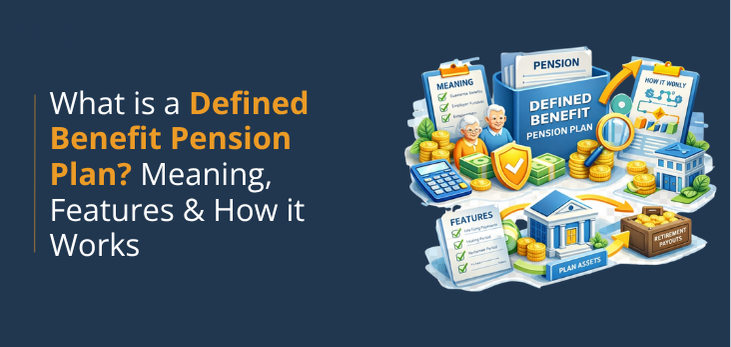
Defined benefit pension plans are retirement schemes that offer a fixed and guaranteed income in your retirement years. Your pension income is based on a specific formula, typically including variables like:
- Your salary
- Number of years worked
- Age
This is different from other types of retirement plans (like building a corpus through mutual funds), where the payouts depend on the outcome of your investment. In defined benefit plans, your employer promises to pay you a specific amount of pension income monthly after you retire.
Start investing with just ₹10K & grow your wealth with fixed return opportunities.
Invest Now

Key Features of a Defined Benefit Pension Plan
Let’s understand the key features of a defined benefit plan in detail:
-
Fixed Retirement Income
The monthly pension payout you receive from a defined benefit pension plan is not based on market performance. It is fixed and guaranteed. The pension sum is calculated using a certain preset formula.
For instance, your employer may use a formula like:
Pension = 2% x Years of Service x Final Average Salary
So, if you’ve worked for 30 years at an average salary of Rs. 50,000/month, your defined benefit pension would be Rs. 30,000 per month. However, it’s important to note that the specific formula used can be different depending on your employer’s policies.
Responsibility of the Employer
Your employer is responsible for making contributions to your defined benefit pension plan. This makes such plans different from defined contribution plans, where both the employer and employee have to make set contributions of the basic salary + D.A. to the scheme.
For defined benefit pension plans, all the contributions and management responsibility fall solely on your employer.
Vesting Period
Most defined benefit pension plans have a vesting period. Vesting period is simply the minimum number of years that you need to work for the company in question to qualify for the pension benefits. In most companies, this vesting period is typically about 5 or 10 years.
If you happen to exit the company before completing this vesting period, you may not qualify for the pension benefits. In some cases, even if you do, you might receive reduced benefits.
Survivor Benefits
In case the employee passes away, the pension benefits are passed on to their spouse. This means the employee’s spouse and family can use the fixed pension income to sustain themselves.
Lifetime Annuity or Lump-Sum
In some cases, employers may offer their employees a choice between getting the retirement corpus monthly to manage expenses and getting it all at once as a lump-sum payment. But in most cases, defined benefit pension plans only offer a monthly payout like an annuity plan.
Automatic Enrollment
Many defined benefit pension plans automatically enrol employees. This means employees don’t need to ‘opt in’ for these plans.
How Does a Defined Benefit Pension Plan Work?
Here’s how a defined benefit plan for retirement actually works:
-
Step 1: You are Enrolled Automatically
As mentioned before, you don’t have to ‘opt in’. If your employer offers a defined benefit plan, you’ll be automatically enrolled on it by default.
-
Step 2: Your Employer Funds the Plan
You don’t have to worry about contributions. Your employer takes care of that and manages the fund. In some cases, employees may be allowed to contribute a small sum, but mostly, employee contributions are not allowed.
-
Step 3: You Keep Working to Accumulate Service Years
You continue working at the company and build your years of service over time. To become eligible for a defined benefit pension, you first need to complete a minimum number of years, known as the vesting period. After that, the longer you stay, the higher your potential pension can be, since the total years of service play a key role in how the final payout is calculated.
-
Step 4: Pension is Calculated
Next, the defined pension amount is calculated. This is done when you retire. The company may use things like your years of service and average monthly income in the last few years to arrive at the defined pension amount you’ll receive post-retirement.
-
Step 5: You Receive Fixed Pension Payouts
Once you retire, you’ll start receiving the defined pension payouts. Usually, these pension payouts continue for life. If the employee passes away, then the benefits are passed on to their spouse and continue until the spouse dies.
Defined Benefit Vs. Defined Contribution Plans: What’s the Difference?
When we talk about defined pension plans, the defined contribution ones (like EPF) come to mind first. But these plans are actually different from defined benefit pension plans. Here’s how the two differ:
| Feature | Defined Benefit Plan | Defined Contribution Plan |
| Who contributes? | Mainly the employer | Employer, employee, or both contribute regularly |
| Who bears investment risk? | The employer takes on the investment risk | The employee bears the investment risk |
| Retirement income | Fixed and pre-decided based on a formula | Depends on market performance and contributions made |
| Portability | Not very flexible when switching jobs | Easily portable across employers or accounts |
| Flexibility | Limited choices for the employee | More flexibility in choosing investment options |
So, Should You Rely on a Defined Benefit Pension Plan for Retirement?
Defined benefit pension plans offer a fixed and guaranteed pension in your golden years. The amount depends on the formula used by the company, which typically includes years of service and average salary figures. However, these plans are:
- Not ubiquitous
- Mainly offered to government employees
- Not made with rising cost inflation in mind
This means relying on a defined benefit pension plan (even if you qualify for one) might not be the wisest decision. That’s why combining them with other relatively safe investments like bonds may be a good option.
If you’re looking to retire early with bonds, you can head to the GoldenPi platform to check out bond collections and invest as per your goals, lifestyle-based corpus needs, and risk appetite.
FAQs on Defined Benefit Pension Plan
1. Who offers defined benefit pension plans in India?
In India, defined benefit pension plans are typically offered to government employees only. Central and State government employees hired before 1st January 2004 are covered under the Old Pension Scheme (OPS), which was a defined benefit pension plan.
2. What are the disadvantages of a defined benefit pension plan?
Defined benefit pension plans have the following disadvantages:
- Lack of portability because you may not be able to transfer benefits if you switch jobs.
- Access to these plans is limited mostly to government employees
- Payouts may be at risk if the employer mismanages the fund
3. Is pension payout from a defined benefit plan taxable in 2026?
Yes. The monthly pension income you receive is taxable under the ‘Income from Other Sources’ head as per your tax slab. However, if you’ve received a part of the amount as a lump-sum, it may be tax-free up to a certain limit. It’s always good to consult a tax advisor to optimise your tax liability.
4. What happens to my pension if I decide to switch jobs?
Most defined benefit plans are not portable. This means that if you switch jobs, you will qualify for a defined benefit plan in the new organisation only if you finish the minimum vesting period here. Your previous record will not carry forward.
5. Is NPS a defined benefit pension plan?
No. NPS, or the National Pension Scheme, is a defined contribution plan. Here, your payouts depend on the market performance and your accumulated corpus.
Disclaimer:
This information is for general information purposes only. GoldenPi makes no guarantee on the accuracy of the data provided here; the information displayed is subject to change and is provided on an as-is basis. Nothing contained herein is intended to or shall be deemed to be investment advice, implied or otherwise. Investments in the securities market are subject to market risks. Read all the offer-related documents carefully before investing.
Bonds or non-convertible debentures (NCDs) are regulated by the Securities and Exchange Board of India and other government authorities. GoldenPi Securities Private Limited is a registered debt broker and acts as a distributor and not as a manufacturer of the product.