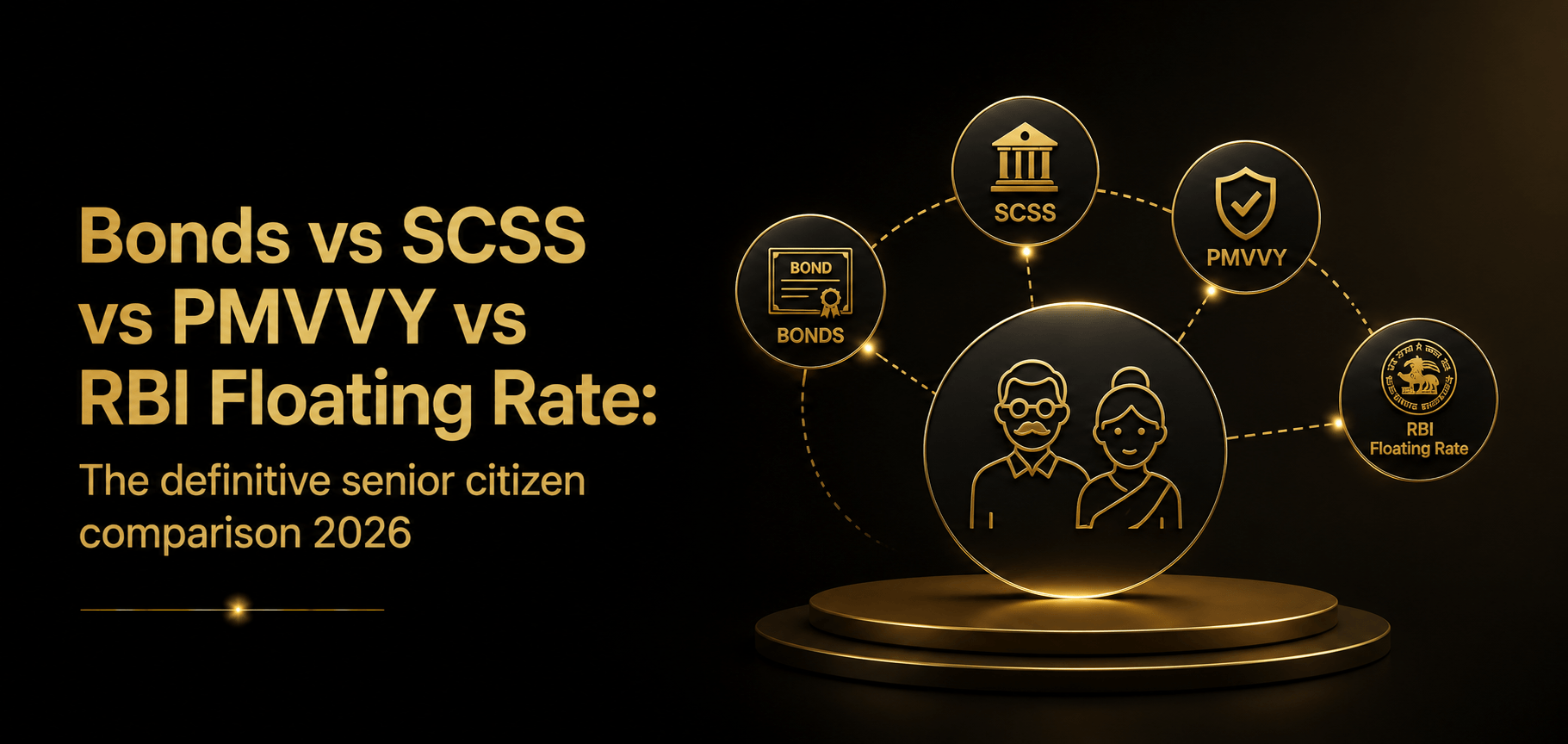
So you recently turned 60 years of age and moved into the senior citizen bracket. You now want to maximise your wealth-creation potential so you can live your post-retirement life comfortably. But you’re not quite sure of which of the senior citizen investment options in 2026 is ideal for you.
This uncertainty is more common than you think. In fact, many senior citizens find it difficult to choose the right investment option. In this article, we’ll break down some of the most common senior citizen fixed-income instruments like bonds, SCSS, PMVVY, and RBI floating rate bonds. We’ll also compare them side-by-side so you can make a decision that fits your needs.
What are Bonds?
Bonds are financial instruments issued by the central government, state governments, or corporations to raise capital from the public. When you invest in bonds, you’re essentially lending your money to the bond issuer for a certain time period, known as the tenure.
In return for your funds, the issuer pays you interest at a predetermined percentage at regular intervals. Once the tenure ends, the bonds will mature, and you will get back the initial investment amount. The regular interest payments make bonds a good senior citizen fixed-income instrument.
How Do They Work?
A manufacturing company issues bonds to raise capital to purchase an expensive piece of machinery. The bonds have a 10-year tenure and will pay interest at 9% per annum. The interest is paid out every quarter till the bond matures.
You decide to invest ₹10 lakhs in the company’s bonds. Every quarter, you will get ₹22,500 (₹90,000 per year) from the company as an interest payment. When the bond matures at the end of 10 years, your initial investment of ₹10 lakhs is returned to you in full.
Start investing with just ₹10K & grow your wealth with fixed return opportunities.
Invest Now

What is SCSS?
The Senior Citizen Savings Scheme (SCSS) is a government-backed savings scheme available exclusively for individuals over the age of 60. You can invest in this scheme through authorised banks or post offices across India.
SCSS offers a fixed rate of interest and is paid out every quarter. While the maximum tenure of the scheme is 5 years, you can extend it by another 3 years. One of the key features of this scheme is that the interest rate is revised by the government every quarter.
Related Post
- Rating Outlook vs Rating Watch: What “Negative Outlook” Means
- How to Do a Demat-to-Demat Transfer in India: CDSL Easiest Step-by-Step Guide

- Beyond the Rupee: Decoding SEBI’s ‘Second Shelf’ for Global Bonds
How Does it Work?
Here’s a hypothetical example to help you understand how this scheme works. It also helps put things into perspective when comparing SCSS vs. bonds.
Assume you just turned 60 years of age. You wish to invest ₹15 lakhs that you received as a gratuity payment from your organisation. You decide to invest in SCSS through your nearby post office.
The current SCSS interest rate is 8.2% per annum. This would mean that you will receive ₹30,750 each quarter (₹1,23,000 each year) for 5 years. Assuming you don’t choose to extend your tenure, you will get back the initial investment amount of ₹15 lakhs at the end of the tenure.
Now, it is important to note that the interest you receive each quarter may change if the government revises the rates.
What is PMVVY?
The Pradhan Mantri Vaya Vandana Yojana (PMVVY) is a pension scheme backed by the government of India and regulated by the Life Insurance Corporation of India (LIC). It was designed to provide a regular source of income for senior citizens.
One of the key features that made PMVVY one of the best senior citizen fixed-income options is that it combined a life insurance policy and a pension scheme. The maximum tenure of PMVVY was 10 years. While the interest rate was fixed, there was flexibility to choose between different payment frequencies.
Note: The subscription period for PMVVY ended on March 31, 2023. This essentially means that no new investments in the scheme can be made.
How Does it Work?
The following example can explain how this scheme works and make it easy for you to compare PMVVY vs. bonds.
Say you’re a 63-year-old retired individual with a lump sum amount of ₹15 lakhs. You chose to invest in the PMVVY scheme on March 31, 2023, and opted for monthly payouts.
The interest rate is 7.40% per annum, which means that you would receive ₹9,250 each month (₹1,11,000 per year) until the end of the 10-year tenure (March 31, 2033).
Now, PMVVY combines both life insurance and pension benefits. So, in the case of your demise during the scheme’s tenure, your nominee will receive the entire initial investment amount of ₹15 lakhs, including unpaid interest.
On the other hand, if you survive till the end of the tenure, the initial investment amount, including interest, will be paid out to you.
Must Read
- Rating Outlook vs Rating Watch: What “Negative Outlook” Means
- How to Do a Demat-to-Demat Transfer in India: CDSL Easiest Step-by-Step Guide
- Beyond the Rupee: Decoding SEBI’s ‘Second Shelf’ for Global Bonds
What are RBI Floating Rate Bonds?
The RBI floating rate bonds are government-backed bonds issued by the Reserve Bank of India. Unlike regular corporate bonds or G-Secs, these floating rate bonds come with a variable interest rate.
The interest rate is linked to the National Savings Certificate (NSC), which is revised every six months. This essentially means that your interest payouts can either increase or decrease if the NSC rates are revised upward or downward, respectively.
Similar to fixed-rate G-Secs, the RBI floating rate bonds also have a long tenure. The interest payments are made twice a year (semi-annually) until the end of the tenure. Once the tenure ends, the initial investment amount is returned to you.
The variable interest rates can be an advantage for an RBI floating rate bond senior citizen investor, especially in a rising rate environment.
How Do They Work?
Assume you’ve invested ₹5 lakhs in RBI floating rate bonds with a tenure of 7 years. The interest rate for the current six-month period is 8.05% per annum. This means that you would receive a payout of ₹20,125 for this period.
Now, let’s say that the interest rate is hiked to 8.5% per annum for the next six-month period. Your interest payout will increase to ₹21,250. This goes on until the end of the bond’s tenure. When the bond matures at the end of 7 years, your initial investment of ₹5 lakh is returned to you.
A Detailed Comparison of SCSS vs. Bonds vs. PMVVY vs. RBI Floating Rate Bonds
The table below compares these instruments across key parameters. It can help you identify the right senior citizen investment options for 2026 that are ideal for your goals.
| Parameters | SCSS | Bonds | PMVVY | RBI Floating Rate Bonds |
| Issuer | Government of India | Corporations, central government, and state governments | Government of India, through LIC | Reserve Bank of India |
| Interest Rate | Fixed, but revised quarterly | Fixed, but varies depending on the issuer and tenure | Fixed for the entire tenure | Variable (linked to the NSC rate) |
| Nature of Returns and Interest Payout | Fixed quarterly payments | Fixed interest payments, but the frequency varies depending on the issuer | Fixed pension payouts, with the freedom to choose frequency | Variable semi-annual interest payments |
| Tenure | 5 years, extendable by another 3 years | Flexible, ranging from 1 year to 40 years | 10 years | 7 years |
| Principal Repayment | Yes, at maturity | Yes, at maturity | Yes, at the end of the tenure | Yes, at maturity |
| Risk Level | Very low | Very low to moderate | Very low | Very low |
| Liquidity | Moderate | High, as they can be traded on the exchanges | Low | Low |
| Maximum Investment | ₹30 lakh per individual | No upper limit | ₹15 lakh per individual | No upper limit |
| Premature Exit | Yes, with a penalty after 1 year | Yes, via the secondary market | Limited, only under medical grounds | Yes, but only for investors above 60 years of age with a reduced payout |
Create Your Fixed Income Portfolio Today with GoldenPi
If you’re above 60 years of age, choosing the right senior citizen investment options in 2026 is important.
If you prefer safety and simplicity but don’t mind receiving payments on a quarterly basis, SCSS is an option you can consider.
Similarly, the PMVVY is another government-backed, safe investment option. With a tenure of 10 years, it is ideal if you want long-term pension payments with a bit of life insurance coverage. However, it is important to note that PMVVY is currently not open for subscription.
If you expect interest rates to rise in the future, an RBI floating rate bond for senior citizens could be the right choice. This is because the payments will increase with the rise in interest rates, which can offset the effects of inflation.
Finally, bonds are an evergreen investment option for all kinds of investors, including senior citizens. If you value flexibility, potentially higher yields, and better liquidity, bonds could be the answer. However, when you compare SCSS vs. bonds, the risk is often higher with bonds.
For senior citizens like yourself, creating a fixed-income portfolio is easy with GoldenPi. You can find a wide range of investment options, like FDs from RBI-licensed banks to NCD IPOs. There’s also an extensive collection of corporate bonds across different credit ratings, tenures, and interest rates.
FAQs on Senior Citizen Investment Options in 2026
When you compare SCSS vs. bonds, you’ll find differences in structure, tenures, returns, and flexibility. The SCSS is a 5-year central government-backed savings scheme exclusively for senior citizens. Bonds are available in different tenures and interest rates. Also, they can be issued by corporations, state governments, or the central government of India.
The return potential of senior citizen investment options in 2026 can vary based on issuer, type, and tenure. Additionally, the interest rates of certain government-backed options like the SCSS and PMVVY are often revised periodically.
Senior citizens can invest in government securities (G-Secs) through the RBI Retail Direct platform. Alternatively, they can also invest in G-Secs and corporate bonds through a SEBI-registered Online Bond Platform Provider (OBPP) like GoldenPi.
The interest payments from these investments are taxed at the applicable income tax slab rate. If you sell bonds before their maturity date for a profit, capital gains tax applies. Depending on how long you hold them for, you may have to pay tax on either Short-Term Capital Gains (STCG) or Long-Term Capital Gains (LTCG).
Corporate bonds and G-Secs offer the most liquidity since they can be sold on the stock exchanges during market hours. Other senior citizen fixed-income instruments like the SCSS and PMVVY have limited liquidity
Disclaimer:
This information is for general information purposes only. GoldenPi makes no guarantee on the accuracy of the data provided here; the information displayed is subject to change and is provided on an as-is basis. Nothing contained herein is intended to or shall be deemed to be investment advice, implied or otherwise. Investments in the securities market are subject to market risks. Read all the offer-related documents carefully before investing.
Fixed Deposit schemes are regulated by the Reserve Bank of India. GoldenPi Securities Private Limited is a registered debt broker and acts as a distributor and not as a manufacturer of the product.
Corporate Bond Related Post
- 6 Risk Factors to Evaluate in Corporate Bond Investments
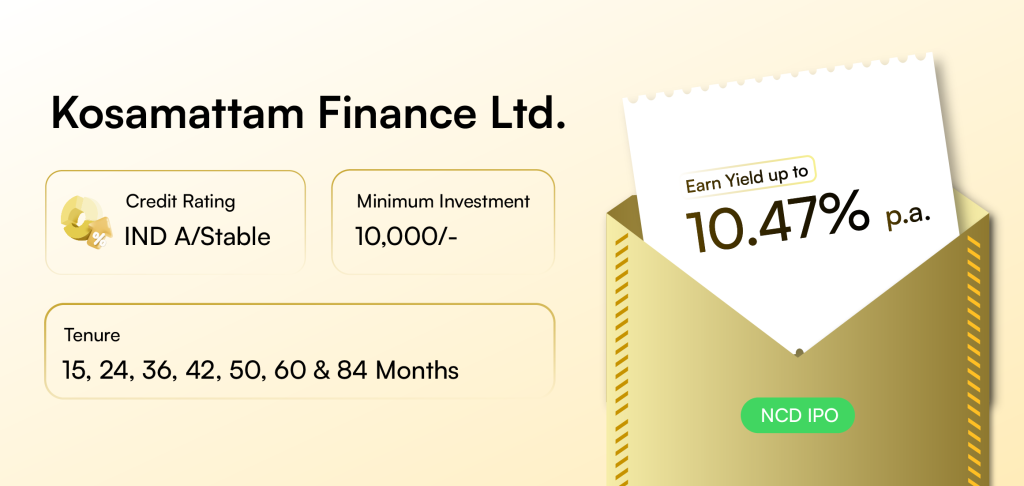
- KOSAMATTAM FINANCE LIMITED NCD IPO
- Muthoot Fincorp Limited NCD IPO