The bond market and the oil market might seem to be worlds apart, but they are in fact closely linked to each other. While the bond market involves financial products that provide income streams to investors, the oil market involves the trading of the most vital commodity in powering the economy today. But how do they connect? There is a reason why the oil price level impacts the bond market as well, and it is something worth knowing for any investor.
Why the Bond Market and Oil Market Are Connected
In the bond market, the prices and yields reflect what investors expect in terms of the economy’s future performance regarding inflation and growth. At the same time, oil is one of the most critical commodities and influences the cost of doing business.
When oil prices fluctuate, it might affect inflation levels, corporate profitability, consumer spending, and governments’ ability to collect tax revenues. All of this might have an effect on bond prices and yields.
For this reason, events in the oil market receive close attention from bond investors all over the world.
Start investing with just ₹10K & grow your wealth with fixed return opportunities.
Invest Now

How Rising Oil Prices Affect Bond Markets
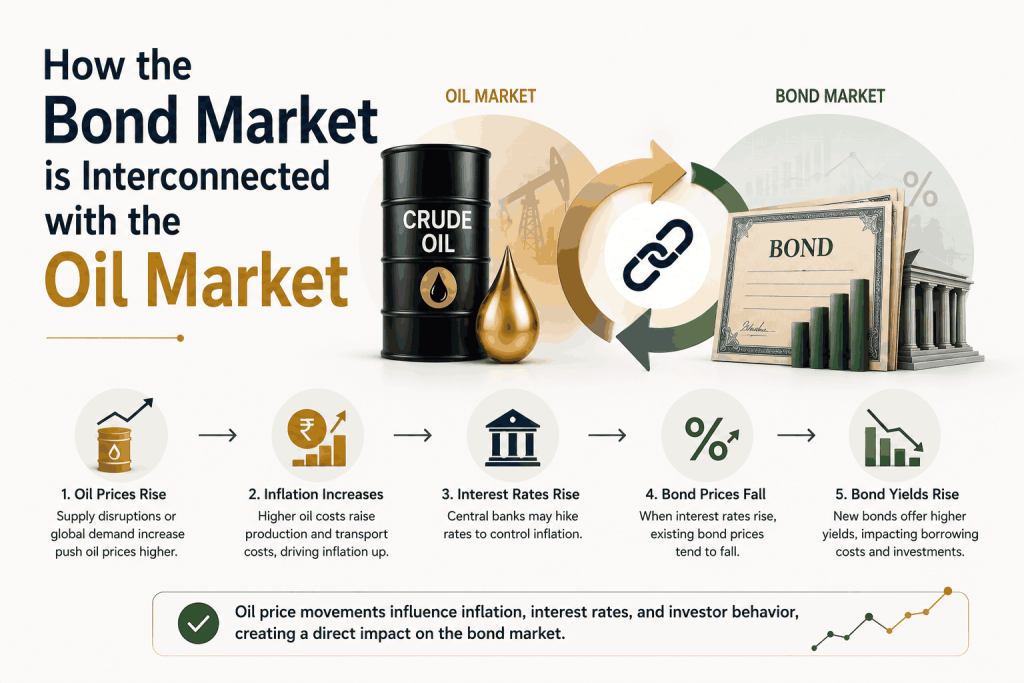
One of the strongest connections between oil and bonds is through the inflation rate.
If the price of oil rises, the cost of transportation, production, and energy will be higher. Companies can increase their costs by passing these increases on to the consumer; hence, an increase in inflation levels.
Inflation can create worries for bondholders since future interest payments will not be worth as much.
Consequently:
- Higher interest payments will be demanded.
- There might be a drop in bond prices.
- Borrowing costs might increase for corporations and governments.
For instance, if there is an abrupt spike in the price of crude oil, bond yields will be pushed higher by investors worried about inflation.
The Effect of Decreasing Oil Prices on Bond Yields
Conversely, falling oil prices have the opposite effect. Reduced costs of energy can reduce inflationary pressures throughout the country. Corporations will have reduced costs, and consumers will have additional money to spend elsewhere in the economy.
If there are reduced expectations of inflation:
- Bond investors will be more content with reduced yields.
- The bond price will increase.
- Interest rates will remain constant or low.
This is the reason why the bond market is pleased with falling crude oil prices, especially if there were concerns about inflation.
The Role of Inflation in the Bond-Oil Relationship
Inflation serves as the main link between the bond market and the oil market.
Oil is one of the major input costs in many industries. Any changes in oil prices may affect everything from airline tickets and shipping expenses to food prices and production costs in industry. As bond buyers look into the future and try to predict future inflation, any change in oil prices is perceived as a harbinger of inflation.
If oil prices continue to stay high for an extended period of time, the bond market may expect a rise in inflation and raise yields. Otherwise, if oil prices stay low, inflation expectations should decline, resulting in rising bonds.
Recent Post:
- Rating Outlook vs Rating Watch: What “Negative Outlook” Means

- How to Do a Demat-to-Demat Transfer in India: CDSL Easiest Step-by-Step Guide

- Beyond the Rupee: Decoding SEBI’s ‘Second Shelf’ for Global Bonds

How Central Bank Policies Connect Bonds and Oil
Any shifts in oil prices could also affect the decisions of central banks.
If increasing oil prices are responsible for inflationary pressure, central banks may decide to increase interest rates. Higher interest rates will result in increased bond yields and decreased bond prices.
On the other hand, if oil prices have fallen sharply and economic growth has slowed down, central banks are likely to be more accommodating and either reduce interest rates or delay any potential rate hikes. Bond markets take future monetary policy into account when pricing bonds.
The Impact of Oil Prices on Economic Growth
In addition, bonds can be impacted by oil through its effect on economic growth.
Moderately reduced oil prices may help consumers and businesses through the reduction of costs and increased buying power. Investors will be incentivized to invest in risky assets as a result of improved economic growth, thus placing downward pressure on bonds.
On the other hand, excessively high prices of oil may negatively impact economic growth due to increased costs. The investors are likely to buy government bonds as they become riskier, resulting in higher bond prices.
As one can notice, there is an indirect relationship between oil and bonds that goes beyond the impact on inflation rates.
The Effect of Oil-Exporting Countries on the Bond Market
Oil-producing countries usually rely extensively on their energy production for their financing needs.
An increase in the price of oil leads to improvement of the fiscal standing of the country and increased revenues, thus improving the investment attractiveness of its sovereign bonds.
A drastic drop in the price of oil may put their government revenues under pressure and adversely affect their bonds.
Countries that produce oil extensively and rely on it have a more pronounced effect on the bond market than more diverse economies.
What Bond Investors Can Learn from Oil Prices
Oil prices are among the key indicators followed by bond investors.
An extended period of increased oil prices indicates the following:
- Inflation is expected to increase
- Interest rates will be raised
- Bond yields may increase
An extended period of declining oil prices suggests the following:
- Inflation pressure is low
- Monetary policies would become more accommodative
- Conditions would be favorable for bond prices
Even if oil prices are only one element influencing bond prices, it has become one of the most important ones.
Conclusion
There is a correlation between the bond market and the oil market because they affect each other through their impact on economic growth, inflation, interest rates, and government revenues. Increased oil prices would raise inflation expectations and cause bond yields to rise, while reduced oil prices would lower inflation pressure and favor bond prices.
Although the link between oil and bonds is not direct, studying the effects of oil on bond markets can be helpful for investors.
Ready to Invest?
Visit GoldenPi to explore current bond options. Compare yields, ratings, and tenures in one place and invest online with as little as ₹10,000.
Disclaimer:
Fixed returns do not constitute guaranteed or assured returns. Investments in corporate debt securities and municipal debt securities/securitized debt instruments are subject to credit risks, market risks, and default risks, including delay and/or default in payment. Read all the offer-related documents carefully. This blog/article should not be construed as financial advice or as an offer or recommendation to buy or sell any security or any products/services of/on GoldenPi or any product/services of its third-party client(s). For a detailed calculation of YTM, visit our website. T&C’s Apply.