Once you reach retirement age, your monthly pension becomes one of the most important sources of income to manage expenses. A PPO, or a pension payment order, is a critical document that ensures your pension income reaches you on time.
Your PPO ensures that the bank credits the pension in the correct amount, on the specified date, without delays. But despite its importance, many pensioners only realise its significance when the bank needs it for verification, or there are delays in their pension.
That’s why this article offers a quick guide on PPO, outlining its importance for a stable income in the post-retirement years.
What is a Pension Payment Order?
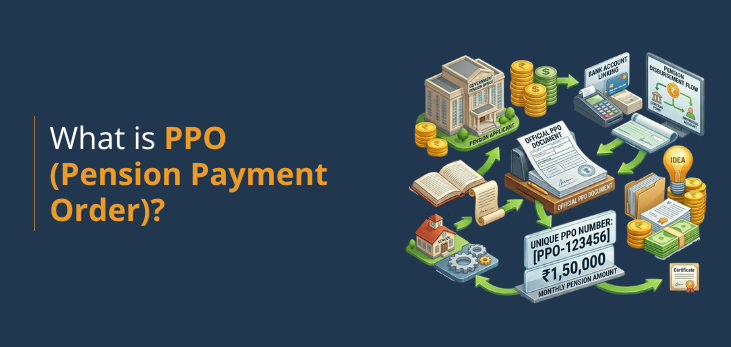
A pension payment order, or PPO, is an official document that’s assigned to every retiree under the central or state government schemes. It authorises the bank or pension office to begin regular pension payments to your account.
Without this document, the bank cannot credit the pension amount. It is also used to track the status of a pension file, apply for dearness relief, and submit annual life certificates. So, simply put, a PPO is a legal proof document which shows that you are eligible to receive a pension.
Start investing with just ₹10K & grow your wealth with fixed return opportunities.
Invest Now

What is a PPO Number?
A PPO number is a 12-digit number that’s given to every pensioner under the EPS (Employees’ Pension Scheme) managed by the Employee Provident Fund (EPF). This number helps pensioners track and manage all pension-related activities.
Here’s what a pension payment order number looks like:
- First 5 digits: Represent the code of the PPO issuing authority.
- Next 2 digits: Show the year of issue (eg, ‘25’ if issued in 2025).
- Next 4 digits: Unique sequential number assigned to each pensioner that year.
- Last digit: Computer-generated check digit or a code for the type of pension.
Please understand that PPO numbers can be structured differently for non-EPS pensioners.
Understanding the Structure and Format of a PPO
Since government pensioners receive PPOs through official departments and private pensioners may receive them through employers, the format may vary a bit. But typically, PPOs include the following key components:
1. PPO Number
This is the unique pension reference number that’s issued to each pensioner. Banks and pension offices use the PPO number to identify and verify the pensioner and process payments. This number is mandatory if you want to track pension status, change/update details, etc.
2. Pensioner’s Personal and Bank Details
The pension payment order also includes your personal details, like your name, DOB, and residential address. These details are needed to verify your identity. Apart from that, PPOs also include bank account details for the account where the pension amount will be credited.
All these details help ensure that the amount reaches the right pensioner every month.
3. Pension Amount and Starting Date
The PPO also includes details on how much pension you’ll receive every month and when the payments will start. This information is crucial because it helps you understand what is the value of regular pension income you’ll receive and plan your post-retirement expenses accordingly.
Importance of PPO
The PPO is one of the most crucial components of the pension system in India. Here’s why your pension payment order is critical:
1. Provision of Regular Monthly Income
As mentioned earlier, banks use PPO numbers as a primary identifier to credit the pension into your account. It serves as proof that you are actually entitled to a pension. This regular income helps you manage medical costs, household expenses, and other needs. Without a valid PPO number, the pension payment won’t get credited.
2. Submission of Life Certificates
Every pensioner has to submit an annual life certificate as proof of life to continue receiving the pension. For both offline and online submissions, having a valid PPO is mandatory. If you enter an incorrect PPO number, the life certificate submission will be invalid, and your pension might stop entirely.
3. Pension Tracking
The PPO number also serves as a reference number for tracking your pension payments. It helps you manage your payments and track arrears, if any, to reduce the chances of errors.
4. Transition to Family Pension
If the original pensioner passes away, their spouse or an eligible family member can file for transition to a family pension. But for such transitions to happen, the PPO number is mandatory because the transfer from service to family pension happens under the same PPO reference number.
5. Grievance Redressal
In case you experience any issues with your pension payments, like delays or calculation errors, you can file a grievance through the accredited portals for your pension issuing authority. But to do so, you will need your PPO number. The number helps the backend team to identify the file and problem, and also helps you track the status of your complaint.
How to Retrieve Your PPO Number?
If your PPO number is lost, you can retrieve it in the following ways:
| Method | How to Retrieve Your PPO Number |
| Bhavishya Portal | Log in using your retirement details or registered mobile number to view status and download your e-PPO. |
| DigiLocker | Your PPO is automatically sent to your DigiLocker account; simply log in to access it. |
| CPAO Website | Enter your 15-digit bank account number in the “Know Your PPO Status” tool to find your PPO number. |
| Bank Passbook / Pension Slip | Check the first page of your passbook or your pension slip, where the PPO number is printed. |
PPO As the Starting Point for Retirement
So, your pension payment order is in many ways the starting point for a regular and steady pension in the golden years. It is issued by the authorised pension office and serves as proof of your pension entitlement, helping you track payments, register grievances, and more.
But many times, the amount on your PPO may not be enough to cover your retirement expenses, especially with rapidly rising medical and living costs.
That’s why relying solely on a pension income isn’t enough. You can build a complementary retirement portfolio with bond investments through GoldenPi. You can visit the platform to see bonds for retirement and potentially boost your pension income with regular interest payments from these bonds.
FAQs on Pension Payment Orders
1. Can I update bank account details in my PPO?
Yes. You can submit an application to the new bank branch. They will coordinate with the Central Pension Processing Centre to update PPO details.
2. How long does it take to get a PPO in 2026?
Under the government’s new ‘Prayass’ initiative, the aim is to issue PPO on the retirement day itself. If all the documents are submitted at least 6 months before retirement, you should receive the PPO by the last working day.
But it may depend on the department as well. In that case, the PPO processing may take a few weeks.
3. Can a pension be credited without a PPO?
No. Pension cannot start without a valid PPO.
4. Who issues the PPO for different employees?
For central government employees, the PPO is issued by the Central Pension Accounting Office. For defence personnel, the PPO is issued through the defence pension offices. For private sector employees, it may be issued by the employer or pension trust.
Disclaimer:
This information is for general information purposes only. GoldenPi makes no guarantee on the accuracy of the data provided here; the information displayed is subject to change and is provided on an as-is basis. Nothing contained herein is intended to or shall be deemed to be investment advice, implied or otherwise. Investments in the securities market are subject to market risks. Read all the offer-related documents carefully before investing.
Bonds or non-convertible debentures (NCDs) are regulated by the Securities and Exchange Board of India and other government authorities. GoldenPi Securities Private Limited is a registered debt broker and acts as a distributor and not as a manufacturer of the product.