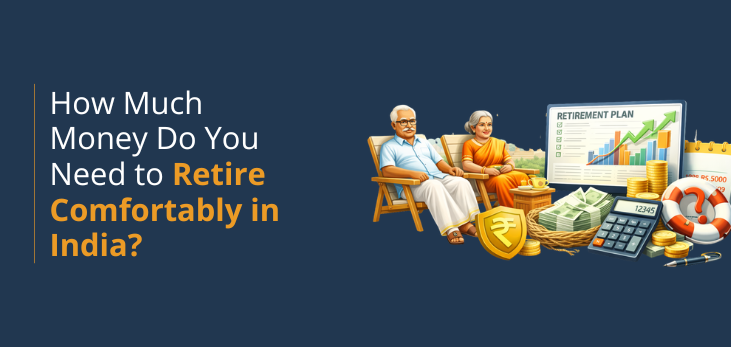
A recent study by NetCredit showed that a retiree would need about $186,000 or roughly Rs. 1.5 Crore to live comfortably in India presently. But is this number uniform for all? Not always.
Most Indian studies believe retirees need about Rs. 5 to Rs. 8 Crore to retire comfortably in 2026. But again, this is based on lifestyle expectations and location. So, the best way forward is to understand how you can estimate a suitable retirement corpus rather than sticking to concrete figures.
What Does a Comfortable Retirement Look Like in India Today?
In practical terms, a ‘comfortable’ retirement looks different depending on the following:
- Your Location
- Your Lifestyle
So, a ‘comfortable’ retirement in urban India today may often mean having an inflation-adjusted spending power of about Rs. 1-2 lakhs/month (if not more). When translated into a corpus, this could be about Rs. 3-8 Crore. Again, this is not a universal number; it’s just a benchmark.
Start investing with just ₹10K & grow your wealth with fixed return opportunities.
Invest Now

How to Calculate Your Ideal Retirement Corpus?
Instead of basing retirement planning on ballpark figures, what helps is learning how to actually calculate a suitable retirement corpus. Here’s a step-by-step guide that might help:
Step 1: Calculate Your Post-Retirement Monthly Expenses
You have to assess your current monthly expenses to estimate how much money you’ll likely have to spend monthly post-retirement. Now, understand that some of your current expenses may not exist in retirement. These may include:
- Home loan and other EMIs
- Children’s education costs
- Office commute and work-related expenses
But new expenses like increased medical and healthcare costs may also be added to your expenses.
Step 2: Adjust Your Post-Retirement Expenses for Inflation
Inflation erodes the purchasing power of money. This means that what you could buy with Rs. 1 lakh 10 years ago, you can buy much less with the same amount today. So, you need to adjust your retirement corpus for inflation.
The Indian Government’s announcement of maintaining headline inflation at 4% in 2026. But for a forward-looking retirement plan, it’s always safe to assume a 6%-7% inflation rate. Based on this assumption, you can use the following formula to calculate your inflation-adjusted expenses:
| Future Monthly Expense = Current Expense × (1 + Inflation Rate)^Number of Years |
So, let’s say you’re spending Rs. 1 lakh/month now without accounting for EMIs and other sudden expenses. This will become Rs. 1.79 lakhs in 10 years, Rs. 3.21 lakhs in 20 years, and Rs. 5.74 lakhs in 30 years. You can use online inflation calculators to check these numbers.
Step 3: Estimating the Retirement Corpus Needed
Globally, most financial planners use the 4% withdrawal rule to estimate a retirement corpus. According to this rule, your retirement corpus should be such that you can easily withdraw 4% annually without depleting it.
In other words, your corpus should be 25x your annual expenses to last you for about 30 years. So, if your annual expenses are Rs. 21,48,000 (Rs. 17.9 lakhs/month), you would need to build a corpus of about Rs. 5.37 Crore using the 25x rule. But many suggest the 30x rule is better for India because
- There is higher inflation volatility in India
- Longer life expectancy
- Unexpected healthcare cost increases
- More market volatility impacting investment returns
Recent Post:
- Sweep-In FD Explained: How Auto-Sweep Accounts Work in India

- RBI Hikes Repo Rate to 5.50%: Calibrated Tightening, Forecasts & What Comes Next

- State Borrowing Surge: Impact of SDLs on India’s Bond Yields
Things to Keep in Mind When Estimating Your Retirement Corpus
Apart from focusing on your main corpus, you also need to remember these things:
- Healthcare inflation can happen fast and at a more rapid rate than CPI. This means you should be prepared for rising medical costs as well.
- Just like your working years, even retirement years benefit from an emergency fund. It may be smart to allocate a separate corpus to medical emergencies and long-term care needs.
- If you plan to travel or pursue other hobbies post-retirement, don’t forget to factor in those costs.
- In case you wish to leave an inheritance for your kids and grandkids, your corpus has to be planned in a way that it outlives you.
Since juggling all this alone and crunching all the numbers accurately at every stage is difficult, it’s always a good idea to consult a professional financial advisor. They can guide you on how to estimate the right corpus, make investments, and adjust with time.
Some Investment Options for Retirement Planning in India
| Investment Option | Risk Level | Returns Type | Why Choose It |
| Employee Provident Fund (EPF) | Low | Fixed | Safe, disciplined savings with steady returns for salaried individuals |
| Public Provident Fund (PPF) | Low | Fixed | Long-term, tax-efficient option with guaranteed returns |
| National Pension System (NPS) | Low to Moderate | Market-linked + fixed | Helps build a retirement corpus with a mix of growth and stability |
| Equity Mutual Funds | Moderate to High | Market-linked | Offers high growth potential over the long term (can be used in the accumulation phase) |
| Debt Mutual Funds | Low to Moderate | Market-linked (stable) | Provides relatively stable returns with better liquidity than FDs |
| Fixed Deposits (FDs) | Low | Fixed | Ensures capital safety and predictable returns |
| Corporate Bonds | Moderate | Fixed | Offers a higher income than traditional fixed deposits |
| Annuity Plans | Low | Fixed income | Provides a guaranteed regular income after retirement |
So, How Much You Need to Retire Varies
While a corpus of about Rs. 3-8 Crore is considered good enough, there is no one magic number for retirement that works for all. Rather, a better way to think about it is
- Estimating your expected expenses
- Adjusting for inflation
- Building a corpus that can sustain these expenses for at least 30 years
And remember, a good retirement portfolio is always diversified, So, if you’ve already started retirement planning with equities and are looking for debt diversification, you may consider corporate FDs, bonds, and NCDs available on the GoldenPi platform.
FAQs on How Much Money Do You Need to Retire Comfortably in India
Whether this amount is enough or not depends on where you live in India (urban/rural), your age, and your lifestyle expenses. But generally, this is considered insufficient, especially if you’re planning on early retirement and have a life expectancy of about 40 years or more.
To understand how much you need, you have to calculate your post-retirement expenses, adjust for inflation, add buffers for medical emergencies and lifestyle spending, and account for your life expectancy post-retirement.
Inflation increases the cost of living over time, meaning your future expenses will be much higher than today. Lifestyle changes, such as higher healthcare costs or travel plans, can further raise your needs. Together, they require a larger retirement corpus to ensure your savings can sustain your desired standard of living.
Disclaimer:
This information is for general information purposes only. GoldenPi makes no guarantee on the accuracy of the data provided here; the information displayed is subject to change and is provided on an as-is basis. Nothing contained herein is intended to or shall be deemed to be investment advice, implied or otherwise. Investments in the securities market are subject to market risks. Read all the offer-related documents carefully before investing.
Fixed Deposit schemes are regulated by the Reserve Bank of India. GoldenPi Securities Private Limited is a registered debt broker and acts as a distributor and not as a manufacturer of the product.