|
Getting your Trinity Audio player ready...
|
In your quest for regular income through portfolio building, you have probably faced the following dilemma: do you buy dividend-paying stocks, or do you lock into bond coupons? Both offer an income stream, but they will behave very differently with changing market conditions. With bond coupons, you’ll be paid a certain amount on a fixed date. Dividends are neither fixed nor certain and, as a result, can grow or disappear depending on the health of the business.
With the RBI holding the repo rate at 5.25% and the 10-year G-Sec yields hovering around 6.8% (as of August 25), the “safe” income-generating opportunities are starting to look better, which makes this comparison more relevant than it has been in the past few years. This article walks through how the two stack up on yield, risk, taxation, and liquidity, so you can decide how much of each belongs in your portfolio.
Start investing with just ₹10K & grow your wealth with fixed return opportunities.
Invest Now

What Are Dividend Stocks and Bond Coupons?
A dividend stock is an ownership stake in a company that regularly shares some of its profits with its stock owners. This ownership stake means you can potentially grow your wealth along with the company’s profits. But your income from dividend stocks isn’t guaranteed; the board has the discretion to skip or decrease dividends if cash flow tightens.
A bond coupon is the fixed interest a borrower pays you for loaning them money. If you invest in government bonds, you are virtually risk-free, while corporate bonds have a variable level of risk depending on the entity’s creditworthiness.
Current Yields: How the Numbers Actually Compare
As of August 2026, the picture looks like this:
| Parameter | Dividend Stocks (Nifty 50) | Government Bonds (10-Yr G-Sec) | Bank Fixed Deposits |
| Approx. current yield | ~1.2% dividend yield | ~6.85%–6.9% | ~6.5%–7.5%, depending on bank/tenure |
| Capital growth potential | Yes, it’s linked to earnings and market prices | Yes, before maturity; none if held to maturity | No |
| Volatility | High prices fluctuate daily | Low to moderate; prices move with interest rates | Low if held to maturity; premature exit may involve a penalty |
| Credit/default risk | Business/company risk | Very low; sovereign credit | Low; deposits insured up to ₹5 lakh per depositor per bank |
| Typical holding horizon | Long-term (3+ years) | Depends on maturity/investment objective | Depends on FD tenure |
Sources: CCIL, NSE, DICGC
Latest Bond Updates:
- Bond Portfolio Stress Testing: What Happens If One Issuer Defaults?
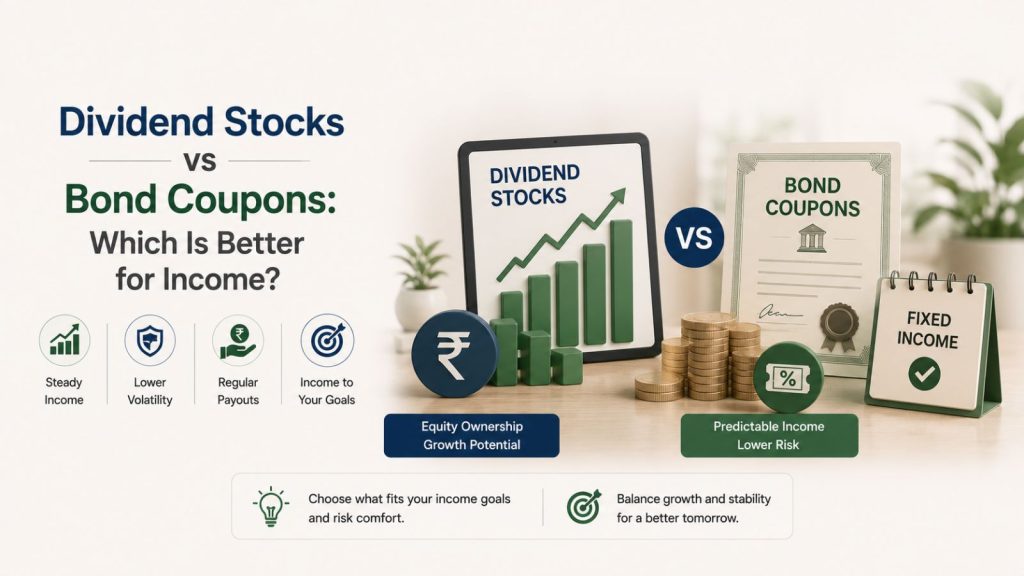
- Dividend Stocks vs Bond Coupons: Which Is Better for Income?
- How to Pledge Bonds for a Loan Against Securities: Step-by-Step

As per the Nifty 50 factsheet dated 29 May 2026, dividend yield on the Nifty 50 was 1.35% [1]. By 26 August 2026, the yield had fallen to 1.15% [2]. Meanwhile, India’s benchmark 10-year G-Sec yield climbed to 6.88% [3] on August 21, a two-month high, before easing to around 6.85% by August 25. The repo rate for August 2026 was set by the RBI at 5.25%, which means most FD and small saving rates have been steady for the year.
Notice the gap: on pure current yield, bonds and FDs win by a wide margin right now. Dividend stocks make their case on the other side of the ledger: capital appreciation and dividend growth over time, not the current payout alone.
Where Each Instrument Genuinely Wins
- Dividend stocks win on growing wealth over the long term, providing a degree of counter-force against inflation by increasing earnings and dividends, and their ability to be liquefied quickly on a stock exchange.
- Bond coupons win on offering more predictable cash flow, potential capital preservation when held to maturity, and lower day-to-day volatility, which makes them ideal for cash needed at a known, future date.
- Both fall short on guaranteed real returns. Equity dividends stand to be slashed in a downturn, while bond real returns can go negative if inflation comes to exceed the coupon.
Taxation: The Part Investors Often Get Wrong
Dividends are taxed at your slab rate as “income from other sources” without any special concession—a change that has confused many investors since the removal of the dividend distribution tax. Interest from bonds is taxed at the slab rate, but the long-term capital gain on bonds held for the specified period may be treated in a manner that is specific to the type of bond (G-Secs, corporate bonds, and bonds from mutual funds all differ). The rules regarding the taxation of debt have been changed more than once in the last few years, so you should check the current rules on the Income Tax Department’s e-filing portal or consult a tax advisor before assuming the treatment from last year will remain the same.
A Practical Way to Combine Both
Most income investors don’t need to pick one exclusively:
- Use G-Secs, high-rated corporate bonds, or debt mutual funds to cover the short-term, non-negotiable obligations you can’t afford to lose value on.
- Use dividend-paying, financially stable companies for the long-horizon part of the portfolio, where you’re comfortable with price swings in exchange for growth.
- Rebalance periodically. When bond yields spike relative to dividend yields (as they have in 2026), it may be a good window to add duration; when equity valuations correct, dividend yields on quality stocks often become more attractive.
Frequently Asked Questions
For a resident individual, both can be taxable, but the treatment differs depending on the investment and applicable tax rules. Dividend income is generally taxable at the applicable rate, while interest on taxable bonds is generally taxed as income. The investor should compare the post-tax income, rather than the headline dividend yield or coupon.
Yes. Stocks have the potential to generate both dividend income and capital appreciation, so their total return can exceed that of bonds over long periods. However, equity prices and dividends can fluctuate significantly.
It depends on the bond. High-quality government bonds generally have substantially lower credit risk than equities, while corporate bonds carry issuer-specific credit risk. Dividend stocks carry equity-market risk, and their prices can fall even when the company continues paying dividends.
Yes. Unlike a bond coupon, a dividend is generally discretionary and depends on the company’s financial position, profits, board decision, and applicable corporate rules. A high dividend yield therefore should not automatically be treated as dependable income.
Check the company’s dividend history, earnings, cash flows, payout ratio, debt levels, and ability to sustain or grow dividends. A high yield by itself does not indicate a high-quality income investment.
Look at the yield to maturity, credit rating, issuer financials, security, maturity, liquidity, and purchase price. The coupon tells you the contractual interest rate, but it does not by itself tell you the return you will earn if you buy the bond at a premium or discount.
Sources
- NSE Indices — Nifty 50 Factsheet, 29 May 2026
- NSE — Index Performances
- Economic Times — India bond yields hit two-month high
Disclaimer
Fixed returns do not constitute guaranteed or assured returns. Investments in corporate debt securities and municipal debt securities/securitized debt instruments are subject to credit risks, market risks, and default risks, including delay and/or default in payment. Read all the offer-related documents carefully. This blog/article should not be construed as financial advice or as an offer or recommendation to buy or sell any security or any products/services of/on GoldenPi or any product/services of its third-party client(s). For a detailed calculation of YTM, visit our website. T&C’s Apply.