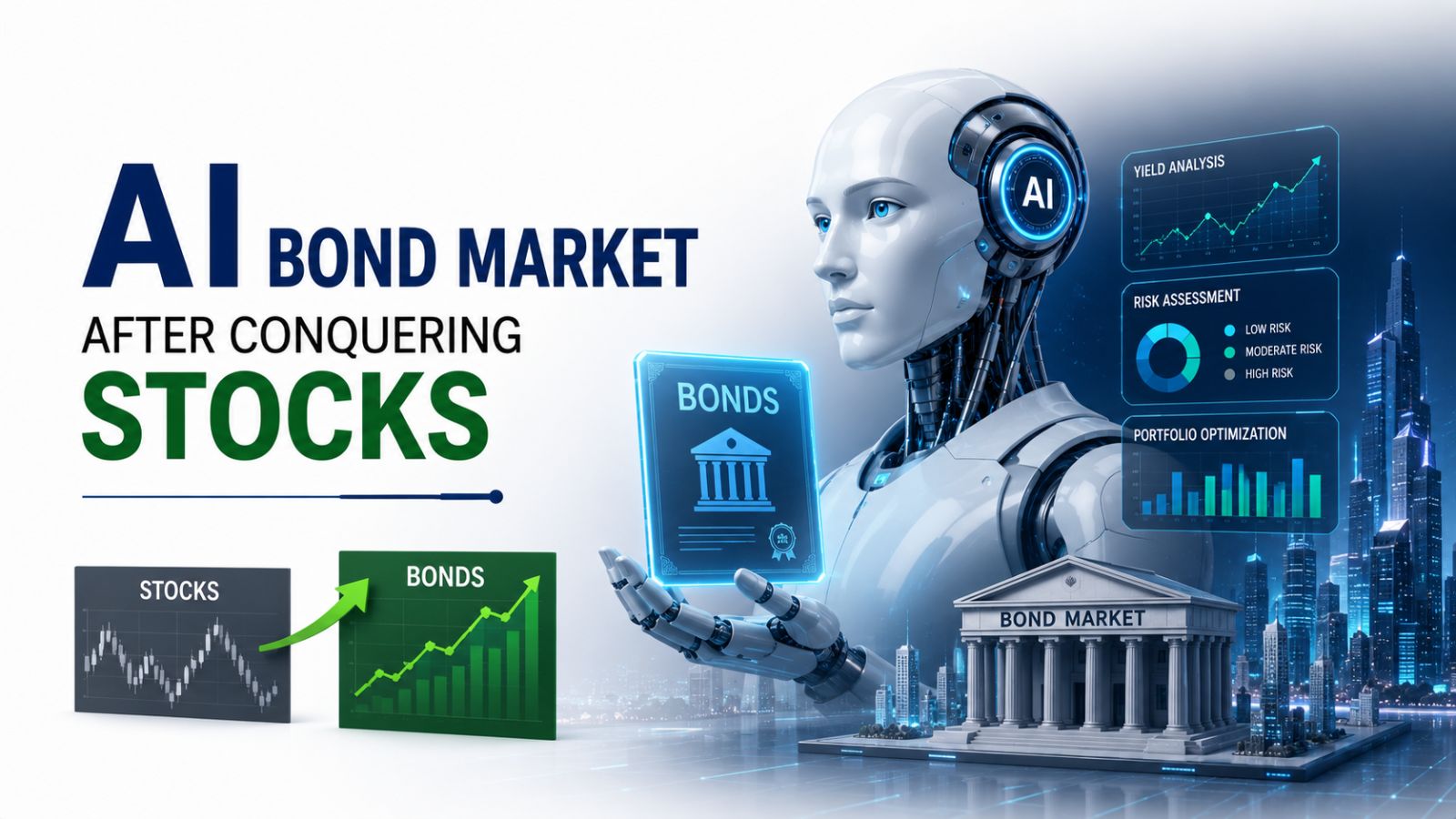
Ask any Dalal Street trader, and they’ll agree: the machines arrived first. In India, algorithms carry out more than 55% of all trades [1]. For certain market segments, like stock futures, the automated participation is reported to be as high as 73% [2]. For artificial intelligence, stocks are the ideal market. They are organized and cleaned data that are readily available to a centralized system. Bonds, however, were not designed this way. But that is changing: AI tools are analyzing and pricing bonds, and the spending of AI infrastructure is becoming one of the largest and fastest-growing forms of capital in global bond markets. Combined, they are redefining the fixed-income markets, and India is catching up quickly
Start investing with just ₹10K & grow your wealth with fixed return opportunities.
Invest Now

Stocks vs Bonds: The Reason AI Took Longer to Arrive
The gap isn’t about AI capability. It’s about data plumbing.
Equity markets are built for machines: a handful of exchanges (NSE, BSE), standardized tickers, continuous price feeds, and millions of trades a day. However, this isn’t the case for government securities. G-Secs trade on the RBI-run NDS-OM platform through CCIL, a centralized electronic system that handles a far smaller, more liquid set of instruments than corporate debt. Because of that structure, G-Secs are easier to trade with algorithms and AI than corporate bonds.
Bonds are the opposite, and even the data is a nightmare. A single company may issue dozens of bonds with different maturities and ISINs, each trading a handful of times a month, often over the phone rather than on an exchange. In India, the size of the corporate bond market has grown from $360 billion in 2016 to $645 billion in 2025 [3]. Still, issuance is concentrated, with over 60% of the market accounted for by the BFSI sector, and more than 85% of the composing papers are rated AAA/AA [4]. The result? Thousands of individual tickers with slim liquidity, which was an AI modeling nightmare until recently.
Why AI Adoption Timelines Differ
| Factor | Equities | Corporate Bonds |
| Trading venue | Centralised (NSE, BSE) | Fragmented, often OTC/voice |
| Number of instruments | ~5,000 listed stocks | Thousands of ISINs per issuer |
| Trading frequency | Continuous, high-volume | Some bonds trade a few times/month |
| Price discovery | Real-time, transparent | Often stale, manually estimated |
| Data structure for AI | Standardised, machine-ready | Fragmented, harder to model |
Latest Bond News:
- Asset Cover Ratio Explained: How Much Security Really Backs Your NCD?
- JSW Paints Plans 4- and 5-Year Bonds to Refinance Akzo Acquisition Debt

- YES Bank AT1 Bond Verdict: Bondholders Seek Clarity on Coupon Payments

GenAI and Bond Prospectuses: The 2026 Workflow Shift
The generative AI’s ability to read is a game-changer in 2026. Now, institutional desks upload hundreds of pages of prospectuses and covenant schedules to large language models and get feedback within minutes regarding subordinate clauses, change of control triggers, and negative pledge terms.
This is important for India because, according to the Economic Survey 2025-26, the corporate bond market is shallow and mainly consists of top-rated issuers. With the introduction of municipal bonds, total return swaps, and the new market-making framework as proposed in the 2025 Union Budget [5], the volume of documentation that investors will be required to review will increase substantially. From a global perspective, most asset managers are already starting to use generative AI by adding layers to their research workflows [6].
How AI Is Pricing India’s Illiquid Corporate Bonds in Real Time
The majority of corporate bonds in India are not transacted on a daily basis; many are traded only a few times a month. Now, machine-learning models are deployed to continuously approximate “evaluated prices” by connecting G-Sec yields, sector spreads, and peer bond trades to produce a fair-value estimate that can be refreshed even in the absence of trading for that bond on that day. This is even more relevant with the RBI’s cumulative repo rate reductions of 125 basis points in 2025, keeping yield curves and repricing active through 2026.
How AI Infrastructure Spending Is Driving Global Bond Issuance
There’s an additional AI-bond connection, which has received less attention: AI infrastructure is driving unprecedented global issuance [7]. Since the beginning of 2026, three of the biggest tech companies, Meta, Nvidia, and Oracle, have each had individual bond offerings of about $25 billion to finance the build-out of their AI infrastructure. Amazon sold $37 billion in bonds in March of 2026 alone, more than any of these companies have raised historically in their equity markets. Morgan Stanley expects there will be $350–400 billion in AI-related, investment-grade bonds offered in the U.S. this year, in addition to the growing “neocloud” junk bonds and convertible bonds issued by CoreWeave, among other firms. The Bank for International Settlements has noted that some AI projects may not generate the necessary cash flow to meet debt obligations, which remains a valid concern.
This issue has two major implications for India. First, the current global credit access of approximately hyperscaler-level credit (about the lowest it has been in the last 25 years) will influence the pricing of Indian corporate debt. Second, the financing of India’s data centers and cloud infrastructure will likely continue to rely on a similar bond-funded approach, following the leasing of telecom towers and hyperscaler infrastructure as capacity expands.
What This Means for Indian Investors
- Faster due diligence: Credit teams can review a larger set of issuers by using GenAI-assisted prospectus review and are now able to consider smaller NBFCs that were previously overlooked due to time constraints.
- Improved pricing for illiquid assets: “Stale NAV” pricing for bond mutual funds and credit AIFs will be addressed through real-time evaluated pricing.
- Quality of credit over yield: Even as outstanding debt has been rising, spreads have been tightening, highlighting the importance of analyzing cash flows over ratings.
- Barriers to entry are lower, but more caution is required: The SEBI has reduced the minimum ticket size to ₹10,000, and more public investors are entering a market that is driven by AI and rapidly changing.
Frequently Asked Questions
Equity market infrastructures tend to be built around centralized systems (NSE/BSE) and continuous price feeds. In India, ~55% of equity trades are algorithmically executed (in stock futures, the number goes as high as ~73%).
The corporate bond market, on the other hand, is extremely fragmented. A single company can issue dozens of different bonds (ISINs) that can trade only a few times a month, and that trade can be executed over the phone. While Central Government Securities (G-Secs) trade seamlessly with the help of algorithms on the RBI’s electronic NDS-OM platform, the nature of corporate bonds has tended to create more of a nightmare for AI with scattered, thin liquidity.
A majority of Indian corporate bonds trade infrequently, leading to market pricing becoming outdated. In 2026, machine learning solved this problem for bonds by constantly calculating “evaluated prices.”
The model examines market proxies that are active, including liquid G-Sec yields, sector spreads, and recent trades of peer bonds. This is done in an effort to determine what the model believes is a true value to an extremely high degree of confidence. After the RBI performed cumulative repo rate reductions of 125 bps in 2025, the need for this type of real-time repricing grew rapidly in the context of fluctuating yield curves.
For a long time, fund managers were driven to the safety of AAA-rated securities. This was due to the challenging nature of the small print included in the 300-page prospectuses of other lower-rated non-banking financial corporations.
GenAI in 2026 acts as a first-line credit analyst. It helps to disassemble a great deal of legal text within a matter of minutes, condensing the time needed to analyze such text. This ultimately enables funding managers to identify lower-rated securities such as A or AA papers that are reliable in terms of liquidity.
AI development needs huge infrastructure investment, including the building of large data centers worldwide. It needs a lot of money. Big data companies in the world are using bonds to finance this hardware. Indian data companies and telecom companies are also using the same policy.
The Retail Edge: Normally, a lot of money was needed to be financed to high-yield bonds. The SEBI regulation now makes it possible for an Indian retail investor to invest ₹10,000 in digital infrastructure bonds from an online bond platform.
Sources
- https://www.imarcgroup.com/india-algorithmic-trading-market
- https://www.quantinsti.com/articles/algorithmic-trading-india/
- https://bfsi.economictimes.indiatimes.com/news/financial-services/indias-corporate-bond-market-grows-to-645-billion-report/131367369
- https://www.careratings.com/uploads/newsfiles/1781523862_Indian%20Debt%20Capital%20Market%20-%20Can%20it%20Finance%20Indias%20Growth_Final.pdf
- https://www.outlookbusiness.com/economy-and-policy/budget-signals-fresh-push-to-deepen-indias-underdeveloped-corporate-bond-market
- https://www.oliverwyman.com/our-expertise/insights/2025/dec/10-asset-management-trends-to-know-in-2026.html
- https://www.economist.com/finance-and-economics/2026/07/07/ai-has-taken-over-the-stock-market-the-bond-market-is-next
Disclaimer
Fixed returns do not constitute guaranteed or assured returns. Investments in corporate debt securities and municipal debt securities/securitized debt instruments are subject to credit risks, market risks, and default risks, including delay and/or default in payment. Read all the offer-related documents carefully. This blog/article should not be construed as financial advice or as an offer or recommendation to buy or sell any security or any products/services of/on GoldenPi or any product/services of its third-party client(s). For a detailed calculation of YTM, visit our website. T&C’s Apply.