|
Getting your Trinity Audio player ready...
|
NBFC bonds are debt instruments issued by Non-Banking Financial Companies to raise funds. Generally, they carry a lower risk than equity shares but a higher risk than FDs.
This makes them suitable for “moderate-risk investors” who are looking for better returns without full equity exposure. So, are you looking to invest? Purchasing NBFC bonds in India involves selecting a bond platform (such as GoldenPi), completing basic KYC verification, and finally placing your order.
Read this article to learn in detail how to invest in NBFC bonds in 2026.
Prerequisites to Invest in NBFC Bonds
Before purchasing NBFC bonds, you need these two basic accounts:
| Requirement | Meaning |
| Demat Account |
|
| Trading Account |
|
Once you open a Demat account with any broker, you’re assigned:
- A “DP ID”, which is the broker’s unique Depository Participant ID
and
- A “client ID”, which is your unique account number
Together, these two form your Demat account number. Once your Demat account is “active”, you can link it to any Online Bond Platform Providers (OBPP) like GoldenPi and start investing in bonds. For more clarity, study the next section.
How to Invest in NBFC Bonds?
When investing in NBFC bonds, you can choose either of these two routes based on your preference:
| Primary Market | Secondary Market |
|
|
Note that both routes give you access to regular interest income and capital repayment on maturity. The choice depends on whether you want to participate at the time of issuance or buy an existing bond from the market.
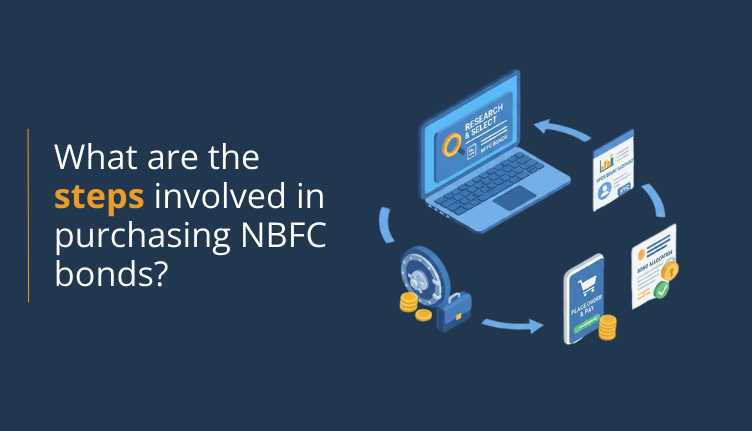
Purchasing NBFC Bonds in India: Step-by-Step Guide 2026
Now, once your Demat and trading accounts are in place, and you have decided whether to invest through the primary or secondary market, you can follow the steps below to purchase NBFC bonds:
Step 1: Choose an Investment Platform
You can invest through a dedicated bond platform such as GoldenPi or through a stockbroker (like Zerodha, Angel One) that provides access to BSE and NSE. All you have to do is:
- Create an account
- Complete the basic KYC process
- Link your Demat account
Step 2: Review Available NBFC bonds
Browse the list of “NCD IPOs” and “already-issued NBFC bonds” available on the platform. You can filter options based on:
- Credit rating
- Interest rate (yield)
- Maturity period
Also, review additional details such as:
- Interest payout frequency (monthly or quarterly)
- Type of bond (secured or unsecured)
This knowledge allows you to match the bond with your risk level and income needs.
Step 3: Place Your Investment Order
Once you select a bond, place your order. You may invest in:
- Primary issues (newly issued bonds)
or
- Secondary market bonds (already issued bonds being traded)
Minimum investment amounts usually start from ₹10,000, depending on the bond.
Step 4: Make the Payment
Complete the payment using the available payment options, such as UPI or net banking. After payment, you receive an “allotment confirmation”.
Next, the bonds are credited to your Demat account, usually within T+1 day (one working day after the transaction). Lastly, interest payments begin as per the bond’s stated schedule.
In Summary, Purchasing NBFC Bonds Involve Opening a Demat + Trading Account and Registering on Broker/Bond Platforms
Till now, you must have understood the process of purchasing NBFC bonds. If we were to recap, firstly, you need an active Demat and trading account to hold and transact in bonds electronically. Once this is in place, you can register on an online bond platform or with a stockbroker by completing the required KYC formalities.
Next, link your Demat account to the chosen platform and begin browsing available NBFC bond options. At this stage, you can compare bonds based on:
- Credit rating
- Interest rate
- Maturity period
- Payout structure
Finally, place your order, make the payment, and receive the bonds in your linked Demat account. If you are looking to explore multiple NBFC bond options in one place, you may visit the GoldenPi platform. Here you can find highly-rated bonds, short-term debt instruments, high-yield bonds, and more.
Purchasing NBFC Bonds FAQs
Will I receive interest income in my Demat account?
No! The Demat account is used only to hold your bonds in electronic form. Interest income and maturity proceeds are usually credited directly to your registered bank account.
Do I need a Demat account to apply for an NCD IPO?
Yes, a Demat account is mandatory to apply for an NCD IPO. Since NCDs are issued only in electronic form, they must be credited to a Demat account in the investor’s name after allotment.
Do I need a trading account while purchasing NBFC bonds on OBPP?
No. When investing through an Online Bond Platform Provider (OBPP) such as GoldenPi, a separate trading account is not required.
How to link your demat account with GoldenPi?
To link your Demat account with GoldenPi, upload any of these documents: a Demat CMR, a latest eCAS statement, or a holding statement showing your DP ID and Client ID. Next, GoldenPi verifies account ownership, the accuracy of your DP and Client ID, and matches your PAN with KYC records before linking the account.
What documents are required for purchasing NBFC bonds (Resident Indians)?
To purchase NBFC bonds, you may need a PAN card for identity and tax verification, Aadhaar for digital KYC, bank account details (account number, IFSC, cancelled cheque) for payments and interest credits, and Demat account details (CDSL or NSDL ID) for bond allotment and holding.
Which documents are required for KYC for NRI bond investors?
NRI investors may be required to submit notarised copies of their passport, visa, PAN, Indian and overseas address proof, NRO bank proof, FATCA declaration, and income proof.
Disclaimer:
This information is for general information purposes only. GoldenPi makes no guarantee on the accuracy of the data provided here; the information displayed is subject to change and is provided on an as-is basis. Nothing contained herein is intended to or shall be deemed to be investment advice, implied or otherwise. Investments in the debt securities/ municipal debt securities/ securitised debt instruments are subject to risks, including delay and/ or default in payment. Read all the offer-related documents carefully.
Bonds or non-convertible debentures (NCDs) are regulated by the Securities and Exchange Board of India and other government authorities. GoldenPi Securities Private Limited is a registered debt broker and acts as a distributor and not as a manufacturer of the product.