The financial landscape is replete with a plethora of investment instruments, each promising lucrative returns. Nevertheless, tax implications loom large and cannot be disregarded. As a matter of fact, debt instruments are often preferred over their equity counterparts due to their inherent safety. Consequently, it is worthwhile to examine how these risk-averse yet secure market instruments are taxed.
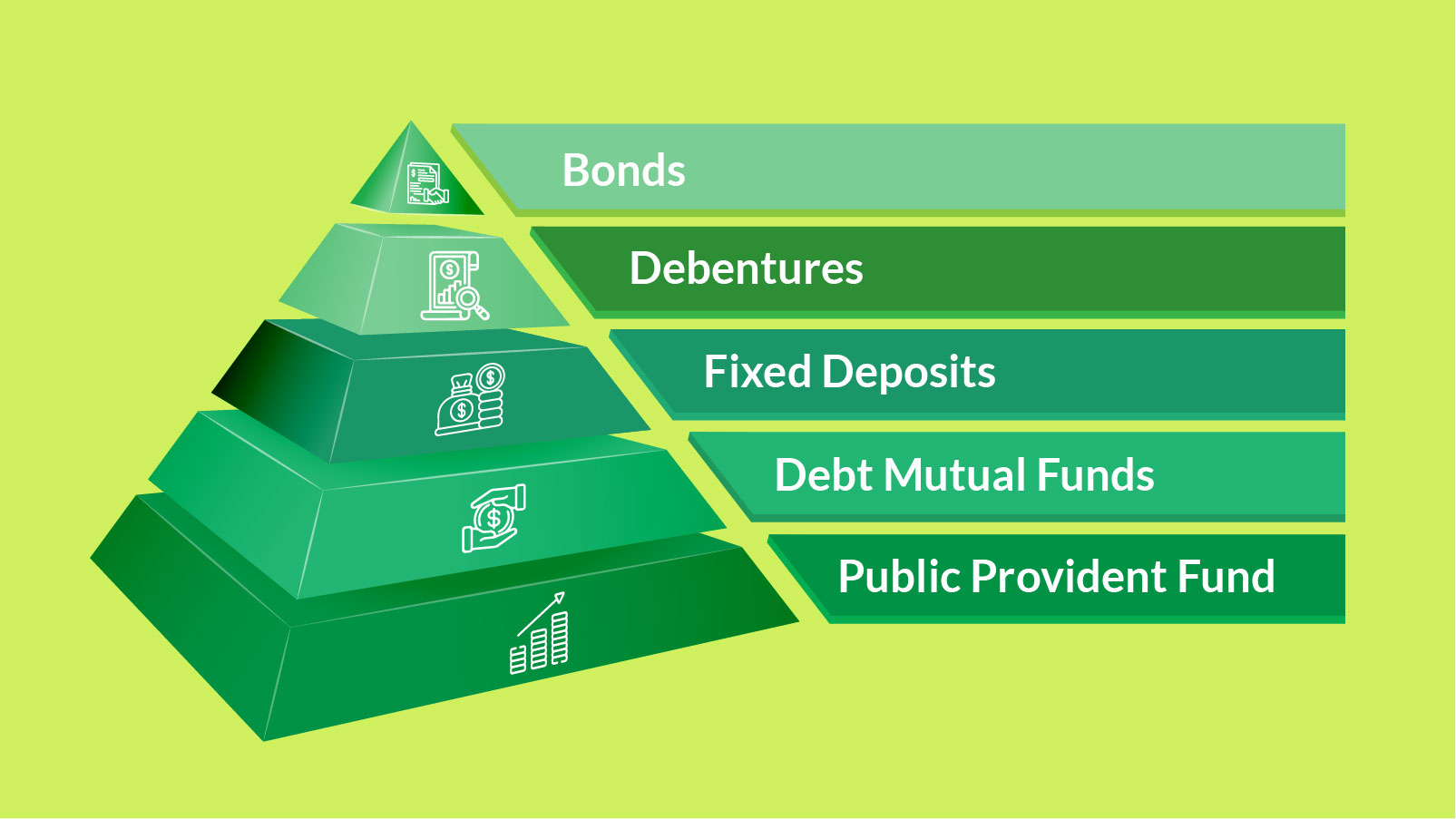
In this regard, it is noteworthy to highlight some of the leading debt instruments that are prevalent among investors. It includes:
- Bonds
- Debentures
- Fixed Deposits
- Debt Mutual Funds
- Public Provisional Fund
Why do you pay taxes?
Bonds
The debt instrument bond earns two types of income for an individual. One is the interest and the other one is capital gains.
Interest is the return that you normally receive on a fixed-income instrument depending on the type of payout option chosen by the investor. Generally, the interests are considered as income from other sources and hence are taxed as per the individual’s tax slab rate.
While capital gains are those profits made due to the difference in the buying price and selling price of the bond during the time of selling or redeeming. Redeeming is usually upon holding it till maturity whereas selling takes place when you want to sell the bond in the secondary market.
The capital gains depend on the time until which the bond is held. Let’s say it is a listed bond, holding it for more than 12 months, and unlisted bonds holding it for more than 36 months calls it to be a long-term capital gain. And holding the bond anytime below the specified time of the respective type of bond results in short-term capital gains.
Well, long-term capital gains are usually taxed at 10% without indexation or taxed at 20% with indexation plus the surcharges.
Yet at times, the taxation is a bit confusing as there are various types of bonds. Zero coupon bonds don’t give interest but capital gains are usually taxed. Tax-free bonds exempt the tax on interest but there is a capital gain tax. An exception is in Sovereign Gold Bonds as they even exempt capital gain tax if held till maturity. Tax saving bonds though are for saving tax they’ll incur tax on the interest and exempt tax on capital gains only if it is held till maturity.
Comparison of listed & unlisted bonds
Debentures
These securities are again divided as listed and unlisted debentures. The tax deduction at source on the interest has been exempted on both. While the capital gains are still under consideration for taxation.
If it is a listed debenture and is held for less than or equal to 12 months then they are taxed under slab rates as per that individual’s income. Similarly for the unlisted debentures, if it is held for less than or equal to 36 months then they are taxed under the respective slab rates as well.
On the contrary, if the holding period exceeds 12 months for listed debentures then it is taxed at 10% without any indexation under section 112. And for the unlisted debentures if held for more than 36 months then they are taxed at 20% without any indexation under section 112.
The working of Market- Linked-Debentures
Fixed Deposits
On the interest earned on your fixed income, there is some tax levied but it has some intricacies that you need to understand as to how your FDs are generally taxed.
When you earn interest on a fixed deposit, the Income Tax Act of 1961 considers it as income from other sources and fully taxable. The bank adds the interest earnings to your total annual income, and you’re liable to pay taxes according to the current tax laws.
Since April 2019, if your fixed deposit interest exceeds Rs 40,000, you’ll be subject to TDS (tax deducted at source). PAN holders will pay a 10% tax, and non-PAN holders will pay a 20% tax on the interest earned. For senior citizens, the interest limit is up to Rs 50,000 and only if it exceeds the amount, it’ll be taxed accordingly depending on whether them being a PAN or Non-PAN holders.
However, the Rs 40,000 limit applies to each fixed deposit separately and not to the aggregate interest earned. The bank deducts TDS on the interest earned every year to distribute the burden of tax payments.
Note that TDS isn’t the total tax liability, but only a part of it. The total tax on your fixed deposit interest is calculated based on your income tax slab for that financial year. If your total income is below the tax slab threshold of Rs 2,50,000, you don’t need to pay any tax, and no TDS will be deducted.
However, to be eligible for this exemption, you must submit form 15H or 15G (depending on age and income) to instruct the bank not to deduct TDS.
It’s time to break the Bank FD habit
Debt Mutual Funds
The taxation on Debts Mutual Funds considers various aspects such as dividends, and capital gains.
The dividends are taken into account as taxable income and are charged as per the individual’s tax slab rate. Regardless of whether you hold the Debt Mutual Fund for less than 12 months or more than 12 months, they are considered short-term capital gains and it adds up to your total taxable income and is taxed according to the tax slab rate.
Public Provident Fund
The Public Provident Fund (PPF) was introduced in India in 1968 to gather modest contributions for investment and returns. This fund serves as an investment instrument that facilitates the accumulation of retirement savings while simultaneously reducing yearly tax obligations.
The Public Provident Fund (PPF) is a type of investment that falls under the Exempt-Exempt-Exempt (EEE) category. This means that any contributions made to the PPF are tax-deductible under Section 80C of the Income Tax Act, up to a maximum of Rs.1.5 lakh per financial year.
Moreover, the accumulated amount and interest earned on the PPF investment are also tax-exempt when withdrawn. It is worth noting that a PPF account cannot be closed before its maturity date.
However, a PPF account can be transferred from one designated point to another. Nevertheless, it is important to remember that a PPF account cannot be closed before maturity except in the case of the account holder’s demise, where the nominee can apply for account closure.
Wrapping up
A perspicacious investor ought to have a comprehensive understanding of the nuances pertaining to tax implications prior to initiating any investment endeavor. It is incumbent upon investors to not merely focus on the returns or interest accrued, but to equally account for the tax liabilities and subsequent financial responsibilities that accompany investment pursuits.