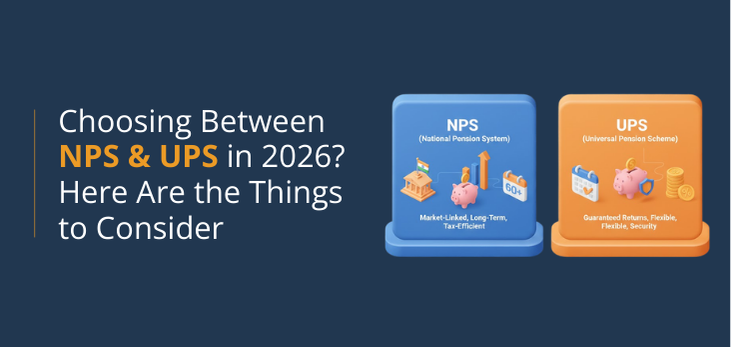
Retirement planning today is no longer limited to one option. Investors are increasingly choosing between the National Pension System (NPS) and the Unified Pension Scheme (UPS). Both aim to support long-term financial security, but they follow very different structures. Knowing how NPS & UPS works can help you make a clearer decision based on income stability, risk comfort, and retirement goals.
What Is NPS?
The National Pension System (NPS) is a long-term retirement scheme regulated by PFRDA. It allows individuals to contribute regularly during their working years and build a retirement corpus over time.
- NPS invests contributions across equity, corporate bonds, and government securities.
- Where returns depend on market performance, which means outcomes may vary over time. Investors can choose how their money is allocated or allow the system to adjust it automatically based on age.
NPS is open to salaried and self-employed individuals. Withdrawals are structured, with part of the corpus required to be used for an annuity at retirement.
What Is UPS?
The Unified Pension Scheme (UPS) is a government-backed retirement framework introduced for central government employees. It is designed to offer predictable and stable post-retirement income.
- Under UPS, employees contribute a fixed portion of their salary during service, and the government provides an assured pension after retirement.
- Unlike market-linked systems, returns under UPS are not directly dependent on market performance.
The core idea behind UPS is income certainty. It focuses on providing a steady pension rather than wealth creation, making it suitable for those who prefer stability over volatility.
Key Differences Between NPS and UPS
While both NPS and UPS aim to provide retirement security, the way they work and the kind of outcomes they offer are very different. Here’s a clear, investor-friendly breakdown:
| Aspect | NPS (National Pension System) | UPS (Unified Pension Scheme) |
| Nature of returns | Market-linked returns based on equity and debt performance | Assured and predefined pension returns |
| Risk level | Moderate risk due to market exposure, reduces over time | Very low risk, backed by the government |
| Pension predictability | Final pension depends on corpus size and annuity rates | Pension amount is fixed and predictable |
| Goal | Long-term wealth creation and inflation protection | Post-retirement income security |
| Investment flexibility | Choice of asset allocation and fund managers | No investment choice, fixed structure |
| Inflation impact | Better potential to beat inflation over long term | Limited inflation protection over time |
Quick Takeaway between NPS and UPS:
- NPS suits investors who want growth and can handle market fluctuations.
- UPS is better for those who value certainty and stable pension income.
Tax Treatment of NPS and UPS
1. Tax Benefits on Contributions:
Both NPS and UPS fall under the NPS framework, so contribution-stage tax benefits are largely aligned.
- Employee contributions are eligible for deduction under Section 80CCD(1) up to 10% of salary (Basic + DA), within the overall ₹1.5 lakh limit of Section 80C.
- An additional deduction of up to ₹50,000 is available under Section 80CCD(1B) for voluntary Tier-I contributions.
- Employer contributions qualify under Section 80CCD(2).
- Up to 14% of salary for central government employees under UPS
- Up to 10% for others. This benefit is over and above 80C limits.
Important note: These deductions apply only if you opt for the old tax regime.
2. Tax Treatment on Withdrawals at Retirement
At retirement (age 60 or superannuation), NPS and UPS follow the same withdrawal structure:
- Up to 60% of the accumulated corpus can be withdrawn as a lump sum, which is fully tax-free.
- The remaining 40% must be used to purchase an annuity, and the pension received is taxable as per your income slab.
3. Partial Withdrawals and Pension Income
- Partial withdrawals during the accumulation phase (up to 25% of self-contributions, subject to conditions) are tax-exempt under Section 10(12A).
- Pension income (annuity) received post-retirement is taxable, whether from NPS or UPS.
- Transfers of corpus within the pension system (for annuity purchase) are not taxed at the time of transfer.
Quick Takeaway:
- From a tax perspective, NPS and UPS are closely aligned.
- The real difference lies not in taxation, but in return structure, NPS remains market-linked, while UPS offers an assured pension framework for government employees.
Common Misunderstandings Around NPS & UPS
“One option is always better”
There’s no universal winner here. NPS and UPS are designed for different needs. The better choice depends on your job profile, risk comfort, and whether you prefer flexibility or income certainty.
“UPS replaces NPS”
UPS does not replace NPS. It is an additional pension option for eligible government employees, built on the NPS framework. NPS continues unchanged for others.
“Returns are guaranteed”
This is only partially true.
- NPS returns are market-linked, so they fluctuate.
- UPS offers an assured pension structure, but it does not promise fixed market-style returns during accumulation.
FAQS on NPS and UPS
1. Can I invest in both NPS and UPS at the same time?
UPS is available only to eligible government employees. Others can invest only in NPS. You cannot freely choose between both unless you fall under UPS eligibility.
2. Is UPS safer than NPS because it offers assured returns?
UPS provides return assurance, but it comes with lower flexibility. NPS is market-linked and can deliver higher long-term returns depending on asset allocation.
3. Which is better for tax planning, NPS or UPS?
Tax benefits on contributions and withdrawals are largely similar. The difference lies more in return structure and flexibility than in tax treatment.
4. Are NPS returns unpredictable compared to UPS?
NPS returns depend on market movements, but investing over the long term helps smooth out ups and downs. UPS, on the other hand, offers more predictable returns but may not grow as much over time.
5. Should private sector employees consider UPS alternatives?
Yes. Since UPS is limited to government employees, private investors can use NPS, EPF, and long-term bonds to build a stable retirement plan.