|
Getting your Trinity Audio player ready...
|
Financial markets in India offer buyers and sellers a platform to trade in financial securities. Indian financial markets are structured to enable:
- Transfer of funds from savers to borrowers
- The government and businesses raise funds
- Price discovery of securities
Individual retail investors, institutional investors (mutual funds), and foreign entities (FIIs) participate in these markets through various instruments, such as stocks, bonds, commodities, and derivatives.
At first glance, the structure of Indian financial markets may seem complex. But worry not. We have made it simple in this article. Read it to understand the structure of Indian financial markets and all the basics you need to enter them.
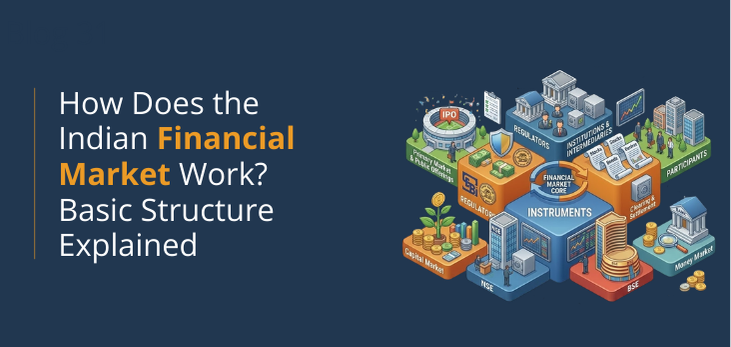
Structure of the Indian Financial Markets
India’s financial markets can be broadly classified into two major segments:
- Money market
- Capital market (primary and secondary markets)
Each of these segments serves a distinct purpose and involves specific instruments. So to understand the structure of the Indian financial markets, we have to look at each in detail:
1. Money Market
The money market deals with short-term financial securities with a maturity window of less than 1 year. Simply put, the money market is a place for short-term borrowing and lending.
The instruments traded in the money market are relatively low-risk, highly liquid, and have short maturities. Commonly traded money market instruments include:
- T-bills
- Certificates of deposits
- Overnight securities
- Commercial papers
So when it comes to ensuring liquidity in the financial system and helping institutions like banks manage their short-term funding needs, the money market in India is crucial.
2. Capital Market
The capital market in India is often seen as the most important financial market. It is the place where money is borrowed for the long-term, typically for more than a year. Companies, and even the Indian government, use capital markets to issue securities and raise money to fund expenses that need long-term funding.
Both equities and debt assets are traded in the capital markets. That’s why stock and bond markets are two common types of capital markets in India.
Capital markets in India can be further subdivided into two categories:
Primary Market
When a company wants to issue a new security, it does so in the primary market. So, let’s say Company A wants to list as a public company and offer shares for retail investment. In that case, they will file for an IPO in the primary market to issue shares for the first time.
In a primary market:
- Companies receive funds directly from investors.
- Securities are issued at face value or at the issue price.
- Investors get the opportunity to invest at the initial offering price before a stock is listed.
- Apart from IPO, the primary market is also used for private placements, bonus and right share issues, and preferential allotments.
Secondary Market
After securities are issued in the primary market, they start trading on the secondary market. Here, companies do not receive funds directly; instead, investors buy and sell securities among themselves.
Trading in India’s secondary market happens through the Bombay Stock Exchange (BSE) and National Stock Exchange (NSE).
So, in a secondary market:
- Securities are not bought and sold at face value. Instead, their value changes in response to demand and supply.
- Trading practices are regulated by SEBI to prevent manipulation.
- Stocks, bonds, and derivatives are some common types of securities traded in the secondary market.
Other Types of Indian Financial Markets
Now that you understand the main structure of the Indian financial market, we can focus on the other types of markets operating in India:
| Commodity Market |
|
| Foreign Exchange Market |
|
| Bond Market |
|
Understanding How Indian Financial Markets Work
With the structure of the Indian financial markets clear, let’s understand how these markets work:
Fundraising
The primary goal of the financial markets in India is to help businesses and the government raise money to meet various expenses. This begins in the primary capital market through:
- IPOs: Companies list their initial share offerings (when listing for the first time) on the primary market. Investors can apply for IPOs within the offered price band.
- Follow-On Public Offers: If the company is already listed and wants to issue additional shares, it can do so through an FPO.
- Issue of Debt Securities: Companies can also raise money through corporate bond issues in the primary market.
Trading
After the security is issued, it can be bought and sold in the secondary market. Here, trading happens through stock exchanges like the NSE and BSE, like this:
- When you want to buy or sell a stock, you place the order through your broker using a trading platform.
- Your order is sent to the stock exchange, where it is matched with someone ready to take the opposite side at the same price.
- Once the match happens, your trade is confirmed.
- The clearing corporation then ensures the shares are credited to your demat account and the money is transferred to the seller within the settlement period.
Apart from stocks, trading can happen in bonds, derivatives, and other financial instruments as well. In the derivative segment, investors trade in futures and options.
Regulation
These operations within the Indian financial markets are overseen and regulated by some important bodies:
RBI: The Reserve Bank of India oversees the money market, forex market, and the overall banking system. It ensures stability and smooth functioning across these areas.
Its key functions include:
- Managing liquidity in the system through monetary policy tools
- Keeping inflation under control
- Supervising banks and financial institutions
- Intervening in the forex market when needed to manage sharp currency movements
SEBI: The Securities and Exchange Board of India is the key market regulator in India, responsible for creating the regulatory framework for all capital market operations. SEBI’s role is centered around:
- Registering and regulating intermediaries such as brokers and mutual funds
- Framing rules that help markets function transparently
- Taking actions against insider trading, fraud, and price manipulation
- Making sure that companies disclose accurate and timely information to investors
Apart from these key regulatory bodies, there are also SROs (Self-Regulatory Organisations) that regulate specific sectors of the financial market. AMFI, for instance, is an SRO that sets ethical and operational standards for the Indian mutual fund industry.
Participating in the Growth of the Indian Financial Markets
The structure of the Indian financial markets is multi-layered, with different markets catering to different borrowing and lending needs. To sum it up:
- Money markets: short-term borrowing (T-bills, CDs, etc.)
- Capital markets: Long-term borrowing (stocks, bonds, mutual funds)
- Forex markets: Trading in foreign currencies
- Commodity markets: Trading in commodity contracts, options, and futures
If you feel ready to dive in with this knowledge, you can head to the GoldenPi platform, where you can partake in the Indian bond market in just a few easy steps! You can review the extensive collection of corporate bonds and check out NCD IPOs to start actively participating in India’s growing bond market.
Indian Financial Market Structure FAQs
1. How do capital markets work in India?
Capital markets in India connect investors with surplus funds to businesses that need long-term funding. Securities are first issued in the primary market through IPOs, FPOs, or bond issuance.
Then, these securities begin trading among investors in the secondary market through stock exchanges such as the BSE and NSE. Prices are determined through demand and supply for the security.
2. Who are the intermediaries in India’s capital markets?
There are several intermediaries working in India’s capital markets that facilitate operations. These include:
- Stock exchanges that facilitate trades
- Stock brokers who execute trades
- Depositories like NSDL and CDSL that hold securities in an electronic form
- Registrars and transfer agents
- Clearing corporations
3. How can I start investing in Indian financial markets in 2026?
To start investing, you will need a valid PAN, Aadhaar Card, and a bank account. Next, you need to assess your goals, risk appetite, and investment timeframe to choose the instrument you wish to invest in (equities, bonds, mutual funds, commodities, etc.). This will determine which market you have to enter.
There will be specific investment rules depending on the market. So, if you wish to invest in equities or bonds, you have to open a Demat account and a trading account with a SEBI-registered broker. Similarly, if you wish to invest in mutual funds, you can do so without a Demat account, directly through the AMC.
Disclaimer:
This information is for general information purposes only. GoldenPi makes no guarantee on the accuracy of the data provided here; the information displayed is subject to change and is provided on an as-is basis. Nothing contained herein is intended to or shall be deemed to be investment advice, implied or otherwise. Investments in the securities market are subject to market risks. Read all the offer-related documents carefully before investing.
Bonds or non-convertible debentures (NCDs) are regulated by the Securities and Exchange Board of India and other government authorities. GoldenPi Securities Private Limited is a registered debt broker and acts as a distributor and not as a manufacturer of the product.