|
Getting your Trinity Audio player ready...
|
If you suddenly find yourself with some spare funds, say to the tune of ₹1 lakh, your first impulse may be to spend it on something expensive. But if you’re here looking for investment options, congratulations! You’ve taken the first step toward a better future.
Still, the question remains: where do you invest ₹1 lakh in 2026?
What are the best investment options for this amount, and which of these are suitable for you? That’s precisely what we’ll discuss in this article.
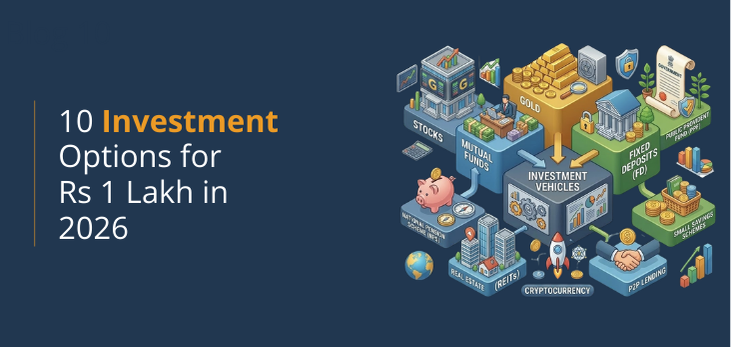
10 Investment Options for ₹1 Lakh in 2026
If you have ₹1 lakh available for investing, here are some options worth considering.
1. Fixed Deposits (FDs)
A fixed deposit allows you to park ₹1 lakh with a bank or NBFC for a fixed period. Over this duration, you earn interest at a guaranteed rate. It’s one of the simplest and most accessible investment options available to investors today.
-
- Risk Profile: Low-risk investment as the principal is protected and the returns are guaranteed
- Investment Tenure: Ranges from 7 days to 10 years
- Expected Returns: Varies, but usually ranges from 2.5% to 8% per annum
- Taxation: Interest earned is taxable according to your income tax slab
2. Recurring Deposits (RDs)
A recurring deposit allows you to invest a fixed amount every month instead of a lump sum. If you want to invest ₹1 lakh in an RD, you can spread it across many months. This makes it a disciplined yet flexible way to invest money.
- Risk Profile: Low-risk investment with guaranteed returns
- Investment Tenure: Ranges from 6 months to 10 years
- Expected Returns: Varies, but ranges from 3.5% to 7.5% per annum
- Taxation: Interest earned is taxable as per your income tax slab
3. Government Securities (G-Secs)
G-Secs are debt instruments issued by the Central or State governments to fund their expenditure. When you invest in these securities, it means you are lending your money to the government. No wonder it’s considered one of the safest investment options for your ₹1 lakh.
- Risk Profile: Virtually risk-free because they are backed by the government
- Investment Tenure: Ranges from 91 days (T-Bills) to 40 years (long-term bonds)
- Expected Returns: Typically range from 5.5% to 7.5% per annum
- Taxation: Interest earned is taxable according to your income tax slab, but profits are taxed as capital gains
4. Corporate Bonds
Corporate bonds are debt instruments that companies issue to raise capital. When you invest ₹1 lakh in these bonds, you will be lending your money to the corporate entity. In return, you will receive regular interest payments. These bonds have credit ratings, and a higher rating means lower risk.
- Risk Profile: Low to medium risk, depending on the credit rating
- Investment Tenure: Can range from 1 year to 10 years
- Expected Returns: Usually ranges from7% to 12% per annum
- Taxation: Interest is taxed as per the normal slab rate, but profits are considered capital gains and taxed accordingly
5. Sovereign Gold Bonds (SGBs)
SGBs are government-issued bonds denominated in grams of gold. With these bonds, you can invest in gold without the hassle of storing physical gold. What’s more, you can also earn a fixed annual interest on your investment in addition to the gains from the gold price rise.
- Risk Profile: Low to medium risk because the returns are linked to gold prices
- Investment Tenure: 8 years, with an option for exit from the 5th year onward
- Expected Returns: Interest at 2.5% per annum + Gains from gold price appreciation
- Taxation: Capital gains are tax-free at maturity, but interest is taxable as per the slab rate
6. Direct Equity
Investing in direct equity means that you buy the shares of listed companies directly. When you invest ₹1 lakh in stocks, you become a part-owner of those businesses. And your returns depend on how well they perform.
- Risk Profile: High risk because the returns are market-linked
- Investment Tenure: Ideally, 5 years or more to overcome market volatility, though short-term investments are also popular and potentially rewarding
- Expected Returns: Varies depending on the market conditions
- Taxation: Gains from the sale of shares are taxed as capital gains
7. Mutual Funds
Mutual funds are also an investment option to consider for your ₹1 lakh worth of capital. These investments pool money from different investors and use the funds to buy stocks, bonds, or both. They’re managed by professional fund managers, and they’re a great way to diversify your portfolio without picking the securities yourself.
- Risk Profile: Ranges from low to high risk depending on the type of fund (debt funds are low-risk, equity funds are high-risk, and hybrid funds are medium-risk)
- Investment Tenure: Ranges from a few days (liquid funds) to 10 years or more (long-term equity funds)
- Expected Returns: Depends on the type of funds and the market performance
- Taxation: Gains are typically taxed as capital gains
8. Digital Gold
With digital gold investments, you can buy gold online in fractions, starting with as little as ₹1. The price of digital gold mirrors the price of physical gold. It’s also backed by real gold that’s stored in secure vaults, so you don’t have to worry about purity or security.
- Risk Profile: Medium risk because returns are linked to the gold market
- Investment Tenure: No fixed tenure
- Expected Returns: Depends on how the price of gold fluctuates
- Taxation: Profits from the sale of digital gold are taxed as capital gains
9. Real Estate Investment Trusts (REITs)
In REITs, you invest in income-generating real estate, like office spaces and malls, without actually buying any property. With ₹1 lakh, you can get real estate exposure that would otherwise require crores of rupees.
- Risk Profile: Medium risk, as the returns depend on the property market and rental income
- Investment Tenure: Ideally 3 to 5 years or more for stable returns
- Expected Returns: Ranges from 8% to 12% per annum (in the form of dividends and capital appreciation)
- Taxation: Dividends are taxed as per income tax slab rates, and profits are taxed as capital gains
10. National Pension System (NPS)
NPS is a government-backed retirement savings scheme through which you can invest your money in equities, G-Secs, and corporate bonds. It’s designed for long-term investments and helps you build a retirement corpus systematically.
- Risk Profile: Low to medium risk, depending on the asset allocation you choose
- Investment Tenure: Until the age of 60, with an option to extend up to 75 years
- Expected Returns: May range from 9% to 12%, depending on the asset mix chosen
- Taxation: Employer contributions are tax-deductible under section 80CCD(2), and at maturity, 60% of the corpus can be withdrawn tax-free, while 40% must be used to purchase an annuity
So, How Do You Choose the Right Investment Option for ₹1 Lakh?
Now that you know what your options are, how do you decide where to invest your ₹1 lakh? To make a smart decision, you need to factor in different aspects, like:
- Your financial goals
- Your investment timeline
- Your risk appetite and comfort level
- How long you can stay invested
- How quickly you may need the money
- Tax implications on your returns
- Current market conditions
Based on these factors, you can decide how to invest ₹1 lakh. You can even split the capital across different investment options.
If you want to invest in fixed deposits or bonds, you can explore the options on GoldenPi. You have many types of bonds to consider, ranging from high-yield bonds and highly rated bonds to G-Secs and short-term bonds.
Investment Options for ₹1 Lakh FAQs
1. If I have ₹1 lakh, should I invest it right away?
You can, but make sure you have an emergency fund first. Once that’s done, start investing. When you invest early, you can maximize the benefits of compounding and avoid letting idle cash lose value to inflation.
2. Should I invest ₹1 lakh as a lump sum or start a SIP?
That depends on the market conditions. In volatile markets, SIP is less risky because of rupee cost averaging. But in stable markets, a lump sum may work well.
3. What are the returns I can earn on an investment of ₹1 lakh?
The returns vary based on the investment options you choose. FDs may offer 6-7%, mutual funds may offer 10-15%, and equities may offer potentially higher returns. It all depends on the market conditions and on your investment horizon.
4. If I have ₹1 lakh, can I invest it in the share market?
Absolutely. ₹1 lakh is sufficient to buy stocks or equity mutual funds. But make sure you diversify across sectors. This will help you manage risks over time.
5. Are there any tax-saving investment options for ₹1 lakh in 2026?
Yes. You can invest in the National Pension Scheme to save tax under the new tax regime in 2026.
Disclaimer:
This information is for general information purposes only. GoldenPi makes no guarantee on the accuracy of the data provided here; the information displayed is subject to change and is provided on an as-is basis. Nothing contained herein is intended to or shall be deemed to be investment advice, implied or otherwise. Investments in the securities market are subject to market risks. Read all the offer-related documents carefully before investing.
Fixed Deposit schemes are regulated by the Reserve Bank of India. GoldenPi Securities Private Limited is a registered debt broker and acts as a distributor and not as a manufacturer of the product.