|
Getting your Trinity Audio player ready...
|
KYC, or Know Your Customer, is a mandatory process introduced to verify customer identity and prevent financial fraud. First implemented by the RBI in 2004 under the Prevention of Money Laundering (PML) Act, KYC ensures that banks, brokers, and financial institutions deal only with verified users.
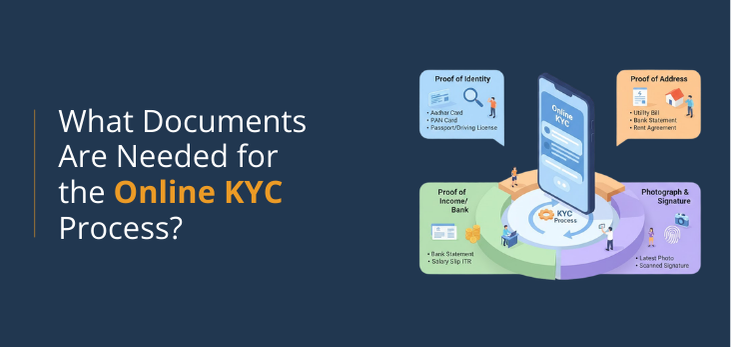
While earlier KYC could only be completed offline, today, you can complete the process digitally with a few online KYC documents. KYC document requirements typically include documents like:
- PAN Card
- Aadhaar Card
- Passport
- Driving License
- Bank Details
These online KYC documents help organisations verify the customer’s identity, address, and other essential details. So, if you are about to open a new bank account, apply for a loan, or sign-up for a mutual fund investment account, knowing the online KYC document checklist is important.
Understanding the Types of KYC Document Requirements
The KYC document checklist has certain ‘Officially Valid Documents’ or OVDs. This refers to the official list of valid documents needs to complete the KYC process in India in 2026. These documents can be divided into:
- Proof of identity documents: These online KYC documents are used to verify who you are. They confirm your legal name, age, and identity as recognised by the government.
- Proof of address documents: Address proof KYC documents are used to verify where you live. These online KYC documents help institutions confirm your current address for compliance and communication purposes.
Apart from proof of identity and address for KYC, some institutions may also require income documents.
List of Valid Online KYC Documents
Here’s a list of the valid list of online KYC documents needed for completing the KYC process:
Proof of Identity
You can use any one of the following documents for digital KYC verification:
- Aadhaar Card
- Voter’s ID
- Passport
- PAN Card
- Driving Licence
- Photo ID cards issued by any Central/State Government department, statutory or regulatory body or PSU
Proof of Address
You also have to submit any one of the following proof of address documents for online KYC verification:
- Passport
- Voter’s ID
- Driving Licence
- Ration Card
- Utility bills like gas, water, telephone, or electricity bill (but not older than 1 month)
- Sale deed
- Rental agreement
- Bank passbook or statement displaying your address
- Proof of address issued by a gazette officer, or notary public
Additional KYC Document Requirements
While proof of identity and address for KYC are mandatory, some platforms may also ask for a few additional documents. This is based on why you’re completing the KYC and to also determine your eligibility for certain financial services.
Let’s look at some additional online KYC documents you may need:
- Recent Photograph – A clear passport-size photo or selfie.
- Signature Specimen – Your signature on plain white paper for verification.
- Income Proof – Bank statements, salary slips, or ITR as income proof may be needed if you wish to trade in the Derivatives segment.
- Bank Account details – This includes your bank account number and IFSC details required for financial transactions.
- DP ID and Client ID – You may need to submit the latest Demat CMR or eCAS statement to verify your DP ID and Client ID.
How to Complete KYC Online?
Now that you have the KYC document checklist handy, let’s understand how you can complete your KYC online.
Method 1: Manual Upload
- Step 1: Access the platform: Log in to the bank, broker, or financial service provider’s website or app where you need to complete KYC.
- Step 2: Initiate the process: Look for the option to ‘Complete KYC’ or ‘Update KYC’.
- Step 3: Fill in details: Enter your personal information carefully, including your Aadhaar and PAN numbers, as these are essential documents for digital KYC verification.
- Step 4: Upload documents: Upload clear scanned copies of your online KYC documents (proof of identity and address for KYC).
- Step 5: Complete verification: Authenticate your details using one of the supported methods:
- OTP verification sent to your Aadhaar-linked mobile number
- Video KYC where you display your physical documents to a live agent
- Selfie or biometric verification, if supported
- Step 6: Submit and wait: Submit your application and wait for approval. You’ll receive confirmation via SMS or email once your documents for digital KYC verification are successfully authenticated.
Method 2: Using DigiLocker
If you prefer a fully paperless process, you can complete your KYC online by allowing the platform to fetch your documents directly from DigiLocker.
- Step 1: Log in to the platform: Open the bank, broker, mutual fund, or investment platform where you need to finish your KYC and navigate to the ‘Complete KYC’ option.
- Step 2: Select DigiLocker verification: Choose the ‘Verify via DigiLocker’ or ‘Fetch from DigiLocker’ option when prompted to upload documents.
- Step 3: Sign in to DigiLocker: You will be redirected to the DigiLocker login page. Sign in using your Aadhaar-linked mobile number and the OTP you receive.
- Step 4: Grant document access: Allow the platform to access your Aadhaar, PAN, and other KYC documents stored in your DigiLocker account. These are considered valid, government-authenticated records.
- Step 5: Auto-fill and verify details: Your personal details will auto-populate from DigiLocker. Review the information carefully and confirm that everything is correct.
- Step 6: Complete final authentication: Depending on the platform, you may need to complete a quick OTP verification, selfie check, or video KYC to confirm your identity.
- Step 7: Submit and wait for approval: Submit your request. Since DigiLocker documents are verified by issuing authorities, approval is usually faster, and you’ll receive confirmation by SMS or email.
Things to Keep in Mind When Submitting Online KYC Documents
To complete your online KYC quickly and without errors, keep these simple things in mind:
- Keep your original Aadhaar and PAN card handy for quick reference during verification.
- Ensure your mobile number linked to Aadhaar is active to receive OTPs instantly.
- Enable your device camera, microphone, and location before starting the digital KYC process.
- Make sure you have a stable internet connection and good mobile network coverage.
- For selfie or video verification:
- Ensure your face is clearly visible with no shadows
- Avoid hats, sunglasses, or anything covering your face
- Keep the camera steady and avoid blurry images
Key Takeaways on Online KYC Documents
Online KYC document requirements typically include proof of identity and address documents. Most financial institutions allow you to submit your PAN and Aadhaar to prove each, but also list other documents you may submit instead. Additionally, some may require additional documents like photographs, signature, and income proof.
It also helps to check the organisation’s KYC list beforehand so you don’t run into delays. For instance, if you wish to invest in fixed-income products like bonds and debentures via GoldenPi, you can review the KYC documents required on our website and get started quickly.
FAQs on Online KYC Documents
1. What are the documents required for the online KYC process?
You will need OVDs (Officially Valid Documents) as proof of identity and address for KYC. This includes documents like your PAN Card and Aadhaar Card. Most platforms also require recent passport-size photographs and a signature sample.
Other than that, income proof may be needed in certain instances like when you wish to trade in the derivatives segment.
2. Where can I find the KYC document requirements listed?
You can find the complete KYC document checklist on the website or app of your bank, broker, or financial service provider for whom you need to complete the KYC.
In case you don’t find the KYC document checklist for the organisation, you can refer to the one we have outlined above.
3. How long does it take to process online KYC documents?
Online KYC is usually processed within a few minutes to 48 hours. Timelines depend on the platform, document clarity, and verification method used during the digital KYC verification process.
4. How to check if my online KYC is registered or verified?
You can check your KYC status on the platform where you applied or through KRA portals like CVL KRA or NDML KRA. If verified, your status will show as “KYC Validated”.
5. Is PAN Card a mandatory online KYC document?
Yes. PAN Card is a mandatory online KYC document for most financial services, including opening Demat accounts, trading accounts, mutual fund investments, and bank accounts. It serves as a primary identity proof and is a key requirement in the documents for digital KYC verification.
Disclaimer:
This information is for general information purposes only. GoldenPi makes no guarantee on the accuracy of the data provided here; the information displayed is subject to change and is provided on an as-is basis. Nothing contained herein is intended to or shall be deemed to be investment advice, implied or otherwise. Investments in the securities market are subject to market risks. Read all the offer-related documents carefully before investing.
Fixed Deposit schemes are regulated by the Reserve Bank of India. GoldenPi Securities Private Limited is a registered debt broker and acts as a distributor and not as a manufacturer of the product.