|
Getting your Trinity Audio player ready...
|
When we think of retirement planning in India, one of the first things that comes to mind is the Senior Citizen Savings Scheme (SCSS). The SCSS is a government-backed small savings scheme that aims to provide a regular flow of income to senior citizens.
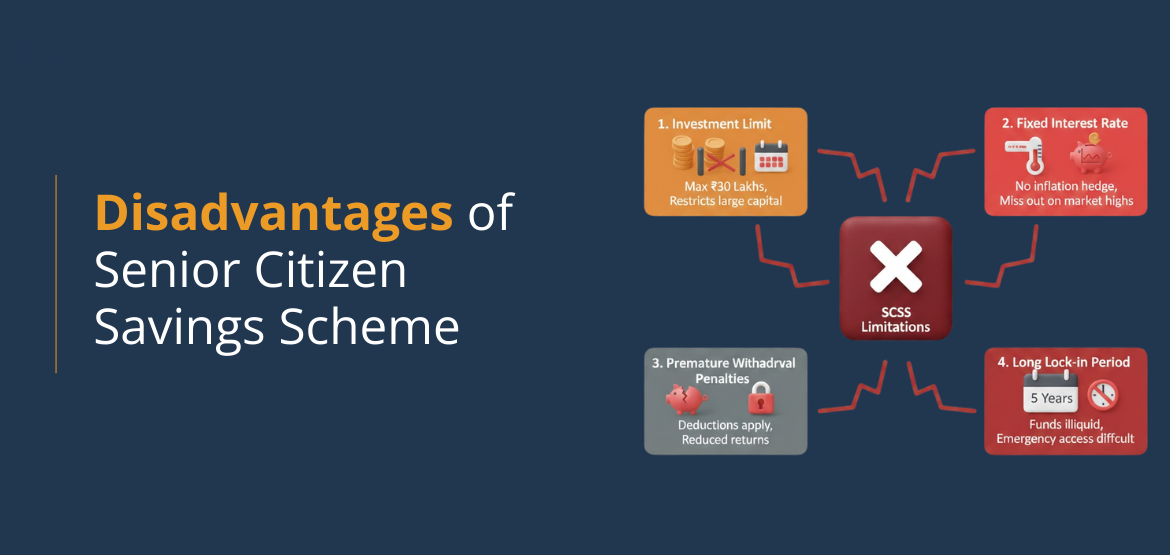
While the scheme is considered safe and reliable for a steady quarterly income, it does come with certain limitations that potential investors should be aware of. This article outlines the key disadvantages of the Senior Citizen Savings Schemes to help investors make an informed choice for their retirement plans.
Overview of the Senior Citizen Savings Scheme
Here’s a quick overview of the Senior Citizen Savings Scheme:
| Feature | Details |
|---|---|
| Eligibilty | Indian citizens 60 years or above (more rules apply) |
| Interest Rate | 8.20% p.a. (As of 14.02.2026); Revised quarterly |
| Minimum Investment | Rs. 1,000 |
| Maximium Investment | Rs. 30 lakhs |
| Tenure | 5 years (extendable by 3 years) |
| Taxation | Tax applicable on interest |
| Tax Benefit | Tax deduction of up to Rs. 1.5 lakhs u/s 80(C) on the principal (only in the investment year) |
| Premature Withdrawal | Allowed but with restrictions |
Disadvantages of the Senior Citizen Savings Scheme
Here are some of the main disadvantages of the Senior Citizen Savings Scheme:
-
Age Limit and Eligibility Rules
Not everyone can invest in SCSS. As per SCSS eligibility rules, only the following can invest:
- Resident Indians of 60 years or above
- Resident Indians who are 55 years or more but less than 60 years and have retired under VRS, superannuation, or special VRS
- Retired Defense Service personnel who have attained 50 years of age (subject to certain conditions)
Moreover, SCSS accounts can be opened jointly, but only with the spouse. HUFs and NRIs cannot open SCSS accounts. These age limits and eligibility rules make the SCSS inaccessible to a pool of senior investors, making this one of the key disadvantages of the Senior Citizen Savings Scheme.
-
Interest is Fully Taxable, and TDS is payable
SCSS offers the highest interest rate (8.20% currently) among all government-backed small savings schemes. But the interest earned is fully taxable. This means that the interest is added to the senior’s annual income and taxed at their applicable slab rate. This can erode real returns, especially for senior citizens who fall into higher tax brackets.
Moreover, if the interest earned in a financial year exceeds Rs. 1 lakh, TDS is deducted at a rate of 10%. The rate becomes 20% if PAN is not provided. While seniors whose income is below the taxable threshold can submit Form 15H to avoid TDS, others must settle this while filing taxes.
-
Rigid Lock-in and Limited Liquidity
The lack of immediate and easy liquidity is a significant disadvantage of the Senior Citizens Savings Scheme. SCSS has a 5-year tenure, during which early withdrawals are allowed but are subject to the following penalties:
- No interest is paid on the deposit if withdrawn before the completion of 1 year
- 1.5% of the deposit amount will be deducted if withdrawn after 1 year but before 2 years
- 1% of the deposit amount will be deducted if withdrawn between 2 and 5 years
These limited withdrawal options and penalty rules can create difficulties for senior citizens in emergencies, especially when they urgently need money for medical or financial needs.
-
Limit on Maximum Investment Amount
Investment caps make for yet another key disadvantage of the Senior Citizen Savings Scheme. As per SCSS rules, the maximum amount seniors can invest is set at Rs. 30 lakhs per individual.
While this maximum investment limit may be suitable for some retirees, it might not be suit those with a higher retirement corpus. It limits their capacity to generate a regular income from a single lump-sum investment for such seniors.
-
No Compounding Interest
Unlike reinvestment options such as mutual funds and FDs, SCSS does not offer compounding of interest. Interest from SCSS is paid out quarterly.
This means that SCSS interest is not reinvested into the scheme to earn further interest and generate compounding returns. While most retirees need and want quarterly payouts, it can compromise opportunities for wealth growth over time.
The lack of compound interest can limit the overall return potential of SCSS as compared to other investment options. That’s why this is one of the key disadvantages of the Senior Citizens Savings Scheme.
-
Can Only Be Held Jointly With the Spouse
An SCSS account can be opened jointly, but only with one’s spouse. This can be a significant disadvantage of the Senior Citizen Savings Scheme, especially for retirees who wish to nominate their kids or other family members as co-accountholders.
-
Returns May Erode Due to Inflation
SCSS interest rates are fixed by the government and reviewed quarterly. And there are no compounding returns. So, SCSS earnings may not always keep pace with inflation.
Over 5 years, if inflation is high, the real inflation-adjusted returns on SCSS investments may be minimal or even negative.
For retirees, this can reduce the real value of their interest income. Over time, it may become harder to manage rising medical and living expenses. Seniors need investment options that can protect their savings from inflation.
-
No Market-Linked Growth
SCSS is a fixed-income instrument backed by a sovereign guarantee. It is not a market-linked investment option for senior citizens.
This means that there is no room for capital appreciation and legacy planning in the way market-linked products like bonds and MFs grow.
SCSS Vs. Other Retirement Planning Options
| Feature | SCSS | Senior Citizen FD | Bonds | NPS | Mutual Funds |
| Interest Rate | 8.2% (as of 14.02.2026) | 7.5–8% | 8–11% (varies by issuer) | Market-linked | Market-linked |
| Lock-in Period | 5 years | 1–10 years | Depends on bond tenure | Till retirement (60 years) | None (ELSS funds: 3 yrs) |
| Liquidity | Low (higher penalties) | High | High (for listed bonds) | Low (withdrawal restrictions) | High |
| Tax Benefits | Rs. 1.5 lakh under 80(C) | Rs. 1.5 lakh under 80(C) | No (unless invested in tax-saving bonds) | Rs. 1.5 lakh under 80(C) + extra Rs. 50,000 +up to 60% of maturity corpus can be withdrawn tax-free | Only on ELSS funds (Rs. 1.5 lakh under 80(C)) |
| Compounding | No | Yes (for cumulative FDs) | When interest payments are reinvested | Yes | Yes |
| Risk Level | Low | Low | Low to Moderate | Depends on allocation | Moderate to High |
Who May Consider Avoiding SCSS Investment
The disadvantages of the Senior Citizen Savings Scheme have made it clear that it may not always be the most suitable option for retirees. SCSS may not be suitable for:
- Senior citizens in a higher tax bracket
- Those needing easy and immediate liquidity
- Those who want to invest more than Rs. 30 lakhs
- Senior investors looking for long-term capital growth and regular income
Beyond SCSS: Tackle the Disadvantages of SCSS with Bonds
SCSS is a good government-backed retirement savings scheme that offers seniors a regular quarterly income at relatively high interest rates. That said, there are several disadvantages to the Senior Citizen Savings Scheme, including limited liquidity, no compounding, and no market-linked growth.
If you’re a retiree who doesn’t want to compromise on these benefits, you can always diversify with bond investments for retirement. You can visit the GoldenPi platform to check out bond options for retirement that offer easy liquidity, regular income, and even market-linked returns (MLDs).
Disadvantages of the Senior Citizen Savings Scheme FAQs
1. What are the main disadvantages of the Senior Citizen Savings Scheme?
The main disadvantages of the Senior Citizen Savings Scheme include limited liquidity, no compounding, a rigid lock-in period, and an investment ceiling.
2. Can I withdraw from the SCSS before maturity?
Yes. SCSS allows withdrawals, but with penalties. IF you withdraw before completing 1 year, the interest paid is recovered. If you withdraw after 1 year but before 2 years, 1.5% of the invested amount is deducted, while if you withdraw between 2 and 5 years, 1% of the invested amount is deducted as a penalty.
3. What is the lock-in period for SCSS?
The lock-in period for SCSS is 5 years. You can extend the account in blocks of 3 years post this initial lock-in period.
4. What is the interest rate of SCSS in 2026?
As of 14th February 2026, SCSS interest rates stand at 8.20% p.a. Interest rates are revised by the government quarterly. Once you open the account, the rate applicable on that day is locked in and stays the same throughout the 5-year tenure.
5. Is SCSS better than fixed deposits for senior citizens?
In terms of interest, SCSS may be better. SCSS interest rates tend to be higher than FD rates (especially in falling rate scenarios). However, SCSS does have more limited liquidity and stricter withdrawal rules than FDs. It doesn’t offer compound interest benefits either.
Disclaimer:
This information is for general information purposes only. GoldenPi makes no guarantee on the accuracy of the data provided here; the information displayed is subject to change and is provided on an as-is basis. Nothing contained herein is intended to or shall be deemed to be investment advice, implied or otherwise. Investments in the securities market are subject to market risks. Read all the offer-related documents carefully before investing.
Bonds or non-convertible debentures (NCDs) are regulated by the Securities and Exchange Board of India and other government authorities. GoldenPi Securities Private Limited is a registered debt broker and acts as a distributor and not as a manufacturer of the product.