For investors, G-Secs, or Government Securities, represent something rare in the fixed-income scenario: a borrower that cannot default. G-Secs are debt instruments that allow state and central governments to borrow money from the people with a promised repayment at maturity and periodic coupon payments along the way.
The Government of India backs the debt with sovereign authority and, in a worst-case scenario, has the RBI standing behind it. This is why G-Secs are considered the risk-free benchmark in India.
In 2026, with India’s 10-year G-Sec yield wavering around 7% and the government’s record gross borrowing target of ₹17.2 trillion for FY2026-27 set, the time is ripe for investors to view G-Secs as a good yielding opportunity.
Types of Government Securities in India
Here is how G-Secs have been categorized in India:
| Type | Tenure | How Returns Work | Best For |
| Treasury Bills (T-Bills) | 91/182/364 days | Issued at discount, redeemed at face value | Short-term investment |
| Dated G-Secs | 5-40 years | Fixed semi-annual coupon | Long-term income seekers |
| State Development Loans (SDLs) | 10 years (typically) | Fixed coupon, slightly higher than G-Secs | Yields with sovereign backing |
| Floating Rate Bonds (FRBs) | Medium to long term | Coupon with T-Bill benchmark rate | Investors hedging rate risk |
| Sovereign Gold Bonds (SGBs) | 8 years | 2.5% p.a. + gold price appreciation | Gold investors seeking income |
| RBI Floating Rate Bonds | 7 years | NSC rate + 35 bps, reset every 6 months | Conservative investors |
T-Bills are the simplest entry point, with short tenure, no coupons, and near-zero risk as the pillars. Dated G-Secs are the most widely held. SGBs occupy a space that sets them apart—part G-Sec, part gold, coupled with a capital gains tax exemption at maturity if bought during the time of original issuance. Ultimately, no single type is the best, and the right fit depends on your investment horizon, income needs, risk appetite, and some other factors.
Recent Post:
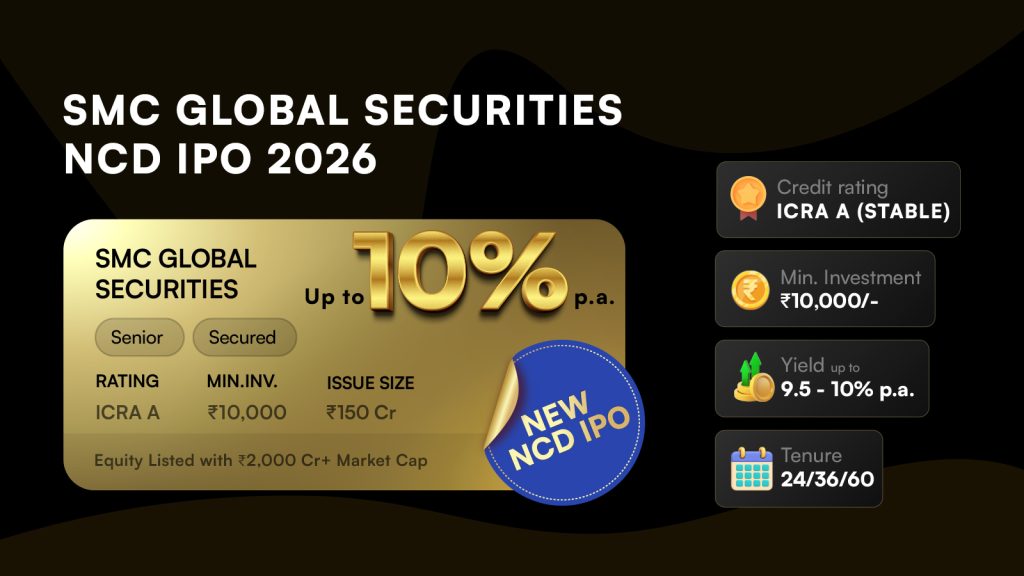
- SMC Global, Securities NCD Issue 2026: 10% Yield, Rating, Details, and How to Invest
- HDFC Bank Fixed Deposits (FDs) and Interest Rates for October 2026

- The Fed Ripple Effect: How a Rate Hike in Washington Hits Your Wallet in India

Start investing with just ₹10K & grow your wealth with fixed return opportunities.
Invest Now

Why Are G-Secs Considered the “Safe” Investment in India
Here are three things about G-Secs that make them safer than corporate bonds:
- Sovereign guarantee: The Government of India cannot default on rupee-denominated debt. Even a worst-case scenario can be dealt with simply by printing money to repay. No private borrower can offer that.
- RBI as debt manager: The Reserve Bank of India manages all G-Sec issuances, holds auctions, supports secondary market liquidity, and even steps in as the lender of last resort. The RBI infused ₹11.7 trillion into the banking system in 2025, of which ₹7 trillion was in the form of direct purchases of debt.
- The risk-free benchmark: The G-Sec yield is the benchmark for all fixed income instruments in India, and every instrument offers a spread over it, making it the bedrock of India’s fixed income market.
Interest Rate Risk: The One Risk Every G-Sec Investor Must Understand
G-Secs carry virtually no credit risk, but they’re not entirely risk-free. And that’s where interest rate risk comes into play.
One of the golden rules of the fixed-income market is When interest rates rise, existing bond prices fall, and vice versa. Suppose you have a 30-year G-Sec. In a rising-rate environment, your losses can be significant if you decide to sell. But this risk is only relevant for investors looking to sell before maturity.
The takeaway: go for short-term bonds if you want to liquidate early; long-term bonds if you are planning to hold till maturity. Try to match the tenure to your investment goals.
How to Buy Government Securities in India in 2026
The retail trading in G-Secs has made tremendous strides in recent years. Here are your options:
- RBI Retail Direct: The RBI’s own platform, launched in 2021, allows Indian residents to buy G-Secs at primary auctions and the secondary market.
- Stock Exchanges using Demat Account: G-Secs, SGBs, and SDLs are listed on NSE and BSE.
- Gilt Mutual Funds: Gilt Mutual Funds are the mutual funds that invest only in G-Secs. They are liquid, come with low minimums, and have other benefits of a mutual fund.
- Banks and Post Offices: You can buy RBI Floating Rate Savings Bonds and SGBs from scheduled commercial banks and selected post offices.
- Online Bond Platform Providers (OBPPs): SEBI-regulated online bond platforms such as GoldenPi list a variety of G-Secs, SGBs, SDLs, and corporate bonds, all consolidated on a single, investor-friendly platform.
Who Should Invest in G-Secs in 2026?
G-Secs cater to the needs of a large number of investors but are especially recommended for investors who value capital security. They include retirees creating a stream of predictable income, conservative investors seeking to earn higher returns than FD, but without credit risk, and others.
A combination of gilt funds and dated G-Secs could be added to the fixed-income side of the portfolio by younger investors with long time horizons. The opportunity cost of a safe fixed-income investment is low, as benchmark yields are pushing back into the 7% range, so now is the time to consider investing.
Frequently Asked Questions: Government Securities
Q1. What are Government Securities in India, and are they really risk-free?
A: Government Securities are debt instruments issued by the central or state governments of the country to raise money from the market. They are safe from credit risk: the sovereign can’t default on rupee-denominated debt. They do, however, have interest rate risk, which means that if rates are to change, the market price will change as well.
Q2: What is the difference between Government Securities and corporate bonds?
A: The biggest difference lies in who is borrowing and how secure the investment is. Corporate bonds are bonds issued by a corporation and carry credit risk, whether or not the bonds are highly rated. Corporate bonds usually pay higher rates of return for this added risk. G-Secs are the safest, the ground floor of the fixed income market, and corporate bonds are instruments that are built on the floor, with higher returns but higher risk.
Q3: What does “Sovereign Guarantee” actually mean for G-Sec investors?
A: It means the Government of India stands behind every rupee it borrows. The sovereign, in contrast with a company that might go bankrupt, has instruments that they don’t: it can raise taxes, cut spending, or, in an extreme case, create money to pay its obligations. For an investor, this means one thing: if they are holding a G-Sec till maturity, they will surely get their money back. No corporate bond, however AAA-rated, can make that promise with the same conviction.
Q4: What happens to my G-Sec investment if interest rates rise?
A: It depends on what you do from then on. Whether rates move up or down between now and the end, if you hold to maturity, you will receive your coupon payments and be paid back your principal. The issue is only if you must sell before maturity. The rule of thumb: Don’t invest in G-Secs that you’re not willing to hold until it’s time to use the proceeds. This risk is much less for shorter time horizons, such as T-Bills and securities with shorter maturities.
Ready to Invest?
Visit GoldenPi to explore current bond options. Compare yields, ratings, and tenures in one place and invest online with as little as ₹10,000.
Disclaimer:
Fixed returns do not constitute guaranteed or assured returns. Investments in corporate debt securities, municipal debt securities/securitized debt instruments are subject to credit risks, market risks and default risks, including delay and/or default in payment. Read all the offer-related documents carefully. This blog/article should not be construed as financial advice or as an offer or recommendation to buy or sell any security or any products/services of/on GoldenPi or any product/services of its third-party client(s). For a detailed calculation of YTM, visit our website. T&C’s Apply.