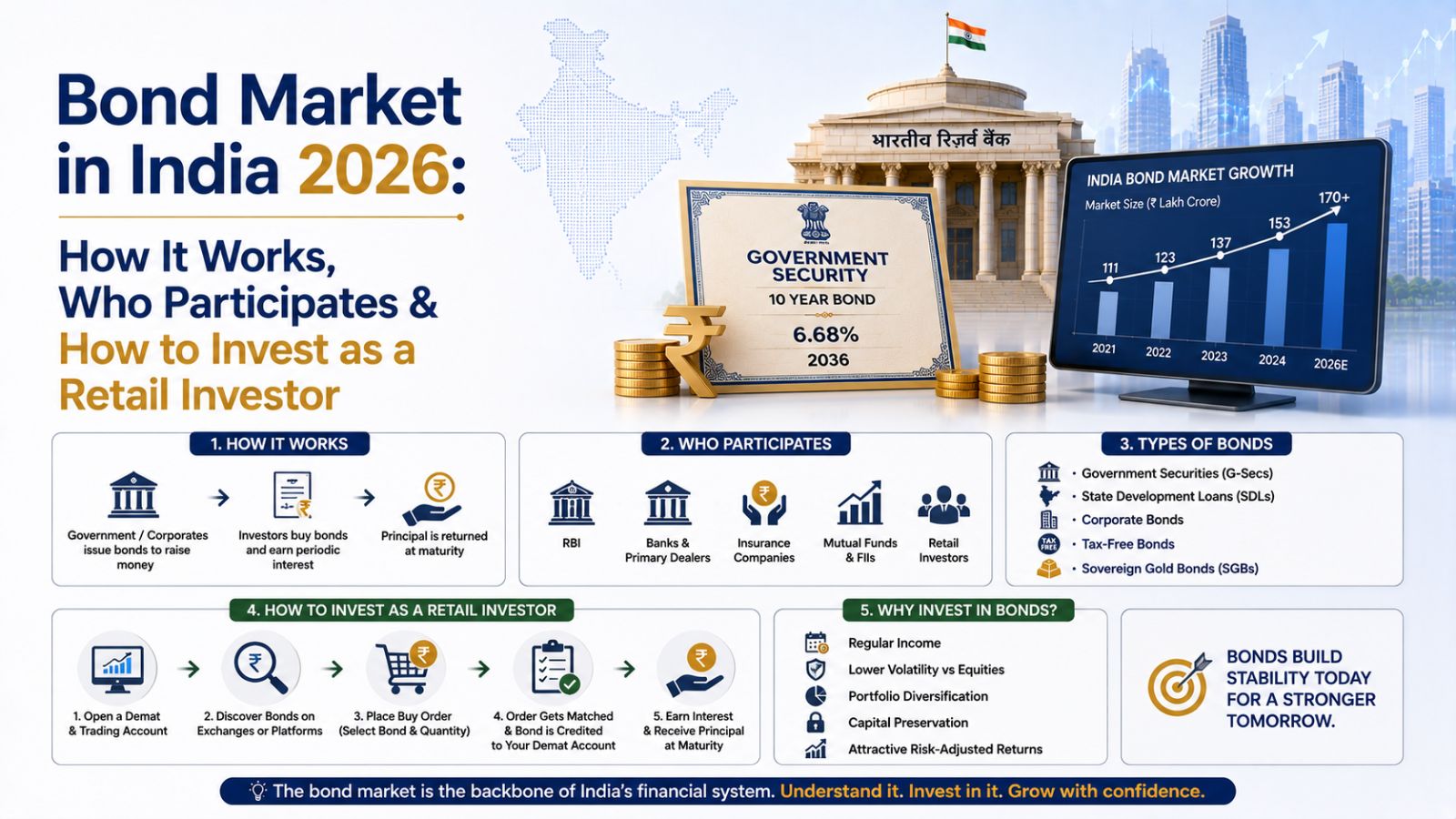
The bond market in India is one of the biggest sectors of the financial industry, with an outstanding size of over ₹230 lakh crore, being much bigger compared to the equity market. However, despite its magnitude, the involvement of retail investors remains rather insignificant, because the majority of people are unaware of what a bond is as an investment instrument and how they can include it in their portfolios.
Until recently, bonds remained a part of investment strategies of institutional investors such as banks, mutual funds, insurance companies, and pension funds. Thanks to some regulatory measures undertaken by the Securities and Exchange Board of India (SEBI), which included reforming the Online Bond Platform Provider (OBPP) framework, bonds have become a more attractive investment opportunity for individuals who can buy bonds through SEBI-registered online bond platforms and have access to more transparent information about them.
Being aware of what a bond is and how the bond market works is essential for making a wise choice regarding fixed income investments. If you are willing to diversify your investment portfolio or to get regular income, knowing how the bond market works will help you to make an informed decision.
Key Takeaways
Before exploring the Indian bond market in detail, here are some important points to remember:
- India has one of the largest bond markets in Asia, serving an important function in financing governments and corporates for their varied funding needs.
- The regulation of the bond market in India is governed by the RBI as well as SEBI. RBI regulates G-Secs, while SEBI regulates the corporate bond market and debt securities.
- There are two sections of the bond market: the primary market, where bonds are issued to the investors, and the secondary market, which involves trading of bonds that have already been issued on recognized stock exchanges like NSE and BSE.
- Retail investors can access the bond market via SEBI-regulated Online Bond Platform Providers (OBPPs), where they can invest in listed bonds as per the criteria set out by OBPPs.
- Bond price and yield are usually inversely proportional. A reduction in market interest rates usually leads to an increase in the price of existing bonds, and vice versa.
- Corporate and government bonds have different yields based on varying factors like the bond issuer, bond ratings, and other prevailing market conditions.
What Is the Bond Market in India?
The bond market in India is an area of the financial market through which issuers such as governments, corporations, and other eligible institutions can raise capital from investors by issuing bonds. You may be asking what a bond is. It is basically a debt security through which an investor loans money to the issuer for a particular period of time and earns interest on the investment as well as the repayment of principal upon maturity in accordance with the terms of the issue.
The bond market in India is regulated by the RBI in case of G-Secs and SEBI in case of corporate and listed debt securities. Currently, it is one of the largest bond markets in Asia and has a total debt in excess of ₹230 lakh crore. An investor can invest in the bond market in India through primary and secondary markets as well as through SEBI-registered OBPPs.
Latest Bond News:
- Tax-Free Bonds in India 2026: Who Should Still Consider Them?

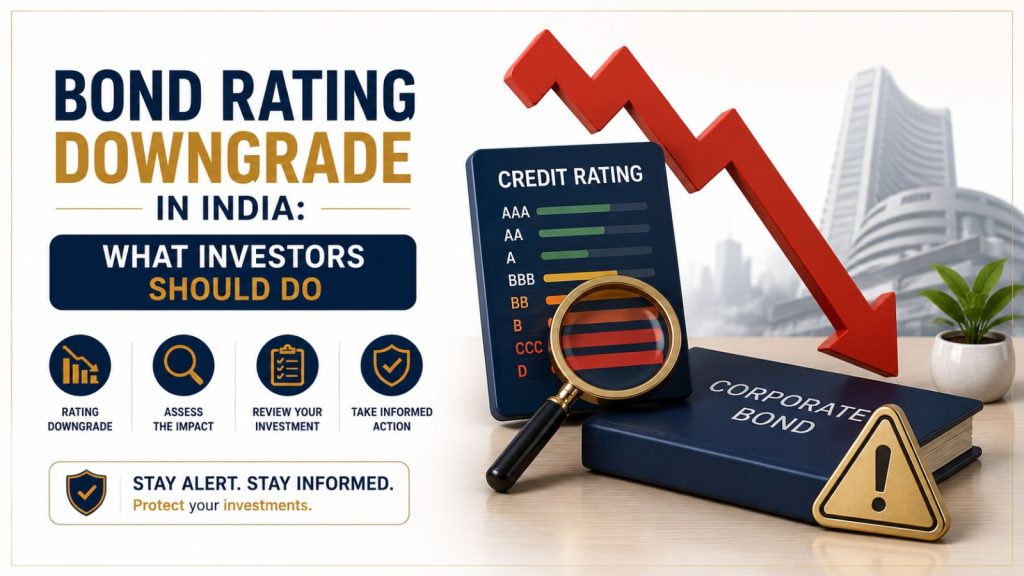
- Bond Rating Downgrade in India: What Should You Do If a Bond You Hold Gets Downgraded?
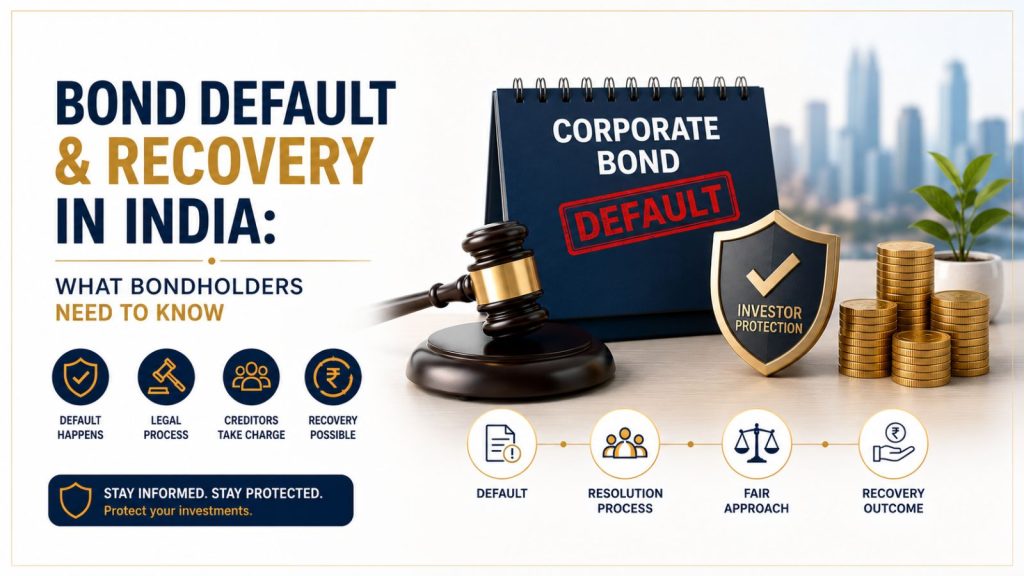
- Bond Default and Recovery in India: What Actually Happens to Bondholders?
Structure of the Indian Bond Market: Who Regulates What
The bond market in India consists of two major parts: G-Sec (Government securities market), which is under the regulation of RBI (Reserve Bank of India), and the corporate bond market, which comes under the supervision of SEBI (Securities and Exchange Board of India). Bond markets together form an integral component of the debt market of India, as they allow both the government and companies to borrow funds and provide fixed-income investments to their investors.
India’s bond market has debt worth more than ₹230 lakh crore outstanding, which makes the Indian bond market larger than that of the equity market by a significant margin in terms of outstanding issuance. Even though India has a large bond market, retail involvement in the fixed-income market is much lower than in the equity market. With the advent of digital technology and improvements in regulations, learning about bond markets has become important for individuals.
Types of Bond Market in India
| Market Segment | Regulator | Examples | Approximate Outstanding Size |
| Government Securities Market | RBI | Government Securities (G-Secs), Treasury Bills (T-Bills), State Development Loans (SDLs) | ~₹170–180 lakh crore |
| Corporate Bond Market | SEBI | Corporate Bonds, Non-Convertible Debentures (NCDs), Listed Debt Securities | ~₹55–60 lakh crore |
Figures are indicative and may vary over time based on issuances and redemptions.
Government Securities Market (G-Secs, Treasury Bills & SDLs)
The G-Sec market makes up the largest part of the debt securities market of the Indian capital market. This market involves bonds floated by the Government of India and State Governments in order to raise funds for their expenditures and infrastructural development.
These include:
- G-Secs: Long-term debt instruments floated by the Central Government.
- T-Bills: Short-term government securities having a maturity of up to one year, floated at a discount and redeemed at par value.
- SDLs: Bonds floated by State Governments in order to meet their borrowing needs.
The management of issuance and functioning of the government securities market is managed by the RBI. These securities are generally low risk due to their sovereign or state government guarantee, although their prices may vary according to changes in interest rates.
Corporate Bond Market
The corporate bond market allows the borrowing of funds by companies, public sector enterprises (PSUs), financial institutions, and other authorized bodies from investors on a long-term basis. The market is governed by SEBI, which regulates the issuance, listing, disclosures, and trading of corporate debt securities.
The corporate debt market consists of securities, including:
- Corporate Bonds
- Non-Convertible Debentures (NCDs)
- Other listed debt securities
Also known as the debenture market when talking about corporate debt, the section offers businesses a way to avoid bank borrowings as well as give investors different fixed-income investment opportunities. Corporate bonds may vary in many aspects, including the entity issuing them, the creditworthiness of the issuer, the term, and the interest payment.
Money Market: Short-Term Debt Instruments
Another important section of India’s debt market is the money market, where short-term borrowings and lendings take place, usually having a maturity period of up to one year. The money market is extremely important in order to maintain liquidity in the financial system and satisfy short-term funding needs.
Some of the common types of money market securities are as follows:
- Treasury Bills (T-Bills): Short-term borrowings made by the Government of India.
- Commercial Paper (CP): Short-term unsecured borrowings by eligible entities to satisfy their working capital requirements.
- Certificates of Deposits (CDs): Short-term negotiable instruments issued by banks and financial institutions.
Though the main participants of the money market are banks, financial institutions, corporations, and institutional investors, sometimes certain instruments are available even to individual investors via eligible investment avenues. Given their short maturities, these instruments tend to be much less interest-sensitive than long-term bonds.
Primary Market vs Secondary Market in India: Key Differences
The Indian bond market is comprised of two main markets—the primary market, wherein fresh bonds are offered for investments, and the secondary market, wherein already issued bonds are traded by investors. Knowledge of the difference between these two markets would aid investors in selecting the right mode of investment in accordance with their objectives and investment horizon.
In either case of primary market bonds or secondary market bonds, or purchasing bonds through the internet in India, both markets hold great significance in the Indian debt market.
| Parameter | Primary Market | Secondary Market |
| How to Access | Invest during a new bond issue or public offering through eligible platforms and intermediaries. | Buy or sell listed bonds through recognized stock exchanges such as the NSE and BSE. |
| Price | Usually issued at the face value or issue price specified in the offer document. | Market-driven and may trade above or below the face value depending on demand, supply, interest rates, and credit quality. |
| Liquidity | Bonds are generally held after allotment until traded or redeemed. | Liquidity depends on the trading activity and demand for the specific bond. |
| Who Participates | Retail investors, institutional investors, banks, and other eligible investors are subscribing to new issuances. | Retail investors, institutional investors, mutual funds, insurance companies, and other market participants are trading existing bonds. |
| Examples on GoldenPi | New NCD issues and public bond offerings, subject to availability. | Listed corporate bonds and other eligible debt securities available in the secondary market, subject to availability. |
What Is the Primary Bond Market?
The primary market is where issuers raise money through the issuance of new bonds directly to investors. Issuance of bonds by firms, PSUs, and government organizations is done to finance business activities, growth plans, infrastructure creation, etc.
Some examples of issuances in the primary market are:
- Non-Convertible Debenture (NCD) public issuance
- Security auctions by the government
- State Development Loan (SDL) issuance
- Other eligible securities
An investor who acquires a newly issued bond does so at the issue price that appears in the issuance documents. Once the allotment process is complete and the bonds are listed (if they are listed at all), they can be traded in the secondary market.
What Is the Secondary Bond Market?
In the secondary bond market, investors can invest in previously issued bonds. Instead of buying from the issuing company, investors buy and sell the previously issued bonds to other players in the market via recognized stock exchanges like NSE and BSE.
Some factors that affect the prices of bonds in the secondary markets include:
- Change in interest rates.
- Credit standing of the company.
- Time to maturity of the bond.
- Market demand and supply.
- Conditions prevailing in the market.
This is a crucial aspect of the Indian bond market, where investors get a chance to invest in more bonds or exit from their investment depending on the market liquidity.
Which Market Should a Retail Investor Use?
Whether one should go for the primary market or the secondary market will depend on the objective of the investor and the investment opportunities that are available.
An investor could be interested in participating in new bond issuance in the primary market at the issue price. An investor could be interested in going for secondary markets where there is a broad range of listed bonds from various issuers, with varying maturity periods, yield rates, and prices.
Investors interested in investing in both markets can use SEBI-registered Online Bond Platform Providers (OBPPs) like GoldenPi to get access to them. Investors can invest in new NCDs issued in the primary market as well as the listed bonds available in the secondary market.
Example: The Synergy between the Two Markets
For instance, let us assume that Ramesh purchases a Tata Capital NCD in the primary market at its face value of ₹1,000 during its public issue period. After six months, interest rates in the market fall. Consequently, the value of Ramesh’s bond rises owing to the presence of other bonds having higher coupon rates.
Provided that the bond is traded and there is enough liquidity in the market, Ramesh may sell it in the secondary market via NSE at ₹1,050. In this case, he may earn coupon amounts according to the terms of the bond, along with making a capital gain from selling it.
The example above is provided solely for illustration and does not represent an assurance of future performance or return on investment.
Who Participates in India’s Bond Market?
The Indian bond market has four main categories of participants: issuers, investors, intermediaries, and regulators. Each plays a distinct role in ensuring that the market functions efficiently, transparently, and securely. Together, they facilitate the issuance, trading, settlement, and regulation of debt securities while making the bond market accessible to a wide range of investors.
Issuers: Who Raise Money Through Bonds?
Issuers are entities that raise capital by issuing bonds to investors. Instead of relying solely on bank loans, they borrow funds from the market and agree to repay investors according to the terms of the bond.
Some of the major issuers in India’s bond market include:
- Government Securities (G-Secs) and Treasury Bills (T-Bills): The Government of India issues these instruments to meet its expenditure needs and other fiscal necessities.
- State Governments: Funds are raised by state governments through State Development Loans (SDLs).
- Public Sector Undertakings (PSUs): These are companies owned by the government that issue debt instruments to fund the growth and expansion of the business.
- Corporate Companies: Corporate bonds or Non-Convertible Debentures (NCDs) issued by companies to meet the financial requirements of their business.
- Non-Banking Financial Companies (NBFCs): Debt instruments are often issued by NBFCs to generate finance.
Each issuer may differ in terms of credit quality, maturity period, and interest payment structure, making it important for investors to evaluate the offer documents and credit ratings before investing.
Investors: Who Invests in Bonds?
The Indian bond market is populated by a range of investors with varying purposes and investment risks.
Some of the important investors are:
- Foreign Portfolio Investors (FPIs): Investments made by FPIs are in eligible debt securities of India within limits prescribed by regulations.
- Mutual Funds: Debt mutual funds invest in government and corporate bonds for the benefit of their investors.
- Insurance Companies: Insurance companies invest a considerable amount of their portfolio in fixed-income securities in order to satisfy the requirements of policyholders for a longer period.
- Banks: Banks invest in government and corporate debt as a means of liquidity management.
- Retail Investors: Investors who have bought bonds for portfolio diversification, income generation, and other financial purposes.
Until 2022, there was relatively low accessibility of retail investors to the bond market compared to institutional investors. However, now that SEBI has launched the OBPP framework, which allows eligible individuals to explore listed bonds on SEBI-registered online bond platforms, accessibility has been greatly improved. Now, bonds worth at least ₹10,000 can be explored by investors in accordance with the issue and platform criteria.
Intermediaries: Connecting Investors and the Bond Market
The function of intermediaries is to ensure efficient execution, clearance, and documentation of the bond transactions.
Some of the intermediaries include:
- Depositories (CDSL & NSDL): The depositories keep the bonds in electronic form and keep track of the investor’s investment safely.
- Clearing Corporation: The clearing corporation ensures that the bond transactions made in recognized stock exchanges are cleared.
- Providers of Online Bond Platforms (OBPPs): SEBI-registered OBPPs provide an online platform through which eligible retail investors can access primary issuances and listed bonds traded in the secondary market.
For instance, ICCL (Indian Clearing Corporation Limited) clears and settles the bond transactions made on BSE. It assists in ensuring that the transaction is made successfully by transferring the securities between the buyer and the seller through the settlement process, after which the bonds are deposited in the investor’s Demat account.
Regulators: Ensuring a Transparent and Well-Regulated Market
The Indian bond market is governed by various regulatory bodies, depending on the nature of the bond security.
Reserve Bank of India (RBI): Governs the government securities market, comprising Government Securities (G-Secs), Treasury Bills (T-Bills), and State Development Loans (SDLs). It also controls the issue of government bonds and monetary policy that affects the bond market.
Securities and Exchange Board of India (SEBI): Governs the corporate bond market and market intermediaries. SEBI also governs listed debt securities and Online Bond Platform Providers (OBPP).
Both the RBI and SEBI work together in order to govern a transparent and efficient bond market that helps both borrowers and lenders.
How Are Bond Prices and Yields Determined in India?
The price of bonds and yield have an inverse relationship in nature; when one increases, the other falls. It is just a single idea that explains most of the movement in the Indian bond market.
Market interest rates cause changes in the price of bonds in such a way that they compete with new bonds being issued. Consequently, there is always a change in the yield to maturity of bonds.
Inversion between Bonds’ Prices and Yields
Let’s assume that we have some bonds paying us some fixed interest rates. Suddenly, new bonds start to pay out lower interest rates. In this case, our bond would be more valuable than others because it pays out higher interest rates or a higher coupon. Hence, the price of our bond would go up because people would be ready to buy it at a premium price. So, the higher its price, the lower its yield.
If new bonds started to pay higher interest rates, old bonds would become less attractive. Their price would be lowered so that their yields would be competitive on the market.
The relationship can be summarized as follows:
| RBI Interest Rate Movement | Bond Prices | Bond Yields |
| RBI cuts the repo rate | Generally rise | Generally fall |
| RBI raises the repo rate | Generally fall | Generally rise |
| Interest rates remain broadly stable | Tend to remain relatively stable* | Typically remain close to prevailing market levels |
Subject to changes in credit quality, liquidity, and market demand.
What Drives Bond Prices in India?
Several considerations affect the pricing of bonds in the Indian market.
Repo Rate from RBI
Another key factor that affects bond prices is the repo rate, which is set by the Reserve Bank of India (RBI). Fluctuations in the repo rate have a direct impact on the cost of borrowing and yields on bonds.
Inflation
Inflation impacts the yield requirements of investors. If there is a rise in the inflation rate, investors will be interested in higher returns in order to make up for their losses and thus put downward pressure on bond prices.
Credit Rating
If we consider corporate bonds, then the credit rating is an important consideration here because the bond prices depend on investor perceptions regarding the credit rating of the issuer of such bonds.
Demand and Supply
Bond prices can also be affected by the law of supply and demand. High demand will drive up the prices of bonds and vice versa.
Understanding the 10-Year Government Security (G-Sec) Yield
The yield on the 10-year Government Security (G-Sec) in India is considered to be the benchmark interest rate. The 10-year G-Sec yield is an important indicator that is followed by investors, banks, financial institutions, and other market participants since it provides guidance in valuing other financial instruments.
Any change in the 10-year G-Sec yield can affect other borrowing rates as well as the sentiment in the market. Even though the 10-year G-Sec yield is not the only indicator that affects bond pricing, it is among those that are followed most carefully.
Example: Effect of Interest Rate Fluctuations on Bond Prices
Let’s say Priya buys a 3-year corporate bond with a face value of ₹1,000 with an annual coupon rate of 9%.
After a few months, the RBI lowers the repo rate, and fresh issuance of bonds with similar risk levels comes with a coupon rate of only 8%. Given that Priya’s bond will give out a better coupon rate than other new bonds available in the market, it may become more attractive to other potential buyers.
Assuming that there is enough demand for the bond, the price of the bond could rise to, say, ₹1,040. Even though Priya will continue getting the same annual coupon payment of ₹90, any new buyer of the bond at ₹1,040 will get a reduced yield to maturity because of the increased purchase price.
The above example explains how changes in bond prices affect yields and vice versa. Real market prices and yields depend on several variables like interest rates, time to maturity, creditworthiness, liquidity, and many more.
RBI Floating Rate Savings Bonds 2026: What They Are and Who Should Consider Them
RBI Floating Rate Savings Bonds, 2020 (Taxable) are savings bonds guaranteed by the Government of India. Contrary to conventional fixed-rate bonds, the interest rate of these bonds is not constant throughout the period. It is reset every six months according to the prevailing NSC interest rate. Thus, the bonds have become quite popular among investors who look for returns according to changes in interest rates.
As of July 2026, the RBI Floating Rate Savings Bond comes with an interest rate of 8.05% p.a., which is made up of the prevailing NSC interest rate plus 35 basis points (0.35%). The coupons of these bonds are linked to the NSC interest rate, which is revised/reset every 1 January and 1 July.
Current Interest Rate, Tenure and Eligibility
Some of the key features of RBI Floating Rate Savings Bonds include:
| Feature | Details (as of July 2026) |
| Interest Rate | 8.05% p.a.* |
| Interest Reset | Every 6 months (1 January & 1 July) |
| Benchmark | NSC Interest Rate + 0.35% |
| Tenure | 7 Years |
| Interest Payment | Semi-annually |
| Issuer | Government of India |
The interest rate is variable and may change at every reset date based on the prevailing NSC interest rate.
Such bonds are typically looked at by those investors who seek government-guaranteed fixed-income instruments where the coupon gets adjusted periodically rather than remaining constant over the course of the entire investment tenure.
How Does the Interest Rate Get Reset Every 6 Months?
Unlike the traditional bonds with fixed coupons, the interest rate in the RBI Floating Rate Savings Bond is directly linked to the interest rate of the National Savings Certificate.
The formula is quite simple:
Coupon Rate = Interest Rate of NSC + 0.35%
Thus, if the rate of NSC interest is 7.70%, then the bond coupon would be 8.05% (i.e., 7.70%+0.35%). In case of any future change in the NSC rate, the interest rate of the bond gets automatically revised in accordance with the new rate on the next reset date, which is 1st January or 1st July.
Are NRIs Allowed to Invest in RBI Floating Rate Savings Bonds?
No. Non-Resident Indians (NRIs) are not allowed to invest in RBI Floating Rate Savings Bonds, 2020 (Taxable).
The bonds are only available for investment by resident individuals and those residents who fall within the ambit of eligible persons as per the scheme rules. The investors who turn out to be NRIs after the purchase of the bonds should consult the scheme rules as well as the applicable regulations with regard to continuing to hold the bonds.
Where to Purchase RBI Floating Rate Savings Bonds?
Residents who are eligible as per the scheme rules can buy RBI Floating Rate Savings Bonds from: Authorized banks accepting subscriptions for the bonds under the scheme. RBI Retail Direct facility, as applicable.
How SEBI and RBI Regulate India’s Bond Market — What It Means for Retail Investors
India’s Bond Market Regulatory Agencies—SEBI and RBI
Two agencies regulate India’s bond market—the Securities and Exchange Board of India (SEBI) and the Reserve Bank of India (RBI). Both agencies are responsible for ensuring transparency, protecting investors, and facilitating the smooth functioning of government and corporate bond markets.
SEBI OBPP Framework (2023)—Opening up Bond Market to Retail Investors
The introduction of the OBPP (Online Bond Platform Provider) framework by SEBI has helped to facilitate greater transparency and make listed bonds available to retail investors through a regulated framework for online bond platforms. In other words, this framework has simplified the process for retail investors to invest in bonds using SEBI-registered bond platforms. To learn more about the OBPP framework, visit our blog.
Benefits of Investing through SEBI-Registered OBPPs
A decision to go with an SEBI-registered OBPP ensures that your investment platform operates within the ambit of SEBI’s regulations and complies with various regulatory requirements, including but not limited to disclosures, investor grievances, and so on. An example of such a platform is GoldenPi (SEBI Registration No.: INZ000310732).
RBI’s Role in the Bond Market
The Reserve Bank of India (RBI) manages the issuance of Government Securities (G-Secs), conducts monetary policy, and sets the repo rate, which influences interest rates and bond yields across the market. Together, the RBI and SEBI play complementary roles in supporting a transparent and well-regulated bond market. For the latest regulations and investor resources, visit the official websites of the SEBI and the RBI.
How to Invest in the Indian Bond Market: 5 Steps for Retail Investors
It has certainly become easier to purchase bonds for retail investors. If you want to diversify your portfolio, earn money periodically, or invest in debt instruments, you can purchase bonds online in India using SEBI-approved sites. This article gives you an insight into the process of buying bonds online.
Step 1: Open a Demat Account
The first step that you have to take is opening a Demat account, since bonds that are available to be purchased are available in an electronic form. You can create a Demat account by going to the site of a depository participant of either CDSL (Central Depository Services Limited) or NSDL (National Securities Depository Limited).
You will also have to undergo the necessary KYC process along with that.
Step 2: Select the Proper Bond
The second step is to select the kind of bond that fits well with your financial objectives and risk-taking capabilities. Some of the most popular kinds of bonds available in the market are as follows:
- Government Securities (G-Secs): Issued by the Government of India.
- Corporate Bonds: Issued by corporate firms to raise capital.
- Non-Convertible Debentures (NCDs): Debt instruments issued by corporates with fixed maturities.
- RBI Floating Rate Savings Bonds: Savings bonds issued by the Government with fluctuating interest rates.
Various types of bonds differ in relation to their issuers, maturities, interest payment frequency, liquidity levels, and risk characteristics.
Step 3: Select a SEBI Registered Portal
In order to invest in bonds via the Internet in India, invest using SEBI-registered portals, such as SEBI-registered Online Bond Platform Provider (OBPP).
GoldenPi is one such SEBI-registered online bond investment portal with SEBI registration number: INZ000310732. It provides eligible individuals with the option to invest in primary bond issues as well as secondary bond issues on the bond portal. Most listed bonds require a minimum investment of ₹10,000, whereas investment in government securities through the RBI Retail Direct portal would be based on the bidding guidelines.
Explore available bonds on GoldenPi: https://goldenpi.com/corporate-bonds
Step 4: Bond Comparison Before Investing
Prior to making the order, one should compare different bonds with respect to certain criteria related to their own investment objectives. The criteria to be considered include the following:
- Credit Rating: This is the measure of the issuer’s credit standing, rated by credit rating agencies.
- Yield: This allows for comparing the possible yields of one bond to another.
- Maturity Period: The choice should depend on your investment horizon.
- Interest Payment Terms: It might either be periodic or upon maturity.
With all of these points being reviewed, one can narrow down the bonds that meet their own investment needs.
Step 5: Make the Investment Order
The order for the chosen bond is then to be placed via the platform selected earlier. After the completion of execution and settlement, the bonds will be automatically reflected in your Demat account.
In the case of exchange trading of bonds, it generally settles after two days from the date of trade, though, again, the exact settlement cycle depends on the security itself, the exchange it trades at, and market conditions.
Following the above five steps will enable retail investors to understand how to invest in bonds in India.
Frequently Asked Questions — Indian Bond Market
The Indian bond market is a platform through which various entities, including governments and companies, can raise money by issuing bonds or debt instruments to investors. The bond market has the primary and secondary markets, whereby bonds are issued and traded in recognized stock exchanges, respectively. An investor will get interest periodically and the return of capital on the maturity of the bond.
Yes. A retail investor can invest in different types of bonds through recognized platforms such as the SEBI-registered online bond platform providers (OBPPs), stock exchanges, and the RBI retail direct facility for eligible government securities. However, one will need to have met the relevant KYC requirements and, if necessary, have a demat account.
Investors get to buy newly issued bonds in the primary market, while those already issued are bought and sold in the secondary market, where they have been listed on the recognized stock exchange. The price of the bonds in the secondary market is subject to interest rate changes, among other factors.
Yes, Non-Resident Indians (NRIs) can invest in some of the types of bonds in India under the guidelines set out by the Foreign Exchange Management Act (FEMA), RBI guidelines, and specific rules relating to that particular bond offering. It must be kept in mind that each category of bonds has different eligibility conditions, and one needs to check that before investing.
The term ‘Online Bond Platform Provider’ (OBPP) refers to an entity registered with SEBI that assists in the buying or selling of eligible debt securities through an online trading facility. This scheme helps in improving transparency, disclosure, and accessibility for retail investors.
There are many aspects that play an important role in determining bond yields. These include prevailing interest rates, the RBI’s monetary policies, inflation, demand-supply situation, credit rating of the issuer, and maturity period. As bond yields and prices move in opposite directions, market dynamics influence the yields of the bonds.
The minimum investment amount depends on the type of bond and the mode of investment. Many listed corporate bonds available through SEBI-registered platforms can be purchased with investments starting from ₹10,000, while investment requirements for government securities and new bond issuances vary based on the specific issue and applicable regulations.
Disclaimer
Fixed returns do not constitute guaranteed or assured returns. Investments in corporate debt securities and municipal debt securities/securitized debt instruments are subject to credit risks, market risks, and default risks, including delay and/or default in payment. Read all the offer-related documents carefully. This blog/article should not be construed as financial advice or as an offer or recommendation to buy or sell any security or any products/services of/on GoldenPi or any product/services of its third-party client(s). For a detailed calculation of YTM, visit our website. T&C’s Apply.