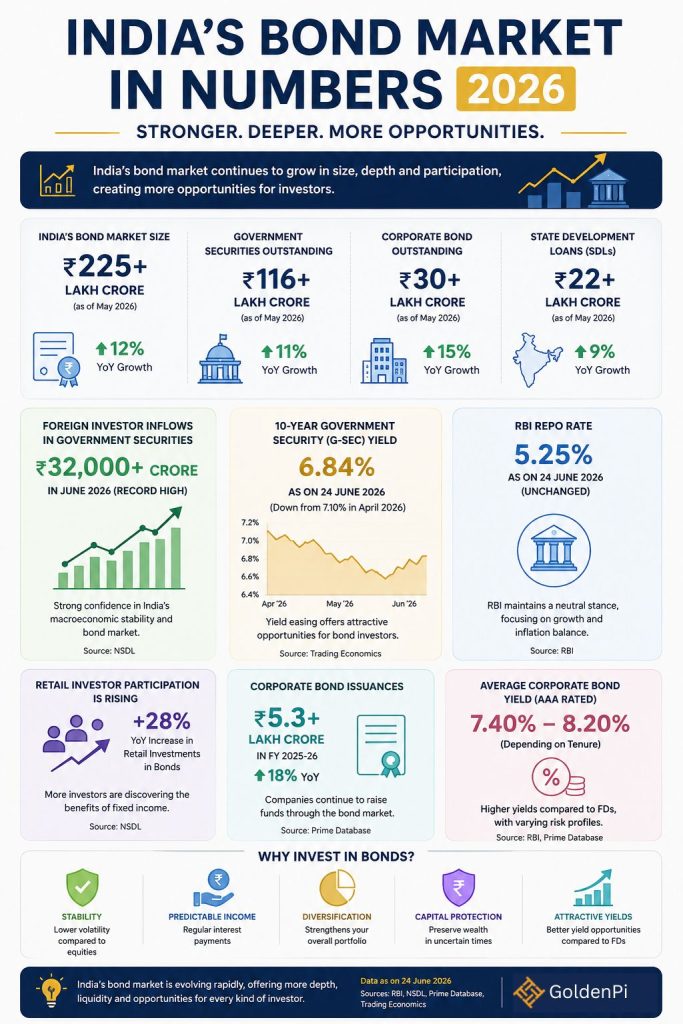
India’s bond market is having a remarkable year, and the numbers from June 2026 tell a story worth paying attention to. From record-breaking foreign inflows to a growing wave of retail investors stepping beyond fixed deposits, India’s fixed-income landscape is changing faster than most people realize. Whether you are a first-time investor or a seasoned portfolio manager, understanding what is happening in the bond market right now can help you make better financial decisions.
This guide breaks down the key trends shaping India’s bond market in June 2026, with clear context on what each number means for you.
Key Takeaways
- Market Deepening: The Indian bond market has surpassed ₹240 lakh crore, expanding issuer diversity and liquidity for investors across the board.
- Stable Rate Climate: The RBI holding the repo rate at 5.25% presents a beneficial window to lock in solid, predictable yields before the macro cycle eventually turns.
- Yield Softening: Increased international buying and lower crude costs have brought the 10-year G-Sec yield down to the 6.7% – 6.8% range, translating to capital gains for existing debt investors.
- Unprecedented Global Inflows: FPIs pumped a historic ₹39,640 crore into local debt papers this month alone; validation of India’s long-term global index potential.
- Corporate Resilience: Primary issuances continue to hit record peaks, with corporate India increasingly leveraging debt markets for capital expenditure as total corporate debt eyes a ₹100 trillion scale by FY 2030.
- Democratization of Bonds: Retail participation is undergoing a structural boom due to lower regulatory investment sizes (₹10,000) and friction-free mobile investment applications.
Start investing with just ₹10K & grow your wealth with fixed return opportunities.
Invest Now

1. India’s Bond Market Continues to Expand
India’s bond market has crossed a significant milestone. As of early 2026, the total size of the Indian debt market stands at approximately ₹240 lakh crore (around US$2.8 trillion).
To put that in perspective: the corporate bond segment alone now stands at ₹53.64 lakh crore (US$627 billion), making up about 22.51% of the total bond market (Source: National Institute of Securities Markets).
Why Market Size Matters to Investors
A larger bond market means the following:
- More choices: A wider array of investment options across maturities and asset profiles.
- Better liquidity: It becomes significantly easier to buy and sell bonds without causing massive price fluctuations.
- Greater price transparency: Deep markets ensure competitive, fair pricing for retail players.
When the market is deep, even individual investors benefit from competitive pricing and access to a wider range of instruments. The Indian bond market has witnessed significant growth of roughly 77% over the past five years, a trend driven by infrastructure spending, regulatory reforms, and growing investor awareness.
Key Takeaway: A larger bond market generally improves liquidity, issuer diversity, and investor choice—all good news for anyone looking to invest in fixed income.
2. RBI’s Interest Rate Decision and Its Impact
The Reserve Bank of India (RBI) is the central bank that sets the direction of interest rates in India. Its key policy tool is the repo rate, which is the rate at which it lends money to commercial banks.
In its Monetary Policy Committee (MPC) meeting held in June 2026, the RBI kept the repo rate unchanged at 5.25% and maintained a neutral policy stance while balancing inflation risks and growth concerns.
Why Did the RBI Hold Rates?
The decision was in line with market expectations, as geopolitical conflicts in the Middle East threatened GDP growth and fuelled inflationary pressures. Consequently, the RBI adjusted its projections:
- GDP Growth Forecast (FY2026-27): Lowered to 6.6% (from an earlier estimate of 6.9%).
- Projected Inflation: Raised to 5.1% (up from an earlier estimate of 4.6%) (Source: TRADING ECONOMICS).
Impact Across Financial Products
When the repo rate stays unchanged, borrowing costs across the economy remain stable. Home loan EMIs, fixed deposit interest rates, and corporate borrowing costs do not change immediately.
For bond investors, a hold in rates, especially after a rate-cutting cycle, can mean that bond prices remain stable and current yields stay attractive. The rate cycle that began with the December 2025 cut has been paused. How long that pause lasts depends almost entirely on how the West Asia situation evolves and what happens to crude oil prices over the coming months.
Investor Takeaway: Interest rate expectations continue to drive fixed-income strategy. With rates on hold, locking in current yields through bonds can be a sensible move for income-focused investors.
Recent Bond News:
- Beyond the Rupee: Decoding SEBI’s ‘Second Shelf’ for Global Bonds
- G-Sec STRIPS Explained: Zero-Coupon Sovereign Paper for Retail
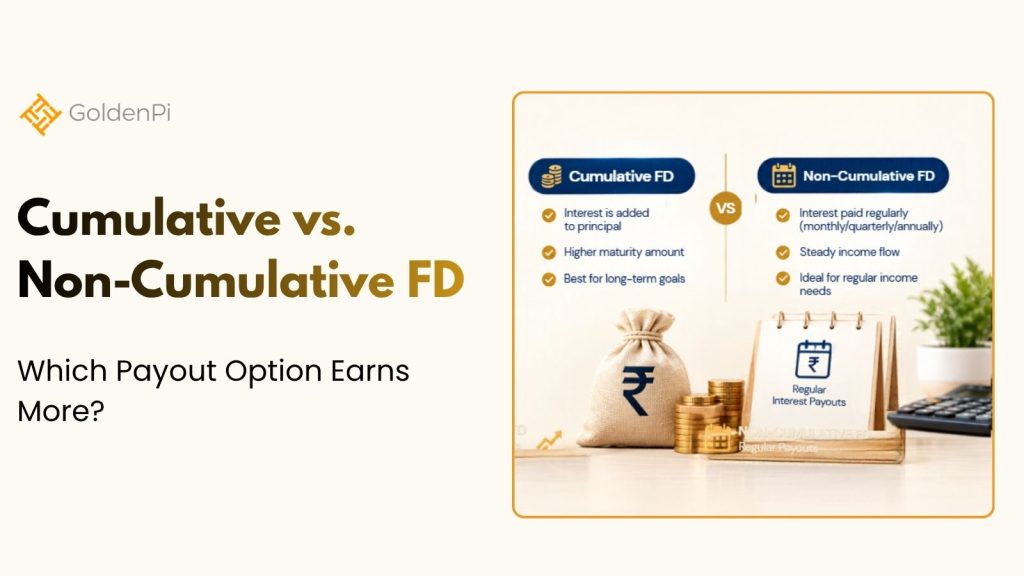
- Cumulative vs Non-Cumulative FD: Which Payout Option Earns More?
3. Bond Yields: What Investors Are Watching
If you have heard the phrase “bond yields are falling” and wondered what it means, here is the simple version: when a bond’s price goes up, its yield (the effective return you earn) goes down, and vice versa. They always move in opposite directions.
The 10-Year Government Security (G-Sec) yield is the benchmark number that the entire Indian fixed-income market watches. Think of it as the risk-free return set by the government, the baseline against which all other interest rates are measured.
India’s 10-year G-Sec yield fell to around 6.7% (its lowest level in thirteen weeks) as declining crude oil prices reduced inflation concerns and boosted demand for government securities. The benchmark yield extended its decline for a fourth straight session after Brent crude retreated to about $72 per barrel. Lower oil prices also supported foreign demand for Indian debt, with foreign portfolio investors purchasing a net ₹236 billion of government bonds in June (Source: TRADING ECONOMICS).
The 10-year benchmark G-Sec yield eased by 20 basis points since the measures were announced, closing at 6.76% according to CCIL data. In bond markets, falling yields signal rising prices, meaning existing bondholders have seen the value of their holdings appreciate even as new buyers continue to enter the market.
Why Yields Moved Lower in June 2026:
- Lower Oil Prices: Easing Brent crude rates structurally cooled domestic inflation fears.
- Record Foreign Buying: Aggressive overseas accumulation heavily pushed up bond demand.
- Dovish Central Bank Signals: The RBI governor indicated that further rate hikes are off the table for now.
When yields fall, bond prices rise, which benefits investors who already hold bonds. At around 6.7%-6.8%, the 10-year G-Sec yield remains highly competitive compared to most traditional savings and deposit products in a stable interest rate climate.
[Simple line chart recommended here: 10-Year G-Sec Yield movement from January 2026 to June 2026, showing the declining trend through June.]
4. Record Foreign Investment in Indian Bonds
One of the biggest stories in India’s bond market this month is the unprecedented surge in foreign investment.
Foreign Portfolio Investors (FPIs) channelled an all-time record of ₹39,640 crore (approximately $4.2 billion) into Indian government securities under the Fully Accessible Route (FAR) in June 2026. This smashed the previous record of ₹22,005 crore set in August 2024 by an astonishing margin of 80%.
What Triggered This Inflow?
The massive spike in demand followed key government policy updates announced on June 5, designed to make Indian sovereign debt highly lucrative for international portfolios:
- Tax Exemptions: The government granted sweeping tax exemptions on interest and capital gains for FPI investments in G-Secs, backdated to April 1, 2026.
- Expanded Bond Access: Authorities opened up a larger basket of securities under the FAR route, including longer-duration instruments (15-year, 30-year, and 40-year bonds) alongside Sovereign Green Bonds.
The Global Index Context
The broader catalyst remains India’s potential inclusion in Bloomberg’s Global Aggregate Bond Index. Market participants see these tax exemptions as the government’s explicit green light that it is clearing regulatory hurdles to make widespread index inclusion possible. Once fully integrated, global index-tracking funds will automatically be required to buy Indian bonds, bringing sustained capital inflows for years.
The immediate impact extended beyond debt markets. The Indian Rupee, which had dropped to a record low of 96.96 per dollar in late May 2026, witnessed a powerful recovery, appreciating to 94.40 by June 26.
Investor Takeaway: Growing foreign participation reflects deep institutional confidence in India’s macroeconomic stability. It structurally deepens domestic liquidity and keeps long-term yields healthily capped.
5. Corporate Bond Market Remains Strong
While government bonds dominate the ecosystem in absolute size, the corporate bond segment is where retail and institutional investors go to capture enhanced yields.
In FY 2025, 1,924 companies issued bonds, up from 1,659 in the previous financial year. This rise in issuances reflects robust demand from investors and companies increasingly choosing the debt market over traditional bank loans, often because it offers faster access to capital at more competitive corporate rates.
According to CRISIL Ratings, India’s corporate bond market is on track to nearly double, reaching around ₹100 trillion by FY 2030, supported by nationwide infrastructure financing needs, expanding NBFC activities, and public sector (PSU) borrowings.
Key Sectors Leading Issuances
- Infrastructure & Energy: Power Finance Corporation (PFC), NTPC, National Highways Authority of India (NHAI), and Indian Railway Finance Corporation (IRFC).
- Financial Services: Large-scale Non-Banking Financial Companies (NBFCs) serving retail, rural, and SME borrowers.
Corporate bonds continue to offer yields ranging from 7% to as high as 14%, depending tightly on the issuer’s credit rating and risk profile. AAA-rated PSU bonds sit at the conservative end of that range (offering yields similar to, or slightly above, G-Secs), while lower-rated corporate issuances scale higher up the chart to compensate for higher credit risk.
Credit Quality Reminder: When evaluating a corporate bond, always check its credit rating. AAA represents the absolute highest security (lowest default risk). Bonds rated below AA⁻ carry higher credit risk and are generally unsuited for strictly conservative portfolios.
6. Retail Investors Are Participating More
For decades, India’s bond market was the exclusive playground of banks, insurance firms, and mutual fund houses. That institutional barrier has finally broken down.
Retail participation in India’s corporate bond market has expanded through 2025 and 2026 across all investor categories. A mix of progressive technology, lower entry boundaries, and evolving asset preferences is driving this shift. Younger investors are increasingly looking past standard savings accounts and rigid fixed deposits. Digital investment portals have streamlined onboarding, KYC, bond discovery, and tracking for everyday savers.
The Three Drivers of Retail Growth
- Lower Entry Barriers: SEBI’s Online Bond Platform Provider (OBPP) framework slashed minimum investment ticket sizes down to ₹10,000 for public debt issues. Historically, participating required a pay-in of ₹10 lakh or more, locking out retail investors.
- Intuitive Fintech Platforms: Regulated Online Bond Platforms (OBPs) allow individual investors to browse, filter by rating, and buy corporate debt on their mobile phones exactly like purchasing equity shares or mutual funds.
- RBI Retail Direct: The central bank’s dedicated direct portal allows individuals to open accounts to bid directly on sovereign G-Secs, Treasury Bills, and State Development Loans (SDLs) with zero intermediary fees and direct sovereign safety backing.
This migration away from bank fixed deposits as the default choice for safe income marks a historic structural evolution in Indian household asset allocation.
7. Corporate Bonds vs Fixed Deposits vs Government Bonds: A Simple Comparison
If you are wondering how bonds compare to your existing fixed deposit, here is a clear side-by-side overview. Keep in mind that returns and risks vary significantly by issuer, credit rating, and tenure, so always do your own due diligence or consult a SEBI-registered advisor before investing.
| Feature | Fixed Deposit (Bank) | Government Bonds (G-Sec) | Corporate Bonds |
| Typical Yield (June 2026) | 6.5% – 7.5% p.a. | 6.7% – 7.1% p.a. | 7.0% – 14.0% p.a. |
| Liquidity | Low (Penalty charges apply on premature withdrawal) | Moderate (Secondary market tradeable via exchanges) | Moderate to High (Varies based on listing status) |
| Risk Profile | Very Low (Insured up to ₹5 lakh via DICGC) | Negligible (Backed by absolute sovereign guarantee) | Low to High (Entirely dependent on corporate credit rating) |
| Income Frequency | Monthly / Quarterly / On Maturity | Semi-annually (Standard for most G-Secs) | Monthly / Quarterly / Semi-annually / Annually |
| Taxation | Interest added to income and taxed as per individual slab | Interest added to income and taxed as per individual slab | Interest added to income and taxed as per individual slab |
| Minimum Investment | Typically ₹1,000 (Varies by bank) | ₹10,000 (Via RBI Retail Direct) | ₹10,000 (Via SEBI-regulated OBPP platforms) |
Important Safety Note: While bank FDs enjoy statutory protection up to ₹5 lakh per depositor via DICGC, and government bonds carry absolute sovereign default immunity, corporate bond safety rests entirely on the issuer’s credit score and financial health. Higher yields always reflect higher risk profiles.
8. What These Numbers Mean for You
How you digest the June 2026 market numbers depends completely on your unique investment timeline and financial goals:
- If you are a conservative investor or retiree, the current benchmark G-Sec yields around 6.7%–6.8% and offers excellent risk-adjusted protection in real terms. With the rate-hiking cycle paused, locking in these yields protects your capital. Government bonds and AAA-rated PSU papers offer institutional safety without compromising your income.
- If you are a young professional or new investor, this serves as a great entry window to introduce fixed income as an asset-allocation tool. Thanks to the accessible ₹10,000 platform rules, you can begin building a balanced profile without locking up immense capital.
- If you are strictly income-focused, regular monthly or quarterly payout bonds from highly rated NBFCs or corporate houses can act as excellent cash flow supplements. Always double-check the underlying credit rating first.
- If you are focused on long-term wealth building, the systematic inclusion of Indian sovereign debt into global indices like Bloomberg’s Global Aggregate Index could trigger notable capital gains through price appreciation in long-duration G-Secs over the coming 12–24 months. Positioning early allows you to harvest both stable yields and potential trading upside. Keep in mind that long-duration assets carry interest rate risk, making this route best suited for a 3–5 year investment horizon.
India’s Bond Market in June Frequently Asked Questions
Bond yields react dynamically to market supply and demand. When massive buyer interest emerges (such as the current wave of FPI inflows), bond prices rise, which pulls yields down. Conversely, if government borrowing expands heavily or inflation surges, investors demand higher yields as safety compensation. In June 2026, falling yields were driven by intense foreign buying and a cooling oil market.
The RBI’s repo rate acts as the baseline anchor for borrowing costs across the macroeconomy. When the central bank drops rates, older bonds with higher coupons become highly valuable, pushing their prices up and market yields down. When the RBI holds or hikes rates, yields flatten or rise. Anticipation of these policy pivots is often priced into the debt market weeks before the actual announcement.
It entirely depends on your capital objectives. FDs offer straightforward simplicity and carry statutory insurance up to ₹5 lakh per bank. Sovereign government bonds offer identical or superior yields with zero credit default risk. High-quality corporate bonds offer higher yield upside but require you to review the financial stability of the issuing firm. Furthermore, listed bonds offer exit liquidity on the stock exchange, whereas FDs typically penalise premature withdrawals.
Global portfolios are drawn to India due to highly competitive yield spreads relative to ageing Western markets, robust domestic GDP trajectories, newly backdated capital gains tax exemptions, and structural inclusion into mainstream global bond indices. This index inclusion creates automatic, passive institutional demand for years to come.
The 10-Year G-Sec yield represents the annualised return an investor receives for holding the government’s benchmark 10-year sovereign bond until maturity. It is universally treated as the ultimate “risk-free rate” in Indian finance since the government cannot default on debt issued in its domestic currency. All alternative commercial rates, such as corporate debentures, car loans, and FDs, are priced using this benchmark as a reference point.
While micro yields tick up and down daily based on fluid economic data points, crude prices, and interbank liquidity, broader macro trends (such as the structural path of interest rates or global investor flows) unfold progressively over months or years. Long-term investors should focus less on short-term market noise and more on locking in yield-to-maturity (YTM).
Conclusion
June 2026 marks a pivotal point for India’s bond market. Record foreign inflows, a stable rate environment, growing retail participation, and the prospect of Bloomberg index inclusion have all converged at once, creating conditions that fixed-income investors have rarely seen before.
Whether you are entirely new to bonds or looking to refine an existing portfolio, the data points to one clear message: India’s debt market is no longer just for institutions. It is open, growing, and increasingly accessible to everyone.
Ready to Invest?
Visit GoldenPi to explore current bond options. Compare yields, ratings, and tenures in one place and invest online with as little as ₹10,000.
Disclaimer:
Fixed returns do not constitute guaranteed or assured returns. Investments in corporate debt securities and municipal debt securities/securitized debt instruments are subject to credit risks, market risks, and default risks, including delay and/or default in payment. Read all the offer-related documents carefully. This blog/article should not be construed as financial advice or as an offer or recommendation to buy or sell any security or any products/services of/on GoldenPi or any product/services of its third-party client(s). For a detailed calculation of YTM, visit our website. T&C’s Apply.
(NOTE: All data points outlined in this guide are gathered from publicly verified market releases as of June 2026, including statistical reports from the RBI, CCIL, CRISIL, SEBI, and associated financial intelligence feeds. This brief is strictly for educational purposes and does not constitute formal financial or investment advice.)