
Ask ten financial advisors how much of your portfolio should be allocated to equities versus bonds, and you may have to deal with ten different answers. There really is no “right” number for the proper allocation, and it hinges on several factors, including what you are saving for, how much time you have to invest, and your tolerance for market volatility. This is the essence of goal-based asset allocation: rather than managing a single large portfolio for your entire wealth, you can manage small portfolios that are suitable for multiple goals and time horizons.
Start investing with just ₹10K & grow your wealth with fixed return opportunities.
Invest Now

Combine Bonds with Equities
Indian investors have been having a more challenging yet exciting time with this exercise lately. The RBI kept the repo rate at 5.25% in its August policy review and raised its FY27 GDP growth forecast to 6.7% while also lowering its inflation projection to 5.0%. Meanwhile, the 10-year G-Sec yield, which hit roughly 6.85% in July 2026 with higher crude prices and tighter banking system liquidity, has since come down to the 6.73 to 6.78% range in early August as the RBI’s dovish stance has supported buying of government debt.
On the equity front, the Nifty 50 index has produced 20-year annualized returns of around 11.1% (price return) to 12.4% (total return) as of early to mid-2026, a good reminder that even “long-term” equity returns show volatility through the measured period. Regardless, these changes do not impact the logic of goal-based allocation. They will, however, impact how you should view and implement it in the current environment.
Goal-Based Investing vs. Traditional Portfolio Planning: What’s the Difference
Many retail investors assign a single “risk profile” (aggressive, moderate, or conservative) to all the money they invest. While your down-payment fund that needs to be cleared in the next 18 months could be radically different from your retirement fund that needs to be cleared in the next 25 years, investors often treat them similarly. It could very well mean that your short-term goal gets locked in equity markets when they are the most volatile, or your long-term goal gets stuck in low-yielding debt.
Goal-based allocation resolves this issue by addressing three distinct questions for each goal:
- What is the goal’s time horizon? A goal that is 3 years away behaves completely differently from a goal that is 15 years away.
- What is the goal’s tolerance for risk? A drawdown (drop in your account or investment value from its highest point to its lowest point) of 20% on a wedding fund a month before the date is unfortunate, while a retirement fund built over 2 decades can absorb many such dips.
- Is the goal amount definite or flexible? School fees are definite and cannot be altered, while a vacation fund in a “nice-to-have” category has flexibility.
Latest Bond Updates:
- Beyond the Rupee: Decoding SEBI’s ‘Second Shelf’ for Global Bonds

- G-Sec STRIPS Explained: Zero-Coupon Sovereign Paper for Retail

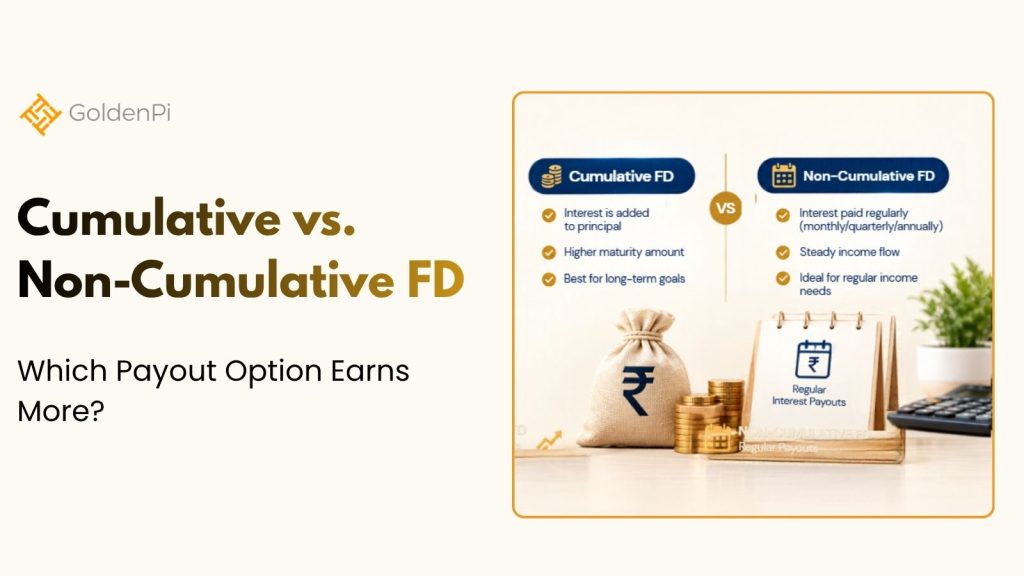
- Cumulative vs Non-Cumulative FD: Which Payout Option Earns More?
Equity vs. Debt Allocation by Time Horizon
The “100 minus age” rule is a simple way to determine your equity allocation. It works well for retirement portfolio management, but for goal-based planning, time horizon is more important than age. Here’s another way to approach it:
| Goal Horizon | Suggested Equity: Debt Mix | Typical Use Case | Why |
| 0–3 years | 10–20%: 80–90% | Emergency fund, upcoming wedding, near-term down payment | Equity volatility can wipe out 2-3 years of gains in a bad quarter; capital preservation matters more than growth |
| 3–7 years | 40–50%: 50–60% | Child’s higher education, car upgrade, home renovation | Enough time to ride out one full market cycle, but not enough to bet heavily on equity |
| 7–15 years | 60–75%: 25–40% | Child’s marriage, second home, mid-career sabbatical fund | A long enough horizon for equity’s compounding to dominate, with debt as a stabiliser |
| 15+ years | 75–90%: 10–25% | Retirement, long-term wealth creation | Time smooths out volatility, and equity has historically rewarded patience over 15+ year holding periods |
A simple example: If you wanted to save for your child’s engineering admission, which would cost maybe ₹25 lakhs, a monthly SIP of ₹12,000 – ₹13,000 might do the trick, assuming a blended return of 9-10 percent long term. Although the SIP amount and the final cost will vary based on market movements and performance, there is no guarantee of this cost.
Why You Still Need Bonds in a Rising Equity Market
When retail participation is high, there is a strong urge to opt for equity. However, SIP inflows hitting ₹31,961 crore in July is a good sign for the mutual fund industry, with the overall AUM at ₹85.75 lakh crore for the month, and SIP holdings for the month standing at 21.2% of the total. However, bonds are not the mere lower-return alternative to equity. Rather, equity gets beaten on the following three key fronts:
- Bonds can help lower portfolio volatility, so it helps avoid selling equities at a loss when there is a market crash and you need the money.
- When equities fall, bonds provide the capital to buy equity at a low price and vice versa.
- Lastly, bonds provide the opportunity to lock in a yield, which, with a 10-year G-Sec at 6.75-6.8%, the repo rate at 5.25% anchoring short-term rates, and coupled with the RBI’s expectation of 5% inflation for FY27, makes high-quality debt instruments an attractive option.
How Debt and Equity Fund Taxation Rules Impact Your Returns
Most Indian investors do not directly hold the ‘debt’ portion of a goal-based portfolio in the form of individual bonds. Rather, they use debt mutual funds. As a result, the tax rules that apply to fund units are just as important as the yield. After the 2023 reforms, debt fund units held for less than a year will attract short-term capital gains tax at the investor’s applicable income tax slab rate, with no indexation.
This has definitely influenced many investors to shift to hybrid funds, target-maturity funds, or even direct bonds, for their debt allocation. The rules on the equity side are simpler: LTCG above ₹1.25 lakh is taxed at 12.5% with no indexation, while STCG is taxed at 20% on gains held for less than 12 months. Not incorporating these in your allocation is like planning a road trip without knowing how much you’ll have to pay at the toll booths.
Rebalancing: The One Habit That Protects Your Long-Term Investment Goals
Getting the initial mix right is common advice. Markets drift. An equity rally can shift a 60/40 portfolio to 75/25 within a few years. Risk increases beyond what was expected. Consider reviewing your goal-based portfolios at least once a year and rebalancing when actual allocation drifts beyond 5% to 10% from the target. This is not just market timing; this is more about good portfolio hygiene.
Building Your Own Goal-Based Mix
There may not be a perfect equity/debt ratio that works for every Indian investor, and that is really what this framework hopes to achieve. The right mix for your child’s education fund in eight years versus your retirement corpus in 25 years will likely be very different, even if they reside in the same bank account.
Three key takeaways from this piece that should be carried forward:
- Start with your goal, not the current market sentiment, to guide your decisions. Current G-Sec yields and an equity rally are good inputs but should not take priority over your time horizon and risk capacity.
- Your portfolio should be reassessed at least annually. Of course, tax rules will also change over time (as seen with debt funds), but the fundamentals of a good portfolio construction remain constant.
- Don’t just take the asset class into consideration when deciding on the instrument; consider the goal as well. Two different debt instruments may be appropriate for two different goals. For example, a two-year goal may call for a liquid fund, while a fifteen-year goal may require a target date fund.
Goal-based allocations are not frameworks that you complete once and forget. Consider goal-based allocations as living, breathing frameworks. The more diligently you revisit it every year, the better the framework will represent your goals.
Frequently Asked Questions
Goal-based asset allocation means choosing the mix of investments based on a specific financial goal, its time horizon, and your ability to tolerate risk rather than using one allocation for every goal.
There is no universal ratio. The allocation should depend on factors such as your goal, investment horizon, income needs, and risk tolerance. Longer-term goals may generally accommodate more equities, while near-term goals may require a larger allocation to relatively stable assets.
Generally, high-quality bonds tend to have lower volatility than equities, but they are not risk-free. Bonds can carry credit, interest-rate, and liquidity risks, while equities carry market and business risks.
Yes. Many bonds provide scheduled interest payments, while equities offer the potential for capital appreciation and dividends. Combining the two can help create a portfolio with both income and growth components.
Not necessarily. The traditional 60:40 approach is only a reference point, not a rule. Indian investors should determine their allocation based on their financial goals, time horizon, risk tolerance, and cash-flow requirements.


