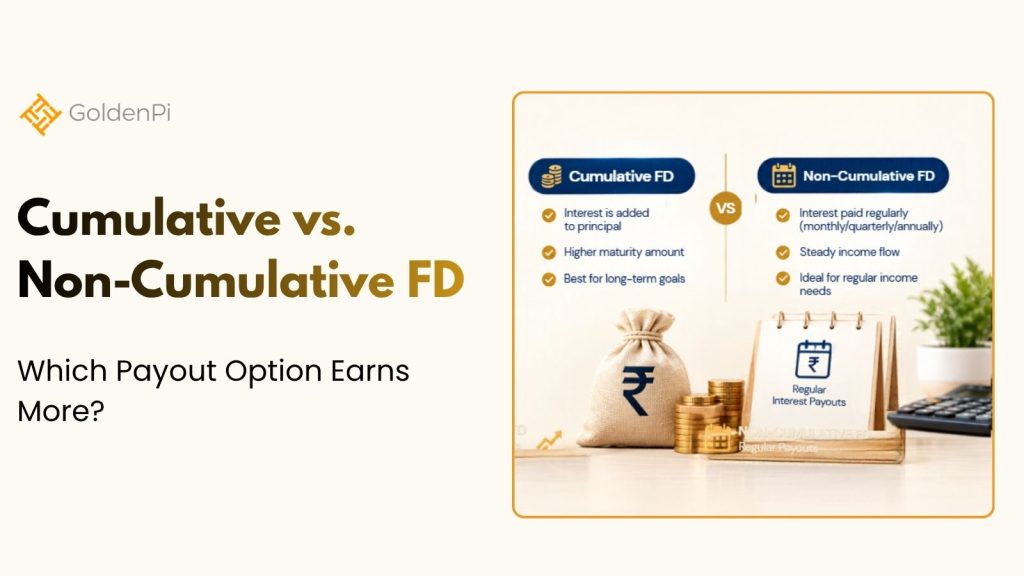
Choosing between a cumulative and non-cumulative fixed deposit looks like a small decision, but it decides how much money you finally take home. Both are bank FDs with the same safety profile. The difference is when you receive your interest: a cumulative FD pays it all at maturity, while a non-cumulative FD pays it out at regular intervals.
If you’re wondering which FD payout option earns more, the short answer is that cumulative usually wins on total returns, because your interest earns interest. But “earns more” isn’t always “suits you better.” Here’s how each works, where the numbers differ, and how to choose in today’s rate environment.
Start investing with just ₹10K & grow your wealth with fixed return opportunities.
Invest Now

How Cumulative and Non-Cumulative FDs Work
In a cumulative FD, interest isn’t paid out. It’s added to your principal, usually every quarter, and compounds. You get the principal plus all accumulated interest at maturity.
In a non-cumulative FD, the bank credits interest to your savings account at an interval you choose: monthly, quarterly, half-yearly, or annually. Your principal stays the same, so interest never compounds inside the FD.
Which Earns More? A Quick Example
Say you invest ₹10 lakh for five years at an illustrative 7% a year. Actual rates vary by bank and tenure.
| Feature | Cumulative FD | Non-Cumulative FD (quarterly payout) |
| Interest paid | At maturity | Every quarter |
| Compounding | Yes (quarterly) | No |
| Quarterly payout | None | About ₹17,500* |
| Total interest, 5 years | About ₹4.15 lakh | About ₹3.5 lakh |
| Amount at maturity | About ₹14.15 lakh | ₹10 lakh (plus payouts already received) |
| Effective annual yield | About 7.19% | About 7% |
*Banks often discount periodic payouts slightly, so your actual credit may be a little lower.
Cumulative earns roughly ₹65,000 more over five years, and the gap widens with longer tenures and higher rates.
There’s a catch, though. Non-cumulative only looks weaker if you spend or park the payouts. Reinvest each one at a similar rate, and the gap narrows. Leave it in a savings account paying roughly 2.5-4%, and compounding inside the FD pulls clearly ahead.
Taxation
FD interest in India is taxed at your slab rate as “income from other sources.” Here’s how the two types differ:
- Cumulative FDs: Interest accrues every year and is taxable annually, even though you receive nothing until maturity. Banks generally deduct TDS on this accrued interest too.
- Non-cumulative FDs: Interest is taxed in the year it’s received, which is simpler to track.
- TDS threshold: Banks deduct 10% TDS once interest at a bank crosses ₹50,000 in a year (₹1 lakh for senior citizens). Confirm the current limits with your bank.
- Form 121 (earlier Forms 15G/15H): If your total income is below the taxable limit, you can submit Form 121 to your bank to avoid TDS on FD interest. It replaces the old Forms 15G (under 60) and 15H (seniors) with a single declaration. The interest is still reportable in your return.
For someone in the 30% slab, a 7% FD yields roughly 4.8% after tax and cess. Compounding matters a little less in real terms, but it doesn’t disappear.
Latest Bond Updates:
- Cumulative vs Non-Cumulative FD: Which Payout Option Earns More?
- Sweep-In FD Explained: How Auto-Sweep Accounts Work in India

- RBI Hikes Repo Rate to 5.50%: Calibrated Tightening, Forecasts & What Comes Next

When a Cumulative FD Makes Sense
- You don’t need the interest for monthly expenses
- You’re saving for a dated goal, such as school fees, a down payment, or a wedding
- You want growth without the effort of reinvesting
- You’re in a lower tax bracket, so annual accrual tax hurts less
When a Non-Cumulative FD Makes Sense
- You’re retired and need predictable monthly or quarterly income
- You want interest to cover a recurring cost, like rent or an EMI
- You prefer to keep the principal untouched and see steady cash flow
A practical split: a retired couple with ₹30 lakh might put part in non-cumulative FDs for income and the rest in cumulative to stay ahead of inflation.
What Today’s Interest Rate Scene Means for Your Choice
The RBI’s repo rate is 5.25%, and the Monetary Policy Committee announces its next decision on 7 October 2026. Forecasts are mixed. Some analysts expect a hold, while an SBI Research report has flagged a possible hike. Nobody knows until the announcement, so check the outcome before you lock in.
- If rates may rise, consider shorter tenures or laddering across maturities, so you can reinvest at better rates.
- If rates may fall, a longer cumulative FD locks in today’s rate and compounds it.
- New RBI deposit rules from 1 October 2026 require banks to publish their rate schedules and follow them, with uniform FD rates across branches. As reported, the rules don’t set rates, and your existing FD’s contracted rate stays unchanged. They do make comparing banks easier.
Remember that deposit insurance covers up to ₹5 lakh per depositor per bank (principal and interest combined), so spread larger sums across banks.
The Bottom Line
If your goal is growth, the cumulative FD earns more. If you need regular income, the non-cumulative FD earns less in total but pays when you need it. Choose based on what the money is for, not just the maturity figure.
Before booking, compare rates across a few banks, work out your post-tax return, and check the payout options. A small difference in rate or frequency can add up over five years.
Cumulative vs Non Cumulative FD FAQ
A cumulative FD does not pay interest periodically. Instead, the interest is accumulated and paid along with the principal at maturity. The exact compounding frequency depends on the bank’s terms.
A non-cumulative FD pays interest periodically instead of accumulating it until maturity. Banks may offer monthly, quarterly, half-yearly, or annual interest payouts, depending on the product.
The interest is retained in the deposit and compounded according to the bank’s FD terms. This allows previously earned interest to generate additional interest during the remaining tenure.
A cumulative FD generally has a larger maturity amount because interest remains invested and compounds. A non-cumulative FD generally returns the original principal at maturity, with the interest already paid out during the tenure.
The underlying TDS rules apply to eligible bank-deposit interest rather than simply to whether the FD is cumulative or non-cumulative. Banks may deduct TDS when the applicable threshold is crossed.
A non-cumulative FD with a monthly payout is generally more suitable when your priority is regular cash flow rather than maximizing the maturity amount.
A cumulative FD may be more suitable when the objective is to leave the interest invested and maximize the maturity proceeds, assuming comparable rates, tenure and terms.
Disclaimer
Fixed returns do not constitute guaranteed or assured returns. Investments in corporate debt securities and municipal debt securities/securitized debt instruments are subject to credit risks, market risks, and default risks, including delay and/or default in payment. Read all the offer-related documents carefully. This blog/article should not be construed as financial advice or as an offer or recommendation to buy or sell any security or any products/services of/on GoldenPi or any product/services of its third-party client(s). For a detailed calculation of YTM, visit our website. T&C’s Apply.