
The RBI policy December 2026 decision can take one of three forms: a pause, a 25 basis point hike, or a bigger hike. The Monetary Policy Committee (MPC) of the Reserve Bank of India meets from 2 to 4 December 2026. Each outcome affects bond prices and the interest rates on new bonds in a different way.
Key Takeaways
- The MPC meets from 2 to 4 December 2026.
- The repo rate is now 5.50%.
- The RBI has said that a rate cut is off the table in the near term.
- When interest rates rise, the prices of existing fixed-rate bonds usually fall.
- Bonds with a longer duration move more in price than bonds with a shorter duration.
Start investing with just ₹30K & grow your wealth with fixed return opportunities.
Invest Now

What Is the RBI Policy December 2026 Meeting About?
The RBI policy December 2026 meeting is a scheduled meeting of the MPC. The MPC is a six-member committee that sets the repo rate. The repo rate is the interest rate at which the RBI lends money to banks for a short time. When the repo rate changes, other interest rates in the economy usually move in the same direction.
The MPC meets six times a year. At each meeting, it looks at inflation, economic growth and global conditions. Inflation is the rate at which prices of goods and services rise. The RBI aims to keep consumer price inflation close to 4%.
Where Do Interest Rates Stand Before the December Meeting?
The repo rate stands at 5.50% before the December meeting. The MPC raised it by 25 basis points, from 5.25%, at its last meeting. A basis point is one hundredth of a percentage point, so 25 basis points equal 0.25%.
[IMAGE: Simple bar showing the repo rate at 5.50% with the SDF rate at 5.25% below it and the MSF rate at 5.75% above it. Alt text: “RBI policy rate corridor with repo rate at 5.50 percent”]
The table below shows the main policy rates, as given in the RBI resolution.
| Rate | Level now | What it means |
|---|---|---|
| Repo rate | 5.50% | Rate at which the RBI lends to banks |
| Standing Deposit Facility (SDF) rate | 5.25% | Rate the RBI pays when banks park extra money with it |
| Marginal Standing Facility (MSF) rate | 5.75% | Rate for emergency borrowing by banks |
At that meeting, the MPC also changed its stance to “calibrated tightening”. A stance is the direction the RBI expects to follow in the coming months. Calibrated tightening means the RBI may raise rates further, in careful steps, if needed. All six members voted for the hike. Four of the six members voted for the new stance.
Why Did the RBI Raise the Repo Rate?
The RBI raised the repo rate because it expects inflation to rise above its 4% target. The RBI projects consumer price inflation at 5.2% for 2026-27. It expects inflation of 6.0% in the October to December quarter.
The RBI resolution names several reasons for higher prices:
- Conflict in West Asia and changes in crude oil prices.
- A weak south-west monsoon, which can push up food prices.
- A weaker rupee, which makes imports more expensive.
- Higher interest rates and bond yields in other countries.
The RBI also projects real GDP growth of 7.1% for 2026-27. Strong growth gives the RBI room to raise rates without a large risk to the economy.
What Are the Three Possible Outcomes of the RBI Policy December 2026 Meeting?
The December meeting has three possible outcomes: a pause, a 25 basis point hike, or a hike of more than 25 basis points. The RBI has said that a rate cut is off the table in the near term. So a cut is not one of the three outcomes.
[IMAGE: Three side-by-side boxes labelled Pause, 25 basis point hike and Bigger hike, each showing the repo rate after the decision. Alt text: “Three possible outcomes of the RBI December 2026 policy meeting”]
| Outcome | Repo rate after | Likely effect on bond yields | Likely effect on existing fixed-rate bond prices |
|---|---|---|---|
| Pause | 5.50% | Small change, unless the stance changes | Small change |
| 25 basis point hike | 5.75% | Yields may rise | Prices may fall a little |
| Hike of more than 25 basis points | Above 5.75% | Yields may rise more | Prices may fall more |
These effects are general patterns, not certain results. Bond yields also respond to the RBI’s comments, to inflation data and to global markets. Markets often move before a meeting if they expect a hike.
Latest Bond Updates:
- Muthoot Bonds: Latest Muthoot Fincorp, Mcred and Capital Bonds Available in 2026

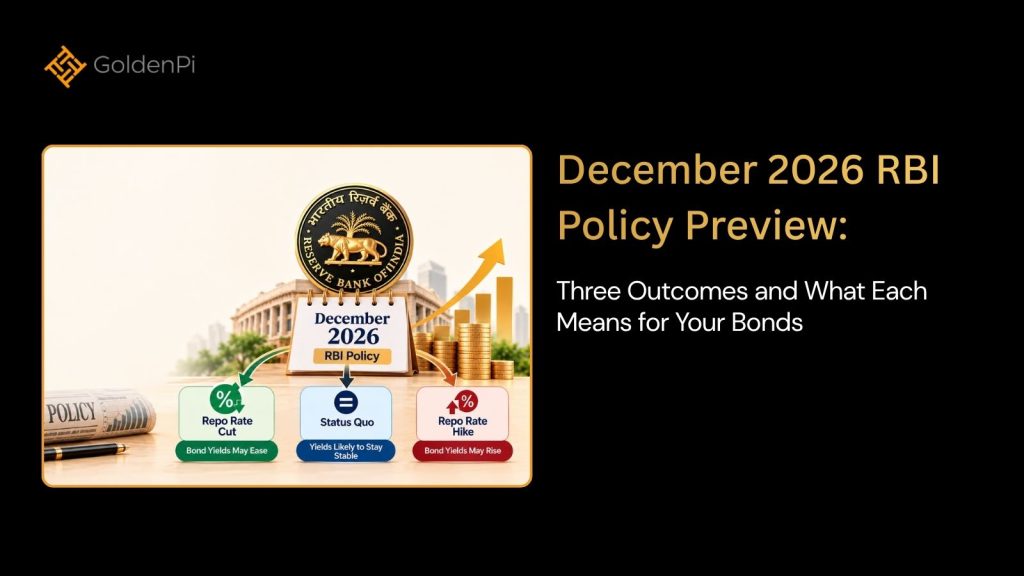
- December 2026 RBI Policy Preview: Three Outcomes and What Each Means for Your Bonds
- Diwali Portfolio Review 2026: Should You Rebalance Your Fixed Income Allocation?

Outcome 1: A Pause
A pause means the MPC keeps the repo rate at 5.50%. A pause gives the RBI time to see the effect of its last hike. If the MPC pauses but keeps the “calibrated tightening” stance, markets may still expect a hike later. In that case, bond yields may not fall much.
Outcome 2: A 25 Basis Point Hike
A 25 basis point hike would take the repo rate to 5.75%. Many market watchers had expected hikes at the October and December meetings. If markets already expect this hike, much of the effect may already be in bond prices before the decision.
Outcome 3: A Hike of More Than 25 Basis Points
A bigger hike, such as 50 basis points, would take the repo rate to 6.00%. A move of this size would usually signal greater concern about inflation. Bond yields could rise more sharply, and prices of long-term bonds could fall more.
How Would the December Decision Affect Bond Prices?
A rise in the repo rate usually pushes bond yields up and bond prices down. Bond prices and yields move in opposite directions. When new bonds offer higher interest, older bonds with lower fixed interest become less attractive. Their price falls until their yield matches the market.
[IMAGE: Seesaw diagram with bond price on one side and bond yield on the other, showing that when yield goes up, price goes down. Alt text: “Bond prices fall when bond yields rise”]
Duration measures how much a bond’s price changes when yields change. Modified duration gives the approximate percentage change in price for a 1 percentage point change in yield. A bond with a longer maturity usually has a higher duration. This guide to duration risk and the yield curve explains this in more detail.
Price Change for Each Outcome
The example below shows how each outcome could affect a bond. It is for illustration only. It takes a bond with a market value of ₹1,00,000. It compares a bond with a modified duration of 2 and a bond with a modified duration of 6. It assumes that the bond’s yield moves by the same amount as the repo rate.
| Outcome | Assumed yield change | Duration 2: approximate price change | Duration 6: approximate price change |
|---|---|---|---|
| Pause | 0 | ₹0 | ₹0 |
| 25 basis point hike | +0.25% | -₹500 | -₹1,500 |
| 50 basis point hike | +0.50% | -₹1,000 | -₹3,000 |
The formula is: price change ≈ market value × modified duration × change in yield. For example, ₹1,00,000 × 6 × 0.25% = ₹1,500. In practice, bond yields do not always move by the same amount as the repo rate.
What Does the December Decision Mean for Existing and New Bonds?
A rate hike affects bonds that investors already hold and new bonds in different ways. For existing bonds, the effect is on price. For new bonds, the effect is on the interest rate offered.
- Existing fixed-rate bonds: the coupon (the fixed interest paid on the bond) does not change. If the investor holds the bond until maturity, the payments stay as promised. This is true only if the issuer pays on time. The price change matters only if the investor sells before maturity.
- New bonds: after a hike, new bonds are often issued with higher coupons. This happens because issuers must match the higher market rates.
- Floating rate bonds: a floating rate bond is a bond whose coupon changes at fixed intervals. The new coupon follows a benchmark rate. If the benchmark rises after a hike, the coupon also rises at the next reset.
This article on when investors sell a bond before maturity lists other reasons for an early sale.
What Is the Bond Market Outlook for December 2026?
The bond market outlook in December depends mostly on two things: the MPC decision and the RBI’s comments. The RBI has said that its next step can only be a rate hike or a pause. This guidance usually keeps bond yields from falling much in the short term.
Other factors can also move bond yields in December:
- New inflation data, especially food and fuel prices.
- Crude oil prices and the value of the rupee.
- Interest rates and bond yields in the United States and other large economies.
- The government’s borrowing plan.
No one can predict these factors with certainty. The yield to maturity of a bond at the time of purchase already reflects the market’s view on rates.
What Are the Risks for Bond Investors Around the December Meeting?
The main risk around the December meeting is interest-rate risk. Interest-rate risk is the chance that bond prices fall because market interest rates rise. Bonds also carry other risks that a policy decision does not remove.
- Interest-rate risk: a bigger hike than expected could cause a sharp fall in the prices of long-duration bonds.
- Reinvestment risk: if rates fall later, interest received may have to be reinvested at a lower rate.
- Credit risk: higher interest rates raise borrowing costs for companies. This can weaken weaker issuers and lead to rating downgrades.
- Liquidity risk: some bonds trade rarely. Selling them soon after a rate move may require a lower price.
- Default risk: an issuer may fail to pay interest or principal on time.
Returns from bonds are not guaranteed. All bonds carry credit, interest-rate, liquidity and default risk.
What Do Bond Investors Usually Check Before the December Meeting?
Bond investors usually review a few details of their bonds before the December meeting. These checks help them understand how a decision may affect their holdings. Any decision depends on each investor’s goals, risk appetite and tax situation.
- The modified duration of each bond.
- Whether each bond has a fixed or a floating coupon.
- The maturity date and whether the plan is to hold until maturity.
- The credit rating of each issuer and any recent rating change.
- The yield to maturity of new bonds compared with existing holdings.
Bond listings on GoldenPi show the rating, yield to maturity, tenure and payout frequency for each bond. An earlier analysis of the RBI decision to hold the repo rate at 5.25% shows how bond markets read a pause.
December 2026 RBI Policy Preview FAQs
The next RBI interest rate decision comes at the end of the MPC meeting from 2 to 4 December 2026. The repo rate is now 5.50%. The RBI has said that its next step can only be a hike or a pause. The MPC announces its decision in a resolution published on the RBI website.
Calibrated tightening is the RBI’s current policy stance. It means the RBI is ready to raise interest rates further, but in small and careful steps. The pace depends on new data on inflation and growth. Under this stance, a rate cut is unlikely in the near term. The RBI adopted this stance when it raised the repo rate to 5.50%.
Bond prices usually fall when the repo rate rises, because bond yields tend to rise with it. Bond prices and yields move in opposite directions. The size of the fall depends on the bond’s duration. Long-duration bonds fall more than short-duration bonds. Investors who hold a bond until maturity still receive the promised payments if the issuer does not default.
The interest on an existing fixed-rate bond does not change after a repo rate hike. The coupon is fixed when the bond is issued. Only the market price of the bond changes. The interest on a floating rate bond can change. Its coupon resets at fixed intervals using a benchmark rate, which may rise after a hike.
The current repo rate in India is 5.50%. The MPC raised it by 25 basis points, from 5.25%, at its last meeting. The Standing Deposit Facility rate is 5.25% and the Marginal Standing Facility rate is 5.75%. The rate after December will depend on the MPC decision at the meeting from 2 to 4 December.
The RBI has said that rate cuts are off the table in the near term. The minutes of the last MPC meeting say the next step can only be a hike or a pause. Inflation is projected at 6.0% in the October to December quarter, above the RBI’s 4% target. This makes a cut at the December meeting unlikely.


