If you have a bond maturing in 2026, you won’t just receive payment. You’ll have to decide what to do with it. In India, most people view a bond maturity as a passive event. Once your payment lands in your bank account, cash loses value due to inflation, and the interest your money earns is negligible.
However, with the RBI keeping the repo rate unchanged at 5.25% and the yield for the 10-year G-Sec remaining around 6.7%-6.85%, this environment is a great opportunity to reinvest your maturity proceeds. Whether your maturing bond was a corporate NCD, government bond, or tax-free PSU bond, this article provides a checklist for consideration on how and where to reinvest so that your money doesn’t sit idly.
Start investing with just ₹10K & grow your wealth with fixed return opportunities.
Invest Now

Step 1: Confirm the Maturity Payout and Tax Treatment First
Money decisions require informed decisions. Here’s what you should know first:
- TDS Check: From April 2023, the exemption for listed bonds/NCDs held in demat form is no longer available. Now, TDS at 10% will be collected on the interest income, irrespective of the form the bond takes (physical vs. demat). However, a TDS exception will be provided if your interest income from a single issuer does not exceed ₹10,000 in a financial year, effective from April 2025.
- Classification of Capital Gains: Capital gains from listed bonds held for more than 12 months will be treated as Long-Term Capital Gains (LTCG) and taxed at 12.5% without indexation. Contrarily, if gains from selling unlisted bonds/debentures are held for a period shorter than 12 months, they will be treated as Short-Term Capital Gains (STCG) and taxed as per the applicable slab rate. The same treatment will be applicable for debt funds, meaning your bond and debt fund will likely not be taxed in the same way.
A quick call to your tax advisor or a look at the Income Tax Department’s capital gains guidance is worth the ten minutes.
Step 2: Compare Today’s Reinvestment Options
Here’s where the real decision-making happens. As of August 2026, here’s how the major fixed-income options in India stack up:
| Instrument | Current Indicative Rate | Lock-in | Best Suited For |
| Bank FD (regular, 3–5 yr) | 6.3–6.8% | Flexible, penalty on early exit | Safety-first investors |
| Senior Citizen FD | Up to 7.25–7.30% (Axis, Kotak) | Same as above | Retirees, regular income |
| Small Finance Bank FD | Up to 8.50% (e.g., Shivalik SFB) | Fixed | Higher yield seekers, DICGC-aware investors |
| PPF | 7.1% | 15 years | Tax-free, long-term goals |
| NSC | 7.7% | 5 years | Tax savings under 80C |
| SCSS (Senior Citizens) | 8.2% | 5 years | Retirees over 60 |
| 10-yr G-Sec (via RBI Retail Direct) | 6.7–6.85% | Market-linked, tradable | Long-term, low-risk portfolios |
| Corporate Bonds/NCDs (AA and above) | 7.5–9%+ depending on rating | Varies | Investors comfortable with credit risk |
| Tax-Free Bonds (NHAI, PFC, REC, secondary market) | 4.5–5.5% YTM (tax-free) | Varies (remaining tenure of old issues) | Investors in 30% tax bracket seeking post-tax efficiency |
Note: Rates as of early August 2026; banks and schemes revise these periodically, so always check current rate cards before investing.
Latest Bond Updates:
- G-Sec STRIPS Explained: Zero-Coupon Sovereign Paper for Retail
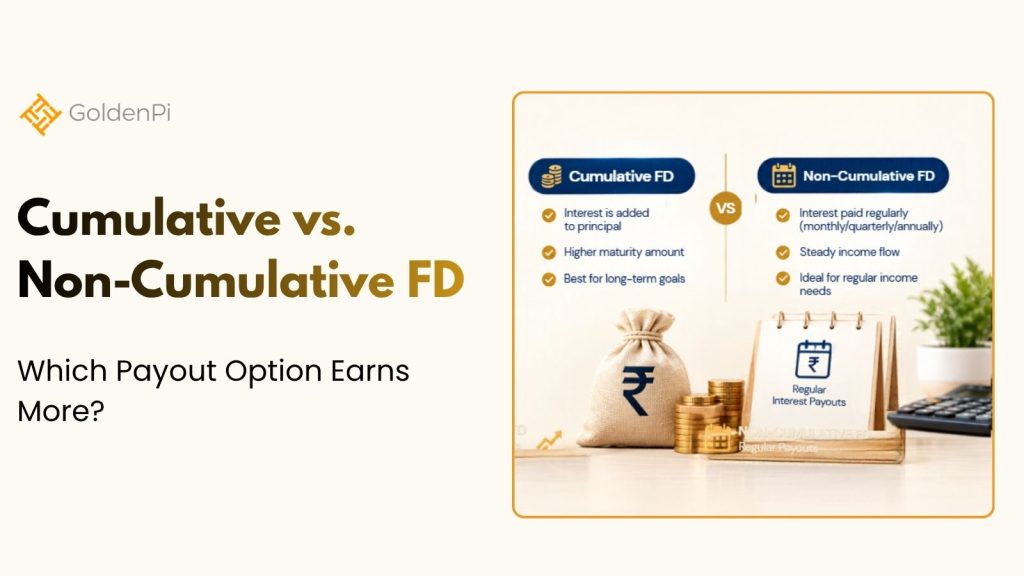
- Cumulative vs Non-Cumulative FD: Which Payout Option Earns More?
- Callable vs Non-Callable FDs: Why Non-Callable Deposits Pay More

A simple example: Consider an individual falling in the 30% tax bracket. A 5% tax-free bond would give a return equivalent to an approximate 7.1% taxable return. This would be greater than what one would get from a regular bank fixed deposit once the tax is taken into account. However, these bonds have not had a new issuance since FY2015-16. You are only buying old paper on NSE/BSE, and often at a premium to the face value. The YTM (not the coupon) is what you should look at.
Step 3: Factor In the Interest Rate Direction
The RBI kept rates unchanged for a fourth straight meeting in August 2026 while keeping a neutral stance and raising the GDP growth estimate for FY27 to 6.7% and cutting the inflation projection to 5.0%. This is relevant for the timing of your reinvestment. Suppose rate cuts happen in the later part of this cycle, then it would make sense to lock in the FD or bond yields at the current levels, since new deposits would be offered at lower yields. On the other hand, if you had reinvested in a floating rate instrument or a short-tenure FD, then you would have the chance to reinvest at a lower rate in the future.
Step 4: Match the Instrument to Your Goal, Not Just the Rate
Do not blindly aim for the highest number on the table. Consider:
- Liquidity timing: Will your funds be required in 2 to 3 years or maybe 10 years from now?
- Credit risk appetite: Smaller finance banks and lower-rated NCDs will pay more but carry a higher risk of default; analysis of ratings from CRISIL or ICRA is a must.
- Tax efficiency: PPF and SCSS-linked exemptions will be of more value to taxpayers in the higher brackets than taxable FDs.
- Diversification: You can reduce credit risk and the risk of reinvestment by spreading the proceeds from the maturities over 2 to 3 different instruments.
Step 5: Don’t Let the Money Sit Idle
Leaving money idle is the most common (and expensive) mistake. Even if funds are kept for a mere few months in a savings account that earns 3%, as compared to an FD that earns 7%, the difference is huge, especially for higher amounts. If you are in a situation where you don’t have a long-term funding option, you can cover the gap with an ultra-short-term FD or a liquid fund.
Final Word: Treat Maturity as a Reinvestment Trigger, Not an Afterthought
Thinking of a maturing bond as an opportunity to rebalance is excellent because you’re not selling anything to take a loss or worry about raising cash. Instead, you are deciding where you will be placing your idle funds. Check off the items on your list: confirm the tax implications, evaluate current rates on fixed deposits (FDs), small savings schemes, and bonds, consider where the rate trend is heading, and fit the instrument with your goal rather than picking the highest offered rate.
Do this within a few weeks around the maturity date, and you will have transformed what was once an uneventful payout into an actual useful decision on your portfolio, instead of some lakhs quietly gathering dust in a low-interest savings account.
Frequently Asked Questions
At maturity, the issuer is expected to repay the bond’s principal to the investor according to the terms of the issue. Any final interest payment is generally paid as specified in the bond documents.
For Demat-held bonds, the principal and applicable interest are generally credited to the bank account registered with the investor’s Demat or bond account, subject to the issuer’s payment process.
Compare current yields, credit quality, maturity, liquidity, interest-rate risk, tax implications, and your investment horizon. Avoid choosing a new bond solely because it offers a similar coupon to your previous investment.
Reinvestment risk is the possibility that, when a bond matures, you may have to invest the proceeds at a lower interest rate than the yield you previously earned.
Not necessarily. Staggering investments across different maturities can reduce timing risk and create a bond ladder that provides periodic liquidity.
Repayment of the original principal is generally not itself taxable as income. However, interest and any applicable capital gains may have tax implications depending on the bond and transaction.
Disclaimer
Fixed returns do not constitute guaranteed or assured returns. Investments in corporate debt securities and municipal debt securities/securitized debt instruments are subject to credit risks, market risks, and default risks, including delay and/or default in payment. Read all the offer-related documents carefully. This blog/article should not be construed as financial advice or as an offer or recommendation to buy or sell any security or any products/services of/on GoldenPi or any product/services of its third-party client(s). For a detailed calculation of YTM, visit our website. T&C’s Apply.