Key Takeaways
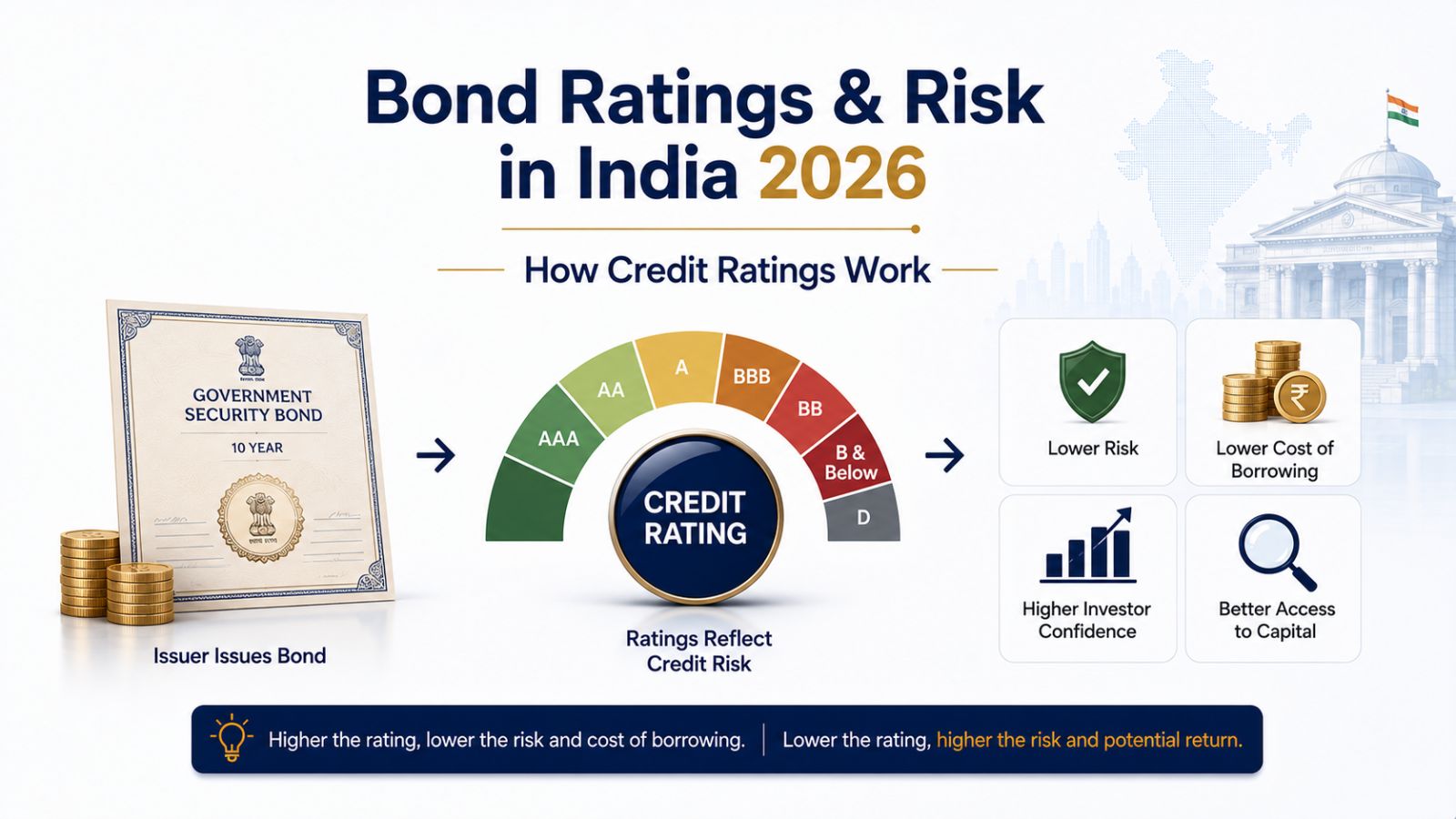
- The Indian Landscape: India has 7 SEBI-registered credit rating agencies, and they all use a standardized AAA-to-D scale.
- The Risk-Reward Tradeoff: AAA-rated bonds generally offer 7% to 8.5% yields, while A-rated bonds offer 10% to 12%+. This difference (called the yield spread) is your compensation for taking on higher risk.
- Not an Absolute Guarantee: Ratings are opinions, not promises. Historic failures like IL&FS, DHFL, and Reliance Capital were all rated high-safety “investment grade” shortly before they collapsed.
- The Central Bank Effect: The Reserve Bank of India’s (RBI) repo rate decisions directly impact bond risk. When the RBI cuts interest rates, existing bond prices generally rise, and borrowing costs drop, reducing default risk for bond issuers.
- Diversification is Key: Retail investors should spread their money across 3 to 5 bonds of varying ratings and sectors, rather than going all in on a single rating basket.
In 2018, IL&FS (once rated AAA (the highest possible safety grade) by ICRA) defaulted on ₹91,000 crore of debt, wiping out thousands of everyday investors who trusted credit ratings blindly without understanding what they actually measure.
For many retail investors, fixed-income products like bonds seem like a simple choice. However, a common mistake is either ignoring ratings entirely to chase the highest yields or trusting high ratings blindly without looking at the bigger picture. This comprehensive guide is designed to solve that problem. It will teach you how to read, interpret, and use bond ratings to make smarter investment decisions.
In India, credit rating agencies, such as CRISIL, ICRA, CARE, and India Ratings, assign letter grades from AAA down to D. These grades directly determine the interest rates (yields), trading prices, and risk levels of every bond you buy.
In this guide, you will learn how India’s credit rating system works, what each rating grade means for your money, how repo rate changes impact bond risk, and how to build a risk-adjusted bond portfolio using ratings as one of your tools.
How Credit Ratings Work
Rating agencies evaluate the issuer’s historical financial performance, debt protection metrics (like interest coverage ratio), and default history. They classify bonds into two primary tiers:
- Investment Grade (AAA to BBB): Issued by well-established corporations or government-backed entities with low credit risk. These offer steady, though relatively lower, returns (approx. 6% – 8%).
- High-Yield or Non-Investment Grade (BB to D): Also known as “junk” bonds, these carry higher credit risk but compensate investors with greater yields to justify the probability of default
What Are Bond Credit Ratings in India?
Bond credit ratings are independent assessments of an issuer’s financial ability to repay its borrowed debt (principal and interest payments) on time. They are assigned by specialized, SEBI-registered rating companies like CRISIL, ICRA, and CARE.
The rating scale ranges from AAA (representing maximum safety and lowest yield) down to D (representing actual default). While credit ratings help investors quickly evaluate how likely a company is to default on its obligations, they should never be used in isolation. To stay safe, you must combine them with your own research on the company’s industry, its cash flow, and the broader interest rate environment.
What Are Credit Rating Agencies in India and Why Do They Matter for Bond Investors?
Credit rating agencies in India are SEBI-registered organizations that independently assess an issuer’s ability to repay its bond obligations—giving investors a shorthand measure of default risk.
Without these agencies, everyday retail investors would suffer from “information asymmetry,” which is a situation where companies know everything about their own financial health, but public investors are left guessing. Evaluating a corporate issuer’s balance sheet, cash flows, debt obligations, and industry pressures takes immense financial expertise and time. Rating agencies solve this by doing the heavy analytical lifting and boiling down complex corporate data into a single, easy-to-understand letter grade.
The 7 SEBI-Registered Credit Rating Agencies
| Agency | Full Name | Promoted / Owned By | Market Share (Approx.) | Official Website |
| CRISIL | CRISIL Ratings Limited | S&P Global (Sovereign & Poor’s) | 38% | crisilratings.com |
| ICRA | ICRA Limited | Moody’s Investors Service | 28% | icra.in |
| CARE | CARE Ratings Limited | Promoted by IDBI, Canara Bank & other FIs | 22% | careratings.com |
| India Ratings | India Ratings and Research Pvt. Ltd. | Fitch Group | 8% | indiaratings.co.in |
| Acuité | Acuité Ratings & Research Limited | SIDBI, Dun & Bradstreet, and Public Banks | 2% | acuite.in |
| Brickwork | Brickwork Ratings India Private Limited | Canara Bank (Founding Backer) | 1.5% | brickworkratings.com |
| Infomerics | Infomerics Valuation and Rating Pvt. Ltd. | Promoted by veteran bankers and finance experts | 0.5% | infomerics.com |
How Ratings Are Assigned: From Request to Publication
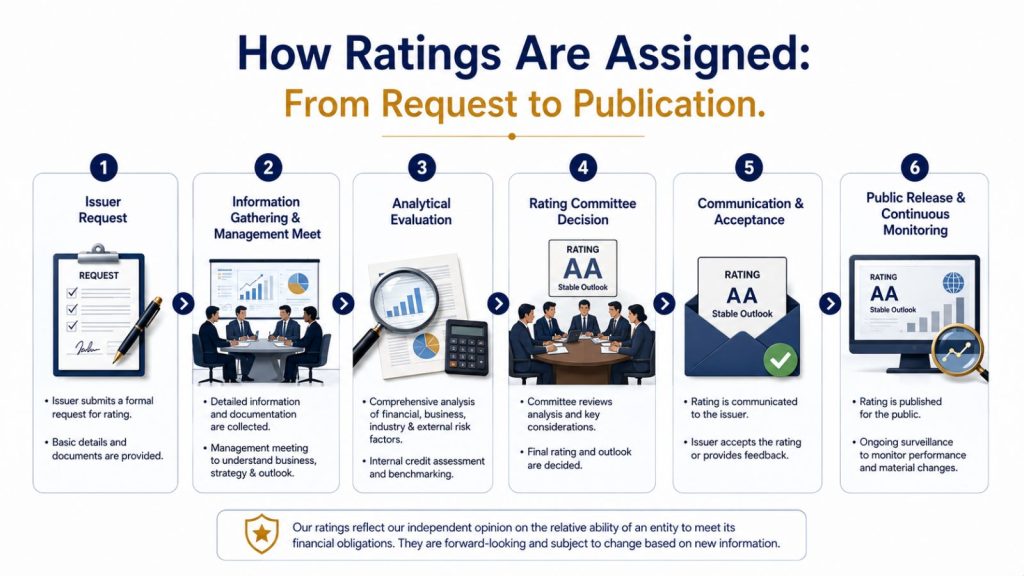
[Issuer Request] ➔ [Information Gathering & Management Meet] ➔ [Analytical Evaluation] ➔ [Rating Committee Decision] ➔ [Communication & Acceptance] ➔ [Public Release & Continuous Monitoring]
To get a bond rating in India, an issuer must go through a formal credit assessment process:
- The Request: A corporate issuer approaches a SEBI-registered rating agency to rate an upcoming bond or commercial paper issue.
- Analysis & Management Meeting: Rating analysts dissect the company’s financial statements, examine industry trends, and interview senior management to understand business strategy.
- The Rating Committee: The analyst team presents their findings to an independent Rating Committee. This committee votes on and assigns the final credit grade.
- Publication & Continuous Monitoring: Once accepted, the debt rating is published on the agency’s website and financial portals. The agency continues to monitor the company, upgrading or downgrading the rating if financial conditions change.
The Potential Conflict of Interest: The “Issuer-Pays” Model
It is vital for retail investors to understand that rating agencies are paid by the companies that issue the bonds, rather than the investors who buy them. This “issuer-pays” model can occasionally create conflicts of interest, as agencies may face pressure to offer generous ratings to win or keep business. Because of this, you should treat credit ratings as a helpful starting point, rather than a final stamp of approval.
Latest Bond News:
- ICICI Bank Returns to Global Bond Market With $1 Billion Dollar Bond

- RBI Announces ₹20,000 Crore G-Sec Buyback Auction on July 28
- SBI to Issue $200 Million Offshore Bonds via London Branch
Bond Rating Scale Explained: AAA to D — What Each Grade Means for Your Money
In India, credit ratings are divided into two main categories: Investment Grade (low to moderate default risk, suitable for conservative portfolios) and Sub-Investment Grade (high risk, highly speculative).
The Standardised Bond Rating Scale
| Rating Grade | Meaning | Default Probability | Typical Yield Range (2026) | Example Issuers |
| AAA | Highest safety; lowest risk of default | Extremely Low (Almost 0%) | 7.00% – 8.50% | HDFC Bank, PFC, Tata Capital |
| AA (+ / -) | High safety; very low default risk | Very Low | 8.20% – 9.70% | Muthoot Fincorp, L&T Finance, IIFL Samasta |
| A (+ / -) | Adequate safety; susceptible to adverse economic shifts | Low to Moderate | 9.80% – 11.50% | Muthoot MCred, Shriram Finance |
| BBB (+ / -) | Moderate safety; lowest investment-grade class | Moderate | 11.20% – 12.50% | NeoGrowth Credit, Spandana Sphoorty |
| BB (+ / -) | Inadequate safety; speculative characteristics | Speculative / High | 12.50% – 14.00% | Small-tier emerging NBFCs |
| B (+ / -) | High default risk; highly vulnerable | Very High | 14.00%+ | High-risk real estate developers |
| C | Extremely high risk of default | Imminent Default | N/A (Highly distressed) | Debt-restructuring firms |
| D | In default or expected to default soon | Defaulted | N/A (Trading suspended) | DHFL, Reliance Capital (historic) |
The Plus (+) and Minus (-) Modifiers
Agencies add plus (+) and minus (-) signs to ratings from AA to C. These modifiers show where a company stands within a specific rating bracket. For instance, an AA+ rating is one notch higher than a plain AA, while an AA- is one notch lower. These modifiers help you compare two similar bonds.
Understanding the “Yield Spread”
The difference in yield between a highly secure bond and a riskier one is called the “yield spread.”
The Yield Spread Rule: The yield spread between AAA-rated bonds and A-rated bonds typically ranges from 200 to 350 basis points (2% to 3.5%). This extra yield is the exact “price of risk” you are paid to accept.
Worked Example: The Real Value of the Risk Premium
Imagine Ramesh has ₹1,000,000 to invest in bonds. He decides to split his money to compare two different risk profiles:
- Bond A (AAA-rated): Ramesh puts ₹500,000 in a public sector utility bond yielding 7.8%.
- Bond B (A-rated): Ramesh puts ₹500,000 in an emerging retail-finance corporate bond yielding 10.5%.
The Returns:
- Ramesh’s annual income from the AAA bond is ₹39,000.
- Ramesh’s annual income from the A-rated bond is ₹52,500.
The Assessment: By choosing the A-rated bond for half of his money, Ramesh earns ₹13,500 extra per year. This extra income is his compensation for taking on a higher risk of default. If the economy slows down, the A-rated issuer is much more likely to struggle with repayments than the AAA-rated government-backed issuer.
What About Short-Term Ratings?
For short-term debt instruments that mature in under a year (such as Commercial Paper and Treasury Bills), agencies use a different scale. On the CRISIL rating scale and ICRA rating meaning charts, this ranges from A1+ (highest safety and liquidity) to A4, and finally D (default).
How CRISIL, ICRA, and CARE Rate Bonds Differently — A Comparative Analysis
While CRISIL, ICRA, and CARE use the same SEBI-mandated AAA-to-D scale, their behind-the-scenes evaluation frameworks, sector specializations, and analytical histories differ.
Agency Methodology Comparison
| Comparison Parameter | CRISIL | ICRA | CARE |
| Global Parent / Affiliate | S&P Global (Majority Stakeholder) | Moody’s Investors Service (Majority Owner) | Independent Publicly Traded (Domestic focus) |
| Analytical Focus | Industry cycles, business scale, parent-group support, and cash reserves | Working capital efficiency, debt refinancing ease, and management quality | Asset quality, cash-flow coverage ratios, and tangible collateral |
| Sectors Strongest In | Public Sector Undertakings (PSUs), heavy manufacturing, banking, and infrastructure | Infrastructure, mid-tier manufacturing, real estate, and retail finance | Non-Banking Financial Companies (NBFCs), power projects, and mid-cap corporations |
| Historical Failures | IL&FS (Rated AAA historically) | IL&FS, DHFL | DHFL, Reliance Capital |
| Market Share (Approx.) | 38% | 28% | 22% |
Understanding “Split Ratings”
Sometimes, two agencies give different ratings to the same bond. For example, CRISIL might give a bond an AA+ rating, while CARE rates it AA-. This is called a “split rating.”
If you encounter a split rating, you should investigate why the difference exists. The lower rating is usually the more realistic and conservative assessment, making it the safer one to follow.
The Repo Rate and Bond Risk: How RBI’s Monetary Policy Changes Everything
Many retail investors do not realize that the Reserve Bank of India’s (RBI) monetary policy decisions have a major impact on the risk level of their bonds.
The Core Rule of Bonds: When the RBI cuts the repo rate, existing bond prices rise (giving you capital gains), and borrowing costs for companies drop (reducing their risk of default).
How Interest Rates Impact Bond Portfolios
| RBI Monetary Policy Action | Impact on Bond Prices | Impact on Issuer Default Risk | Impact on New Bond Yields | Recommended Investor Strategy |
| Repo Rate Cut | Rises (Existing higher-coupon bonds become more valuable) | Falls (Companies can borrow more cheaply to pay off old debts.) | Falls (Newly issued bonds will pay lower interest rates) | Lock in long-duration, high-yield bonds before rates fall further. |
| Repo Rate Hike | Falls (Existing bonds become less attractive compared to newer, higher-paying ones.) | Rises (Borrowing costs go up, making it harder for weak companies to refinance.) | Rises (New bonds will offer higher interest rates) | Stick to short-duration bonds to avoid capital losses, and wait to reinvest at higher rates. |
Current Context (June 2026)
As of June 2026, the RBI has kept the repo rate steady at 5.25%, following a series of rate cuts from the 2024 peak of 6.50%. This lower interest rate environment has made it easier for corporate borrowers to service their debt, keeping default risks relatively low across the bond market.
For a deeper dive into these mechanics, see our detailed analysis: [RBI Repo Rate Pause vs Rising G-Sec Yields: What Investors Need to Know].
Real Defaults in India: What Ratings Failed to Predict — Lessons for Retail Investors
To build a secure portfolio, you must understand that credit ratings are backwards-looking. They tell you how healthy a company was in the past, not what will happen to it in the future. Three major defaults in India highlight this reality.
1. IL&FS (2018): From AAA to Default in Weeks
- Rating Prior to Default: AAA (Highest Safety)
- Date of Default: September 2018
- Amount Defaulted: ₹91,000 Crore
- What Happened: Infrastructure Leasing & Financial Services (IL&FS) used short-term debt to fund long-term, slow-yielding infrastructure projects. When credit markets tightened, the company ran out of cash. Because rating agencies relied too heavily on the company’s parent group’s reputation, they failed to spot the looming liquidity crisis, downgrading the bond to “D” (Default) only after payments had already been missed.
2. DHFL (2019): AA+ Rated Months Before Collapse
- Rating Prior to Default: AA+ (High Safety)
- Date of Default: June 2019
- Amount Defaulted: Over ₹40,000 Crore
- What Happened: Dewan Housing Finance Corporation Limited (DHFL) faced a severe liquidity crunch and accusations of financial mismanagement following the IL&FS crisis. Rating agencies failed to identify these internal governance issues, leaving the company with high ratings until its cash reserves had almost completely vanished.
3. Reliance Capital (2021): A Big Name That Couldn’t Protect Investors
- Rating Prior to Default: A-category (Adequate Safety)
- Date of Default: November 2021
- Amount Defaulted: ₹24,000 Crore
- What Happened: Despite the prestigious “Reliance ADAG” family name, the company was hollowed out by high debt and poor performance at its subsidiary businesses. This case serves as a stark reminder that a famous promoter’s name does not guarantee a bond’s safety.
5 Crucial Red Flags Ratings Often Miss
Before buying a corporate bond, look out for these five red flags, which credit ratings may not immediately reflect:
- High Promoter Pledge Levels: If company founders have pledged more than 50% of their shares as collateral for loans, any drop in the stock price could trigger a sudden debt crisis.
- Rising Debt with Flat Revenues: If a company’s total debt is growing rapidly but its sales and operating profits are flat, it is likely using new debt just to pay off old loans.
- Complex Related-Party Transactions: Watch out for companies that frequently move cash, loans, or investments to unlisted subsidiary businesses.
- Frequent Rating Agency Changes: If a company suddenly fires its rating agency and hires a new one, it is often “rating shopping,” which means it’s looking for an agency willing to give it a higher grade.
- Delayed Financial Results: Well-run companies publish their quarterly earnings on time. Delays in financial reporting are a major warning sign.
Risk Alert: No credit rating is an absolute guarantee of repayment. Even AAA-rated bonds carry risk. Always diversify your portfolio across at least 3 to 5 different issuers, and never put more than 10% of your total bond portfolio into a single company’s bonds.
How to Use Bond Ratings to Build a Risk-Adjusted Portfolio
To build a successful bond portfolio, you need to find the right balance between three key factors: your risk tolerance, your investment timeline, and your liquidity needs.
The Rating-Yield Portfolio Matrix
| Portfolio Allocation Style | Target Rating Composition | Blended Yield (Expected) | Portfolio Default Risk | Ideal Investor Profile |
| Conservative | 80% AAA / AA, 20% A | 8.00% – 9.00% | Minimal / Low | Retirees, risk-averse savers, and capital-preservation portfolios. |
| Balanced | 50% AAA / AA, 40% A, 10% BBB | 9.50% – 10.50% | Moderate | Middle-aged professionals seeking higher yields with reasonable safety. |
| Aggressive | 30% AA, 50% A, 20% BBB+ or BBB | 10.50% – 12.00% | High | Experienced investors aiming to beat equity returns over short timelines. |
Explore the Gold-Backed Bonds
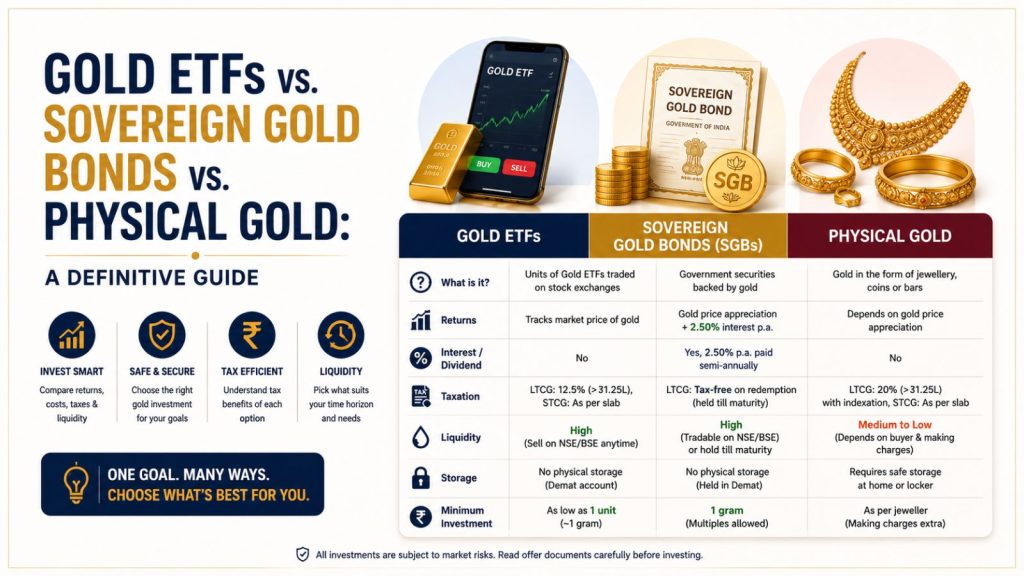
- Gold ETFs vs. Sovereign Gold Bonds vs. Physical Gold: A Definitive Guide
- Gold Price and Bond Market in India: Understanding the Relationship in 2026

- RBI Gold Bond Scheme Explained: A Simple Guide for 2026
Worked Example: Priya’s Conservative Portfolio
Priya, a 35-year-old professional in the 30% tax bracket, wants to invest ₹2,000,000 in a conservative bond portfolio. Here is how she allocates her money:
- Pristine Layer (80%): She puts ₹1,600,000 into a mix of AAA and AA-rated bonds, earning an average return of 7.80% (yielding ₹124,800 annually).
- Yield-Enhancing Layer (20%): She puts ₹400,000 into A-rated corporate bonds, earning an average return of 10.50% (yielding ₹42,000 annually).
The Financial Breakdown:
- Total Portfolio Investment: ₹2,000,000
- Blended Pre-Tax Yield: 8.34% (Total annual pre-tax return of ₹166,800)
- Post-Tax Income (30% Tax Slab): ₹116,760 net annual income
This simple asset-allocation strategy allows Priya to beat traditional bank Fixed Deposits by over 1.5% while keeping 80% of her money in highly secure, high-safety investments.
Take Action: On GoldenPi, you can filter corporate bonds by credit rating—allowing you to instantly view all available AAA, AA, or A-rated bonds.
Explore rated bonds on GoldenPi
Bond Risk Beyond Ratings: 5 Types of Risk Every Indian Investor Must Know
Credit ratings only measure one specific type of risk: credit risk (the probability that a company defaults on its payments). However, as a bond investor, you face four other key risks that ratings do not capture.
The 5 Dimensions of Bond Risk
| Risk Category | What It Actually Means | Who is Most At Risk | How to Protect Yourself | Does a Credit Rating Measure This? |
| Credit Risk (Default) | The company goes bankrupt and cannot pay back your principal or interest. | Investors holding lower-rated (BBB or below) bonds. | Stick to highly rated AAA/AA bonds and diversify across different issuers. | Yes (This is the primary focus of credit ratings) |
| Interest Rate Risk | RBI interest rates rise, causing the trading price of your existing bonds to fall in the secondary market. | Investors holding long-term bonds (10 to 30 years). | Keep your investment horizon aligned with the bond’s maturity date. | No |
| Liquidity Risk | You need cash urgently, but there are no active buyers for your bond on the exchange, forcing you to sell at a steep discount. | Investors holding unlisted or thinly traded corporate bonds. | Stick to popular, publicly listed bonds with high trading volumes. | No (Though higher-rated bonds are usually easier to sell) |
| Reinvestment Risk | RBI cuts rates, meaning when your current bond matures, you cannot find a new bond that offers the same high return. | Investors holding short-term bonds (under 1 year). | Buy longer-term bonds to lock in today’s high yields for a longer period. | No |
| Inflation Risk | Inflation rises faster than your bond’s interest rate, eroding the real purchasing power of your money. | Investors holding low-yield bonds during periods of high inflation. | Avoid locking up all your money in low-yield bonds when inflation is high. | No |
Understand the Risk Trade-Offs
Risk is multi-dimensional. For example:
- A 10-year AAA-rated Government Bond has virtually zero credit risk, but it carries high interest rate risk and inflation risk due to its long tenure.
- A 1-year A-rated Corporate Bond has moderate credit risk, but it has almost zero interest rate risk because it matures so quickly.
Frequently Asked Questions — Bond Ratings & Risk in India
Credit rating agencies are independent organizations registered with SEBI that evaluate an issuer’s ability to repay its debt. India has 7 SEBI-registered rating agencies: CRISIL, ICRA, CARE, India Ratings, Acuité, Brickwork, and Infomerics.
A AAA rating is the highest grade on the bond scale, indicating that the issuer has an extremely strong capacity to meet its financial obligations. These bonds have the lowest risk of default and generally offer lower, more stable yields.
Yes. While default is highly unlikely, it is possible. Historical failures like IL&FS prove that a high rating is not a guarantee of absolute safety. This is why you should always diversify your investments.
Bond prices and interest rates move in opposite directions. When the RBI cuts the repo rate, older, existing bonds (which pay higher interest rates) become more attractive, causing their prices to rise. When the RBI raises rates, existing bond prices fall.
Both agencies use the same AAA-to-D scale mandated by SEBI, but they are backed by different global parents (CRISIL by S&P Global; ICRA by Moody’s) and use slightly different analytical models and sector specializations.
Sovereign bonds (issued directly by the Government of India) are the safest, as they carry an implicit sovereign guarantee. Among corporate bonds, AAA-rated bonds issued by public sector undertakings (PSUs) are the safest corporate investments.
You can check a bond’s rating on SEBI-regulated online bond platforms like GoldenPi or look up the issuer’s official rating rationale documents directly on the website of the rating agency (CRISIL, ICRA, or CARE) that evaluated the bond.
A rating downgrade means the issuer’s financial health has deteriorated. If this happens, the market price of your bond in the secondary market will likely fall, and it may become harder to sell. However, unless the company actually defaults, the issuer is still legally obligated to pay you your scheduled interest and principal.
Risk Warning
Risk Alert: Bond investments carry credit risk, interest rate risk, and liquidity risk. Past credit ratings do not guarantee future performance. Always diversify your investments across different issuers and rating grades. Consider consulting a SEBI-registered investment advisor for personalized guidance.
Conclusion
Credit ratings are an essential starting tool for fixed-income investors, but they should never be the final word in your investment decisions.
To build a safe and profitable portfolio, you must combine credit ratings with your own analysis of warning signs, practice smart diversification, and understand how the RBI’s interest rate cycle affects your investments. By doing so, you can confidently navigate the Indian bond market to earn attractive returns of 7% to 12%+, while keeping your hard-earned capital secure.
Disclaimer
Fixed returns do not constitute guaranteed or assured returns. Investments in corporate debt securities and municipal debt securities/securitized debt instruments are subject to credit risks, market risks, and default risks, including delay and/or default in payment. Read all the offer-related documents carefully. This blog/article should not be construed as financial advice or as an offer or recommendation to buy or sell any security or any products/services of/on GoldenPi or any product/services of its third-party client(s). For a detailed calculation of YTM, visit our website. T&C’s Apply.