|
Getting your Trinity Audio player ready...
|
This guide explains the YTM vs. coupon rate NCD distinction, works through a numerical example, and sets out how to read NCD yield correctly before a purchase.
Start investing with just ₹10K & grow your wealth with fixed return opportunities.
Invest Now

What Does the Coupon Rate Represent?
The coupon rate is the starting point of any bond assessment. In the YTM vs coupon rate NCD pair, the coupon rate is the fixed rate of interest an NCD pays each year on its face value.
Consider an NCD with a face value of 1,000 rupees and a coupon rate of 9%. It pays 90 rupees a year, and that amount remains constant for the entire life of the bond. Critically, the coupon is calculated on the face value, not on the price an investor actually pays to acquire the bond.
This distinction is central to the YTM vs. coupon rate NCD question. The coupon is anchored to the face value, which never changes. The market price of the bond, however, can be higher or lower than that face value. Once the two diverge, the coupon rate no longer reflects an investor’s true return, and the YTM vs. coupon rate NCD gap becomes significant.
What Yield to Maturity (YTM) Represents
Yield to maturity is the second figure in the YTM vs. coupon rate NCD pair and the more informative of the two. YTM is the total annual return an investor earns by purchasing the bond at its current market price and holding it until maturity.
YTM incorporates three elements that the coupon rate omits. It accounts for the coupon received each year. It accounts for the price paid today, rather than the face value. And it accounts for the gain or loss realized when the bond is redeemed at its face value on maturity. Combined, these produce a single figure that represents the investor’s genuine return.
This is why YTM carries greater weight in the YTM vs. coupon rate NCD comparison. The coupon rate reflects only the interest. The YTM reflects the interest, the purchase price, and the final redemption together. A sound approach to how to read NCD yield, therefore, centers on the YTM rather than the coupon.
YTM vs Coupon Rate NCD: The Core Difference
The essence of the YTM vs coupon rate NCD topic can be stated as a single principle. The coupon rate is fixed; the YTM varies with the price paid.
When a bond is purchased at exactly its face value, the two figures are identical. A 9% coupon bond bought at 1,000 rupees carries a YTM of 9%, the one case where the YTM vs coupon rate NCD figures agree.
In practice, bonds frequently trade above or below their face value. When an investor pays more than face value, known as a premium, the YTM falls below the coupon rate because more was paid for the same fixed interest. When an investor pays less than face value, known as a discount, the YTM rises above the coupon rate because less was paid for that same interest. In every YTM vs coupon rate NCD assessment, therefore, the purchase price determines which figure is higher. This is the defining rule of the YTM vs coupon rate NCD relationship.
Example on NCD YTM Calculation
A numerical illustration, in the form of an NCD YTM calculation, makes the YTM vs. coupon rate NCD principle concrete.
Consider a bond with a face value of 1,000 rupees, a 9% coupon, and one year remaining to maturity. It will pay 90 rupees in interest and return the 1,000 rupee face value at maturity, giving the holder 1,090 rupees in total at the end of the year.
The purchase price then determines the return in this NCD YTM calculation. Bought at 1,000 rupees, it returns 1,090, a gain of 90 rupees, producing a YTM of 9%, equal to the coupon. Bought at 1,050 rupees, it still returns only 1,090, a gain of 40 rupees, so the NCD YTM calculation yields approximately 3.8%, well below the 9% coupon. Bought at 950 rupees, it returns 1,090, a gain of 140 rupees, so the NCD YTM calculation yields approximately 14.7%, well above the coupon. The same bond and the same coupon produce three very different returns, which is the central lesson of the YTM vs. coupon rate NCD comparison.
Why the Coupon Rate Can Be Misleading
The coupon rate can be misleading because it never changes even as the purchase price does; it can conceal an investor’s actual return, and the YTM vs coupon rate NCD gap is where that concealment occurs.
Marketing material often highlights the coupon rate because a high figure appears attractive. A 9% coupon presents well. Yet if the bond trades at a premium, the real return, the YTM, may be 6% or lower. In such cases the coupon rate is misleading because it makes an expensive bond appear as favorable as an inexpensive one.
Latest Bond Updates:
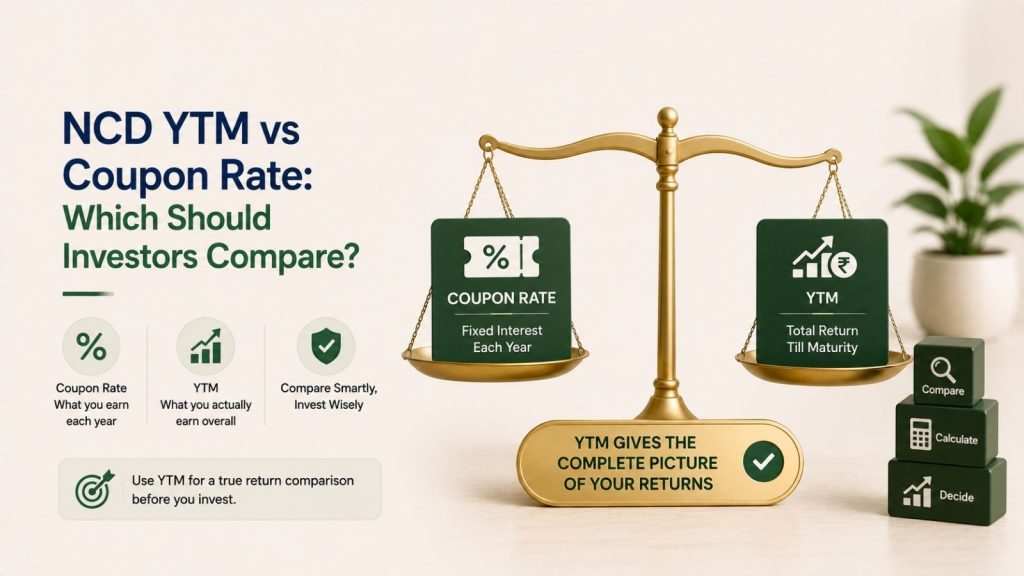
- NCD YTM vs. Coupon Rate: Which Should Investors Compare?
- SGB Maturity Payout 2026: Tax Calculation for Existing Holders
- Gold Mutual Fund vs Gold ETF vs SGB: Which Is Best in 2026?

This is the risk the coupon rate’s misleading effect poses to inexperienced buyers. Two bonds may each advertise a 9% coupon, but if one trades at a premium and the other at a discount, their real returns differ substantially. Relying on the coupon rate alone, while disregarding the YTM vs coupon rate NCD gap, is the most common way investors overpay in the YTM vs coupon rate NCD trade. The coupon rate is misleading whenever the price paid differs from the face value.
How to Read NCD Yield Before You Buy
Protecting against the YTM vs. coupon rate NCD trap depends on a disciplined approach to how to read NCD yield, which rests on three habits.
First, identify the YTM, not merely the coupon. Any reputable bond platform displays the YTM for a listed NCD. That single figure is the correct basis for assessing a bond, since it already combines price, interest, and maturity.
Second, compare bonds on YTM rather than on coupon. When two NCDs are weighed against each other, the one with the higher YTM offers the better real return, regardless of their stated coupons. This is the foundation of a fair comparison.
Third, account for individual tax treatment. YTM is a pre-tax figure, so two bonds with the same YTM can leave investors with different amounts after tax. A complete approach to how to read NCD yield begins with the YTM and then considers tax. Applied consistently, this removes the risk posed by the YTM vs. coupon rate NCD gap.
YTM vs Coupon Rate on an NCD Frequently Asked Questions
Yes. In the YTM vs coupon rate NCD comparison, the YTM falls below the coupon when a bond is purchased at a premium, above its face value. The investor has paid more for the same fixed interest, so the real return is lower than the coupon indicates.
This lies at the heart of the YTM vs. coupon rate NCD question. An NCD YTM calculation combines three inputs: the annual coupon, the price paid today, and the gain or loss when the bond is redeemed at face value. Investors need not compute it manually, as bond platforms display the YTM, but understanding its components aids interpretation.
YTM. This is the principal conclusion of the YTM vs. coupon rate NCD topic. The coupon rate ignores the price paid and can therefore be misleading. The YTM reflects the real return, making it the correct basis for comparing two bonds.
Yes, and this is a key reason the YTM is more reliable than the coupon rate. When a bond is bought below face value, the YTM includes the gain realized at maturity. When bought above face value, it includes the loss. The coupon rate reflects neither.
Because its market price moves. The coupon is fixed, but once a bond is listed and traded, its price rises and falls with demand and prevailing interest rates. As the price changes, the YTM changes with it, which is why how to read NCD yield requires checking the YTM on the day of purchase.
It indicates a purchase at a premium, above face value. The investor receives the same fixed coupon but has paid more for it, so the real return is lower. In this situation the coupon rate is misleading, and the lower YTM represents the true return.
It indicates a purchase at a discount, below face value. The investor receives the same coupon but has paid less and also gains when the bond is redeemed at face value, so the real return exceeds the coupon. The YTM captures this additional return that the coupon omits.
The YTM, decisively, which settles the YTM vs. coupon rate NCD debate. The coupon rate states the fixed interest, but only the YTM states the real return at the price paid. In the YTM vs coupon rate NCD decision, the YTM is the figure that should guide the choice.
Disclaimer
Fixed returns do not constitute guaranteed or assured returns. Investments in corporate debt securities and municipal debt securities/securitized debt instruments are subject to credit risks, market risks, and default risks, including delay and/or default in payment. Read all the offer-related documents carefully. This blog/article should not be construed as financial advice or as an offer or recommendation to buy or sell any security or any products/services of/on GoldenPi or any product/services of its third-party client(s). For a detailed calculation of YTM, visit our website. T&C’s Apply.