If you’ve ever transferred shares between demat accounts, you’ve probably filled out, or digitally authorized, a Delivery Instruction Slip (DIS). Bonds work the same way, but with a few twists that catch even experienced investors off guard. Maybe you’re trying to consolidate your bond portfolio across different brokers, or perhaps you want to gift some debentures to a family member, or you’re looking to move government securities out of an SGL account. Whatever the reason, the DIS is what makes it all happen. Here’s a rundown of how it works for debt securities, what you can expect to pay in stamp duty, and how the bond transfer process changes if you don’t have a Power of Attorney on file.
Start investing with just ₹10K & grow your wealth with fixed return opportunities.
Invest Now

What Is a Delivery Instruction Slip?
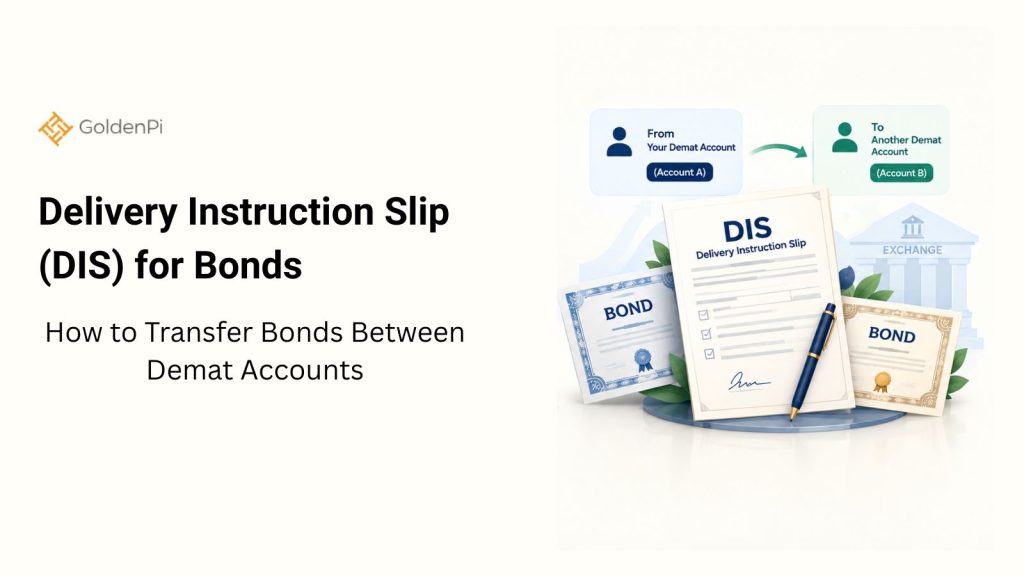
A DIS is a written or electronic instruction you give your Depository Participant (DP) authorizing them to debit securities from your demat account and credit them to another account. Think of it as a transfer check, but for securities instead of money. Its counterpart, the Receipt Instruction Slip (RIS), is used on the receiving end, though RIS is now largely optional since most transfers auto-credit.
For bonds, the mechanics are identical to equities: you need the recipient’s Client ID, their DP ID, the bond’s ISIN, and the face value or quantity you’re moving. Since October 2020, there’s been this extra step for off-market transfers: the person transferring the bonds needs to confirm the deal with an OTP before it actually happens.
The main difference with bonds is that government securities (like G-Secs and SDLs) are often stored in the RBI’s SGL/CSGL system rather than a regular demat account, especially for big institutions. And when you transfer those, it goes through the RBI’s own system, not using a DIS.
Why DIS Matters for Bond Trading Specifically
Most bond transfers in India don’t happen through an exchange—they happen off-market. Common scenarios include:
- Moving a bond portfolio when you switch brokers
- Gifting or inheriting debentures within a family
- Pledging bonds as collateral against a loan
- Institutional transfers—mutual funds, PMS, and insurers rebalancing debt holdings across custodians
Because bonds are traded far less frequently on exchanges compared to equities, the DIS-driven off-market route is often the default way debt securities change hands in India, not the exception.
Stamp Duty Implications on Off-Market Bond Transfers
Here’s where bonds diverge meaningfully from equities. Since the amendments to the Indian Stamp Act took effect on 1 July 2020, depositories collect stamp duty on off-market transfers when the DIS is executed, but the rate depends on what you’re transferring.
| Instrument type | Applicable stamp duty rate | Who pays on an off-market transfer? |
| Equity shares (delivery-based transfer) | 0.015% | Transferor |
| Transfer and reissue of debentures (corporate bonds) | 0.0001% | Transferor |
| Government securities (G-Secs, SDLs) | Nil | Not applicable |
Note: For off-market transfers through a depository, stamp duty is collected from the transferor. The statutory rate depends on the type of security and transaction. Transfers without consideration, such as gifts, are exempt from stamp duty.
Latest Bond Updates:
- Delivery Instruction Slip (DIS) for Bonds: How to Transfer Bonds Between Demat Accounts
- Top Corporate Bond Issuers in India 2026: Tata, Bajaj, Aditya Birla & More

- Corporate Debt Issuances in H1 FY27: Ratings, Yields & Retail Allotment Trends

The stamp duty rate schedule has been in force since 1 July 2020, with the amount collected by the exchange, clearing corporation, or depository executing the transaction. Corporate bonds that are classified as debentures attract a significantly lower rate compared to equities. And when it comes to stamp duty on issuing and transferring securities through depositories and stock exchanges, it’s collected on behalf of state governments, with no separate state-level stamp duty applicable.
One useful exemption to know: SEBI has clarified that no stamp duty is payable on off-market transfers made without consideration, such as gifts or legacy transfers. So, if you’re gifting bonds to a family member through a DIS, there is no stamp duty on the transfer, although the required depository transfer process still applies.
Selling Bonds Without a Power of Attorney (PoA)
Until 2022, most brokerage accounts were set up with a Power of Attorney (PoA), which allowed your broker to debit securities from your demat account for specified purposes, including settlement, without needing a new authorization every single time. But then SEBI stepped in, introducing the Demat Debit and Pledge Instruction (DDPI) as a more limited alternative to PoA.
From September 1, 2022, brokers could no longer insist on PoA as a condition for opening a demat or trading account, while DDPI could be used for specified purposes such as transferring securities towards exchange settlement obligations. Existing PoAs continued to remain valid until revoked. SEBI followed up with another circular that expanded DDPI’s permitted uses to mutual fund transactions on exchange platforms and tendering shares in open offers, with these provisions taking effect from November 18, 2022. Importantly, PoAs did not become completely obsolete on that date, and DDPI itself is not mandatory.
Here’s what this means practically if you’re selling bonds and don’t have a PoA or DDPI that authorizes the relevant transfer:
- Your broker won’t be able to use a standing authorization to debit bonds from your demat account for settlement.
- You’ll need to authorise the transfer yourself, either by physically signing a DIS or using an electronic instruction mechanism such as eDIS with CDSL’s TPIN and OTP-based authentication.
- Without a DDPI in place, you can use eDIS to authorise eligible securities transfers electronically on a transaction-by-transaction basis, rather than giving a standing authorisation to your broker.
This isn’t necessarily a drawback. DDPI is essentially a limited-purpose standing instruction that lets your broker handle specified securities transfers, whereas eDIS lets you authorise individual transactions as they occur, giving you transaction-by-transaction control over each sale. This distinction can be particularly useful for less frequently traded securities such as bonds, where you may prefer to approve each transfer individually.
Key Fields to Get Right on a Bond DIS
Whether physical or electronic, your DIS needs to be filled with precision; bonds don’t get “un-transferred” easily once a DIS executes. Double-check:
- Target Client ID and DP ID: A single wrong digit sends bonds to the wrong account
- ISIN of the bond: Critical for debt securities, since multiple bonds from the same issuer often carry different ISINs based on coupon and maturity
- Quantity/face value: Bonds are typically quoted by face value, not units, so confirm this matches your intent
- Execution date and purpose (market vs. off-market)
The Bottom Line
The DIS remains the backbone of demat-to-demat bond transfers in India, despite digital tools like eDIS and DDPI making things easier. Two key things to keep in mind: corporate bond transfers attract a fraction of the stamp duty that equities do, while G-Secs are totally exempt, and if you don’t have a PoA or DDPI on file, you’ll need to get individual authorisation every time you sell a bond via DIS or eDIS. So, double-check that the ISIN and your account details are spot on, and the transfer should be a breeze.
Delivery Instruction Slips Frequently Asked Questions
A Delivery Instruction Slip is an instruction given to a Depository Participant (DP) to debit securities from a demat account and transfer them to another account or eligible destination. It works somewhat like a check for transferring securities.
Not necessarily. CDSL provides electronic instruction facilities through which eligible transactions can be initiated without submitting a physical DIS. The exact options depend on your DP and the facility it supports.
In some cases, yes. Depositories and DPs offer electronic instruction facilities. For example, CDSL’s Easiest facility allows eligible account holders to set up securities transfers electronically.
A transfer moves the security from one demat account to another. A sale is a transaction in which the security is sold to a buyer, generally creating a corresponding payment obligation. An off-market family transfer, for example, is not the same as selling the bond on an exchange.
Yes. Incorrect account details, an invalid ISIN, insufficient securities, signature or authentication issues, incomplete information, or other procedural problems can result in rejection or delay.
Use a DIS issued by your DP, verify that the booklet and slips carry the required account details and serial numbers, fill in the target account and security details yourself, and avoid leaving signed blank slips with anyone. CDSL specifically advises investors to keep DIS booklets secure and not hand over signed blank slips.
Disclaimer
Fixed returns do not constitute guaranteed or assured returns. Investments in corporate debt securities and municipal debt securities/securitized debt instruments are subject to credit risks, market risks, and default risks, including delay and/or default in payment. Read all the offer-related documents carefully. This blog/article should not be construed as financial advice or as an offer or recommendation to buy or sell any security or any products/services of/on GoldenPi or any product/services of its third-party client(s). For a detailed calculation of YTM, visit our website. T&C’s Apply.