
A strong credit rating tells you an NBFC is likely to repay its bonds. It does not tell you whether the cash will be there on the day the money is due. That gap in timing is called an ALM (asset-liability management) mismatch, and it is one of the risks associated with NBFC bonds and NCDs. It arises when a lender funds long-term loans with short-term borrowings and has to keep rolling them over to stay afloat.
With RBI’s Asset Liability Management Directions, 2025, updated in July 2026, now setting stricter liquidity expectations for NBFCs, it is worth understanding how this risk works, why it matters for your holdings, and how to spot it early.
Start investing with just ₹10K & grow your wealth with fixed return opportunities.
Invest Now

What Is ALM Mismatch and Why Does It Matter for NBFC Bonds?
An NBFC is a middleman: it borrows from banks, mutual funds, and bond markets, then lends to customers. ALM mismatch arises when the two sides run on different clocks.
Say an NBFC gives a five-year vehicle loan but funds it with a six-month commercial paper (CP). The loan repays gradually through EMIs, while the CP must be repaid in full in six months. The NBFC has to raise fresh money to repay the old, and that only works if markets stay open and investors stay confident.
Some mismatch is normal, since every lender transforms maturities to some degree. The risk lies in how large the gap is and how dependent the NBFC is on rolling over short-term funds.
How ALM Mismatch Turns Into Liquidity Risk
The textbook case is the 2018 IL&FS episode. After IL&FS defaulted on commercial paper repayments, RBI deputy governors said some NBFCs had sought too much short-term capital to finance long-term projects. Once one large borrower stumbled, lenders became wary of the whole sector, and rollovers got harder and costlier.
For a bond investor, the danger is not always outright default. It usually shows up earlier, as
- Widening spreads on the issuer’s bonds
- Thin secondary-market liquidity, so you can’t exit at a fair price
- Rating outlook changes driven by funding stress rather than asset quality
Perception matters as much as numbers. If lenders start doubting an NBFC, they stop rolling over, and the doubt becomes self-fulfilling.
L(earn) More:
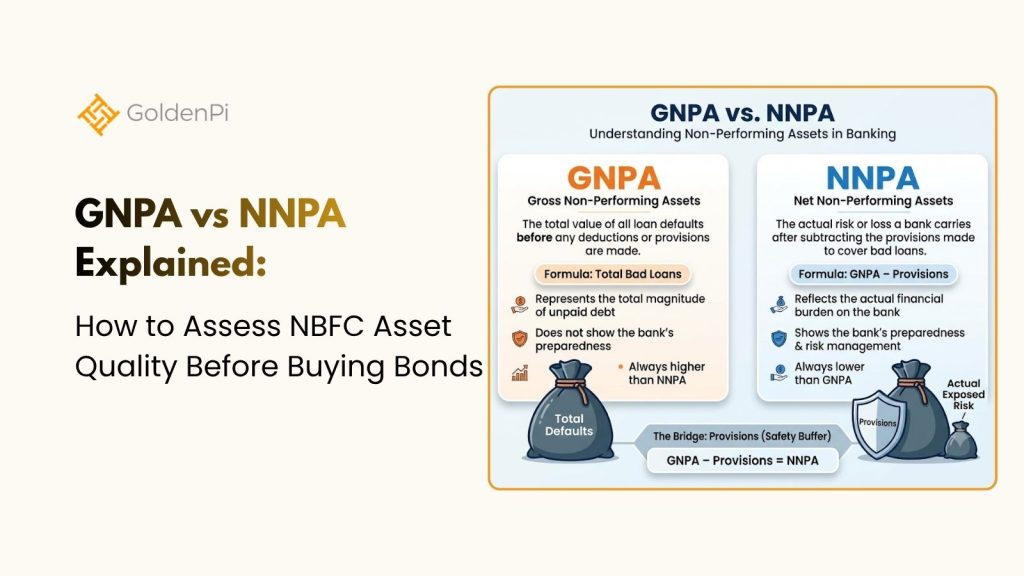
- GNPA vs. NNPA: How to Read Asset Quality Before Buying NBFC Bonds
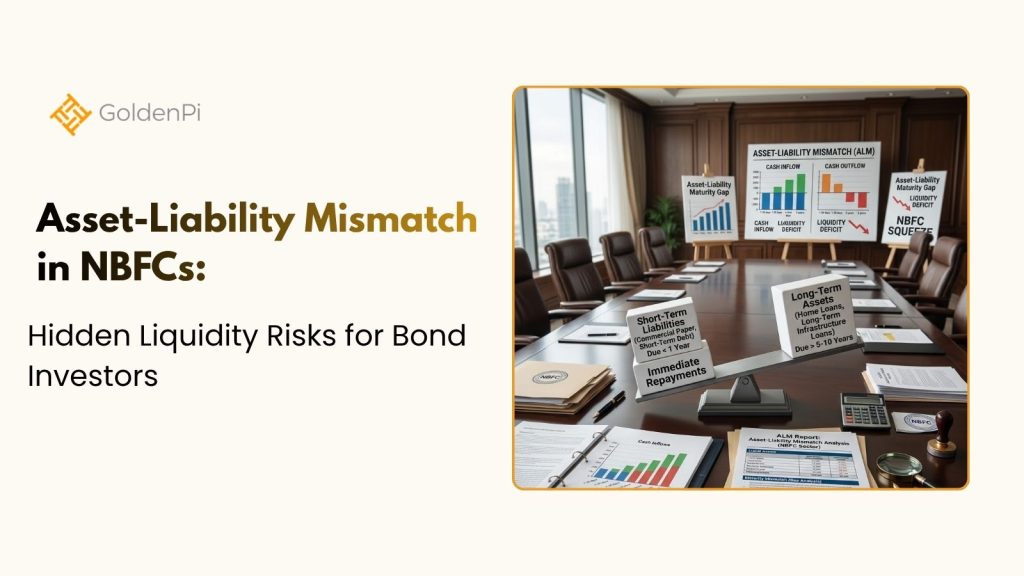
- Asset-Liability Mismatch in NBFCs: Hidden Liquidity Risks for Bond Investors
- AIS and Form 26AS for Bond Investors: How to Reconcile Coupon TDS

What RBI’s Latest ALM Norms Say for NBFCs
The key requirements under the 2025 Directions:
| Requirement | What RBI prescribes |
| Cumulative negative mismatch, 1–7 days | Not more than 10% of cumulative outflows |
| Cumulative negative mismatch, 8–14 days | Not more than 10% of cumulative outflows |
| Cumulative negative mismatch, 15–30 days | Not more than 20% of cumulative outflows |
| Liquidity Coverage Ratio (LCR) | Minimum 100%: high-quality liquid assets (HQLA) at least equal to net 30-day outflows |
| Public disclosure | Quarterly liquidity disclosures on the NBFC’s website |
The LCR stress test assumes outflows are 15% higher than contracted and inflows 25% lower. HQLA broadly means assets that convert to cash quickly with little loss, such as cash and government securities. The LCR applies to deposit-taking NBFCs and to non-deposit-taking NBFCs with assets of ₹5,000 crore or more. The broader liquidity-risk chapter doesn’t apply to NBFCs with assets below ₹100 crore.
One nuance: RBI fixes hard limits only up to 30 days. For buckets up to one year, each NBFC’s board sets its own internal limits, so the quality of that internal discipline matters.
Banks vs. Bond Markets: Where NBFC Funding Stands in 2026
The way NBFCs raise money is changing, but not in one direction. Avendus Capital [1] projected that market-based funding could account for 64% of NBFC borrowings by FY27, up from 43% in FY24, while bank credit accounted for around 42%. Greater reliance on market funding can increase refinancing risk if market conditions worsen, particularly for short-term borrowing such as commercial paper (CP), which must be repaid or refinanced frequently.
The picture became more mixed in 2026. CRISIL Ratings expected bank loans to account for 44–45% of NBFC borrowings in FY27 [2] as bond issuances slowed and yields rose above January 2025 levels by March 2026. Bank loans often have longer repayment periods than CP, but relying heavily on a small number of banks can create another risk: if one or more lenders reduce their exposure, an NBFC may find it harder to replace that funding.
So neither source is automatically safer. What matters is diversification across lenders and maturities.
How to Spot ALM Mismatch Before Buying an NBFC Bond
You don’t need a treasury desk to check this. Start with the quarterly liquidity disclosure each NBFC must publish, and look for:
- Short-term borrowing share: high CP or sub-one-year NCDs relative to total assets or liabilities (RBI’s indicative list of critical ratios includes these)
- Funding concentration: how much comes from the top 10 lenders or a single instrument
- LCR cushion: a ratio well above 100% suggests a real buffer
- Negative gaps in near-term buckets: persistent deficits in the 1–30 day buckets
- Asset tenor vs. liability tenor: long-term loans (like infrastructure or housing) funded with short-term money
- Contingency access: committed bank lines and the NBFC’s track record of raising money in tough months
Read these alongside the rating rationale, where agencies often flag liquidity and refinancing risk.
Final Thoughts: Look Beyond the Rating
A rating answers whether an issuer can pay in the long run. ALM answers whether it can pay on time. The regulatory framework has more guardrails than it did in 2018, but the discipline still has to come from the investor. Before adding NBFC debt, spend ten minutes on the liquidity disclosure, because a small yield premium rarely compensates for a refinancing scare.
Asset-Liability Mismatch in NBFC FAQs
An Asset-Liability Management (ALM) mismatch occurs when an NBFC’s expected cash inflows and outflows do not line up in timing. For example, it may lend money to borrowers for five years but fund those loans partly through borrowings that must be repaid within one year.
Yes. An NBFC may hold loans that are expected to be repaid over several years, but those loans cannot always be converted into cash quickly without a discount. If substantial liabilities fall due before cash becomes available, the NBFC may struggle to pay on time.
Short-term borrowings must be repaid or refinanced relatively soon. If an NBFC uses them to finance long-term loans, it depends on continued access to funding or the timely collection of borrower repayments. If lenders become reluctant to roll over facilities, the NBFC may face a cash shortfall.
The RBI’s NBFC Asset Liability Management Directions require covered NBFCs to monitor liquidity positions, assess cash flows across maturity buckets, and establish appropriate controls and limits. Applicability depends on the NBFC’s category and the relevant provisions.
Check the NBFC’s official website, annual report, financial statements, and investor disclosures. Look for structural liquidity statements, maturity profiles, liquidity ratios, and explanations of significant changes.
Sources
- Avendus Capital — Beyond the Bank: The New Borrowing Playbook for NBFCs (PDF)
- CRISIL Ratings — NBFCs bank on banks as debt capital market issuances taper
Disclaimer
Fixed returns do not constitute guaranteed or assured returns. Investments in corporate debt securities and municipal debt securities/securitized debt instruments are subject to credit risks, market risks, and default risks, including delay and/or default in payment. Read all the offer-related documents carefully. This blog/article should not be construed as financial advice or as an offer or recommendation to buy or sell any security or any products/services of/on GoldenPi or any product/services of its third-party client(s). For a detailed calculation of YTM, visit our website. T&C’s Apply.


