
Two NCDs can both be labelled “secured” and offer nearly the same coupon, yet protect your money very differently. The difference often lies in the asset cover ratio, a number that shows how much collateral stands behind the debentures compared with what the company owes. For Indian investors drawn to NCDs, understanding this ratio is one of the simplest ways to separate genuinely protected investments from ones that only sound safe.
In this article, we explain what the asset cover ratio is, how it is calculated, what SEBI’s rules require, and how to read it alongside the type of charge and the credit rating before you invest.
Start investing with just ₹10K & grow your wealth with fixed return opportunities.
Invest Now

What Is the Asset Cover Ratio in an NCD?
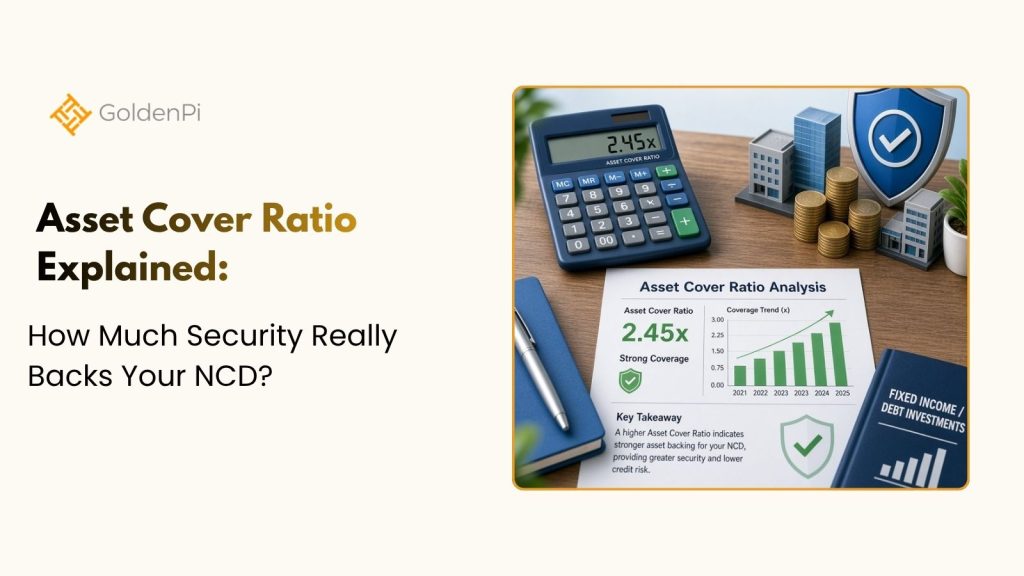
The asset cover ratio (also called security cover) compares the value of the assets pledged to NCD holders with the amount owed to them. The formula is:
Asset cover = Value of assets offered as security ÷ (NCD principal + accrued interest)
Say a company raises ₹1,000 crore through secured NCDs and pledges assets worth ₹1,250 crore. The cover is 1.25x. Even if those assets fetch somewhat less than their stated value in a recovery, debenture holders still have a cushion.
What Does SEBI Require for Asset Cover?
For listed secured NCDs, the baseline is 100% security cover: the assets charged as security must be sufficient to cover the outstanding principal and interest or provide higher cover if required by the offer document or debenture trust deed. Under SEBI’s LODR Regulations, issuers must disclose their security cover, while the Debenture Trustee Master Circular sets out the related certification and monitoring requirements. Recent issuer filings commonly confirm compliance with the 100% minimum or the higher level specified in the trust deed.
Monitoring is built into the system. Issuers submit a security cover certificate every quarter, usually with their financial results. An auditor or chartered accountant reviews the computation, though the auditor’s role is often limited to the book values of the assets. The debenture trustee, who represents investors, uses these certificates to check compliance. Circulars do get updated, so always check the latest disclosures on the exchange website for the NCD you’re considering.
L(earn) More:
- Asset Cover Ratio Explained: How Much Security Really Backs Your NCD?
- JSW Paints Plans 4- and 5-Year Bonds to Refinance Akzo Acquisition Debt

- YES Bank AT1 Bond Verdict: Bondholders Seek Clarity on Coupon Payments

Exclusive vs Pari-Passu Charge: Why It Changes Your Risk
The ratio alone doesn’t tell the whole story. You also need to know how the assets are charged. Auditors’ certificates routinely check whether the charge on the issuer’s assets is exclusive or pari-passu.
| Feature | Exclusive charge | Pari-passu charge |
| What it means | Specific assets are earmarked only for these NCD holders | The same assets are shared with other lenders, such as banks or other debenture holders. |
| Claim on recovery | Direct and undiluted | Shared in proportion to dues |
| Risk to you | Lower | Higher, since the pool is divided |
| Typical setup | Identified assets set aside for the issue | A common loan book or asset pool shared across lenders |
Here’s how that plays out: A company has ₹2,000 crore of receivables charged pari-passu. It owes ₹600 crore to NCD holders and ₹1,400 crore to banks, so cover is 1.0x on the whole pool. If the receivables sour and the pool realises only ₹1,500 crore, everyone recovers about 75 paise on the rupee, and NCD holders can’t jump the queue. Compare that with an exclusive charge on ₹660 crore of specific assets against ₹600 crore of NCDs. That’s a 1.1x cover, and it belongs to you alone.
How to Read a Security Cover Certificate
You don’t need to be an accountant to read these filings, which are published on NSE and BSE. Start by comparing the required cover with the actual cover. A thin gap deserves attention. Then look at the trend across quarters, since certificates often explain what moved the ratio, such as a change in asset value or in how much debt shares the charge. A steady decline over several quarters is a warning sign.
Also look at what the assets actually are. Cover backed by a healthy loan book, land, or listed shares behaves differently in a downturn, and for lenders the quality of receivables matters as much as the quantity. Finally, note the valuation basis, because book value can differ from what assets would fetch in a forced sale.
What the Asset Cover Ratio Can’t Tell You
Treat it as one input, not a safety guarantee. It’s a snapshot, certified quarterly, and things can change between filings. Book value isn’t realizable value either: real estate may sell at a discount, and an NBFC’s loan book can deteriorate quickly when defaults rise. Enforcement also takes time, and recovery from secured assets can be slow and legally messy.
Unsecured NCDs rely entirely on the issuer’s cash flows and credit strength, which is why they typically pay higher coupons. And a high ratio on weak assets is not the same as a modest ratio on strong ones.
Checklist Before You Invest in a Secured NCD
- Confirm the NCD is secured and find the stated asset cover in the offer document.
- Check whether the charge is exclusive or pari-passu.
- Read the latest quarterly security cover certificate on the exchanges.
- Review the credit rating and the rating agency’s rationale, not just the letter grade.
- Look at the issuer’s asset quality, such as gross NPAs for lenders or debt servicing for corporates.
- Check who the debenture trustee is and what the trust deed says about enforcement.
Final Thoughts
The asset cover ratio won’t make a risky NCD safe, but it will help you stop treating “secured” as a word that answers everything. Pair it with the type of charge, asset quality, and the credit rating, and you’ll have a much clearer picture of how much protection your coupon actually comes with.
Asset Cover Ratio FAQs
The asset cover ratio measures the value of assets pledged or charged as security against the debt they secure. It helps investors assess the collateral backing a secured non-convertible debenture (NCD), subject to the terms of the security documents and the method used to value the assets.
Generally, higher cover provides a larger reported collateral cushion, all else being equal. But the quality, liquidity, valuation, and legal enforceability of the assets matter just as much. A high ratio based on difficult-to-sell or disputed assets may offer less protection than the headline figure suggests.
No. Secured NCDs are backed by specified collateral, subject to the security documents and applicable regulations. Unsecured NCDs do not have a specific pool of assets charged to secure repayment in the same way.
Depending on the transaction and applicable rules, security may include immovable property, receivables, loans, equipment, shares, or other eligible assets.
An exclusive charge gives the relevant secured creditor or creditor group an exclusive claim over specified collateral, subject to the legal terms. Under a pari-passu charge, multiple creditors share security at the same ranking. The presence of other creditors can affect how collateral proceeds are allocated.
Disclaimer
Fixed returns do not constitute guaranteed or assured returns. Investments in corporate debt securities and municipal debt securities/securitized debt instruments are subject to credit risks, market risks, and default risks, including delay and/or default in payment. Read all the offer-related documents carefully. This blog/article should not be construed as financial advice or as an offer or recommendation to buy or sell any security or any products/services of/on GoldenPi or any product/services of its third-party client(s). For a detailed calculation of YTM, visit our website. T&C’s Apply.


