|
Getting your Trinity Audio player ready...
|
As per a Bloomberg report (dated February 2, 2026), global bond sales crossed $1 trillion in record time. This milestone was reached after Oracle Corporation raised $25 billion through the year’s largest corporate bond sale.
This shows how large and active the global bond market has become. Usually, movements in such international bond markets influence financial conditions in India. Thus, as an investor, you must track global trends, such as:
- Fluctuating global bond yields
- Changes in interest rate expectations
- Large corporate or sovereign bond issuances
- Changes in global investor risk appetite
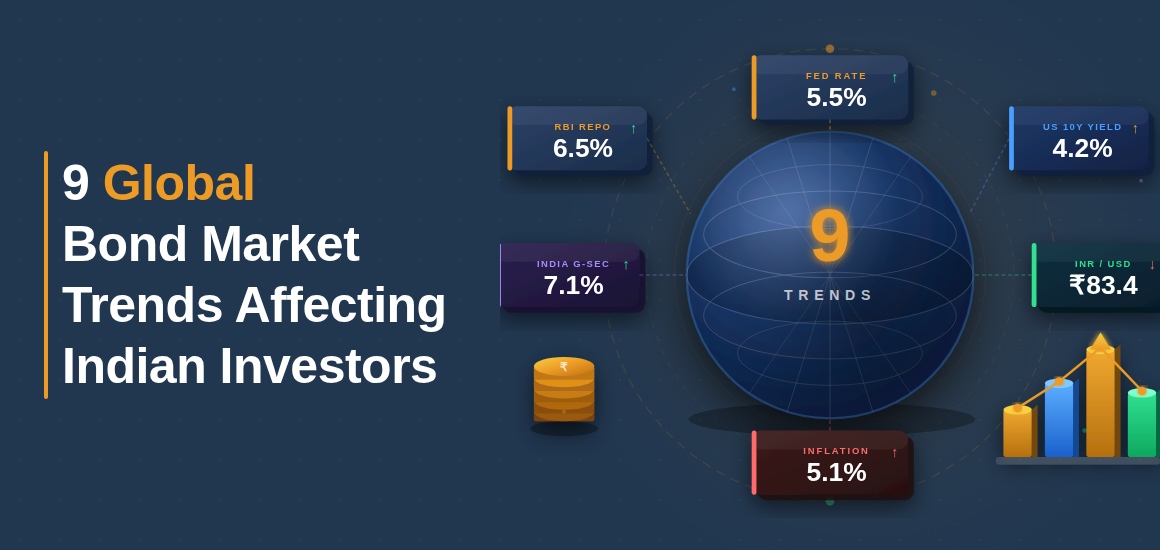
Need a compilation? Below are nine global market trends you must be aware of as an Indian bond investor in 2026:
1. Interest Rates are Stabilising After the Inflation Shock
In the past years, major central banks such as the U.S. Federal Reserve, European Central Bank, and Bank of England increased interest rates to control high inflation. For example,
- Between March 2022 and July 2023, the Federal Reserve repeatedly increased its benchmark policy rate (the federal funds rate) to control rising inflation.
- The rate increased from 0.25% in March 2022 to about 5.25%–5.50% by July 2023.
- This was one of the fastest rate-hiking cycles in decades.
Now, this created a negative impact and raised borrowing costs across economies. But now inflation is easing. Recently, on September 17, 2025, the U.S. Federal Reserve reduced the federal funds rate by 25 basis points, bringing it to 4.00%–4.25%. This was the first interest rate cut since December 2024.
Due to higher chances of “monetary policy easing” in the coming years, most global markets are expecting interest rates to stabilise or decline in the coming years.
2. Investors are Prioritising Strong Credit Quality
Recent credit events and corporate defaults in global markets have increased investor caution. For example,
- In August 2025, property developer Road King Infrastructure failed to make a scheduled interest payment on its offshore bond.
- The company missed a $22.62 million coupon payment on a bond due in 2029.
- After the grace period ended, the missed payment was officially treated as a “bond default”.
As a result, investors are now paying closer attention to the financial strength of bond issuers. In 2026, bonds issued by governments or companies with strong credit ratings (known as investment-grade bonds) are receiving greater demand.
In contrast, high-yield bonds issued by companies with weaker credit profiles are attracting selective interest due to a higher default risk.
3. Technology is Changing How Bonds are Issued and Traded
Digital technology is changing the way bonds are bought, sold, and issued across global markets. Earlier, bond trading involved:
- Multiple intermediaries
and
- Longer settlement cycles
But today, electronic bond trading platforms allow investors to access bond markets through online systems. In India, the Securities and Exchange Board of India introduced the concept of Online Bond Platform Provider (OBPP) to support these technological advancements. Platforms such as GoldenPi now allow retail investors to view, compare, and purchase bonds online.
Additionally, new developments such as “tokenised bonds” and “blockchain-based” issuance platforms are also emerging. These systems can create digital records of ownership and transactions. The benefit? It can increase transparency and reduce processing delays.
4. “Sustainable Bonds” are Becoming a Major Investment Theme
Sustainable bonds are debt instruments used to finance projects that support environmental or social objectives. These include:
- Renewable energy
- Clean transportation
- Water conservation
- Climate adaptation
- Affordable housing
Studies show that in the first half of 2025, “sustainable bond issuance” reached nearly $600 billion. And now, as per S&P Global, the forecast is for $800-900 billion in 2026.
For those unaware, India also participated in this market via “sovereign green bond” issuances. For example,
- In January 2023, the Government of India issued its first sovereign green bonds worth ₹8,000 crore.
- Later, in February 2023, another tranche of ₹8,000 crore was issued (taking the total to ₹16,000 crore).
- These bonds were issued through the Reserve Bank of India on behalf of the government.
5. Efforts to Expand India’s Corporate Bond Market Size
India’s corporate bond market currently equals about 16% of the country’s GDP. A NITI Aayog report proposes steps to expand this share significantly by 2030 and 2047 as part of the “Viksit Bharat” vision.
Additionally, the report highlights that India’s bond market is heavily dependent on banks, with limited participation from:
- Retail investors
- MSMEs
- Foreign portfolio investors (FPIs)
This “narrow investor base” reduces liquidity and limits market depth. To address this issue, the policy suggests several incentives for first-time investors. These incentives may:
- Expand the investor base
and
- Increase trading volumes
6. “Emerging Market Bonds” are Attracting Global Capital
In 2026, investors around the world are searching for higher returns as inflation stabilises in many developing economies. This has increased interest in bonds issued by emerging markets such as India, Indonesia, and Brazil.
Reason? These countries may offer higher bond yields compared with developed markets. As a result, global investors are now allocating more capital to “emerging market debt”.
Additionally, a major development for India is its inclusion in the JPMorgan Government Bond Index-Emerging Markets (GBI-EM). For those unaware, this index is tracked by several global investment funds. When India enters such an index, passive funds that follow the benchmark begin investing in Indian bonds.
7. Rising Japanese Bond Yields Are Triggering Global Market Reactions
Japan’s government bond market has entered a “volatile phase”, with long-term bond yields rising to the highest levels seen in decades. The biggest increase has occurred in bonds with maturities of 20 to 40 years, which usually remain stable.
The change started after the Bank of Japan began moving away from its long-standing ultra-low interest rate policy. Now, such rising Japanese bond yields can push up interest rate expectations in India. This may also:
- Increase long-term borrowing costs for companies
and
- Negatively influence sectors that depend heavily on credit.
8. India’s Sovereign Rating Upgrade Improves Investor Confidence
India received a sovereign rating upgrade from Rating and Investment Information, Inc. It raised the country’s long-term rating to BBB+ from BBB with a “stable” outlook. This was the third upgrade in 2025, following earlier upgrades from S&P Global Ratings in August and Morningstar DBRS in May.
Such higher credit ratings may improve investor perception and increase the demand for Indian government and corporate bonds.
9. Inclination of Foreign Investors Towards Indian Bond Markets
Foreign investors are currently adjusting their investment strategy in India. Due to factors such as a weakening rupee and global tariff tensions, investor sentiment toward equities has remained cautious.
As a result, foreign portfolio investors (FPIs) sold ₹13,450 crore worth of Indian equities in September 2025. This was followed by even larger withdrawals of ₹17,740 crore in August and ₹34,993 crore in July.
However, the trend is different in the bond market. FPIs have continued to invest in Indian debt securities. They purchased ₹12,339 crore worth of bonds in September 2025, after investing ₹14,640 crore in August and ₹11,811 crore in July.
Now, what does this pattern indicate? Global investors currently prefer the relative stability and pre-determined returns offered by bonds compared to equities.
The Key Takeaway
So now you are aware of the latest global bond market trends. As a bond investor, studying them is important, as such knowledge allows you to better anticipate market movements, manage risk, and identify new investment opportunities.
If we were to recap, some major trends (as of February 21, 2026) you must remember are:
- Investors preferring high-credit-quality bonds
- Sustainable bonds are gaining global investor attention
- Foreign investors are increasing allocations to Indian bonds
- Policy efforts are expanding India’s corporate bond market
- Emerging market bonds are attracting global capital
Are you looking to invest in the Indian bond market? You may consider GoldenPi, a SEBI-registered debt broker and OBPP licence holder. On the platform, you can explore multiple bond options such as highly rated bonds, high-yield bonds, short-term bonds, and more. Also, you can apply to the latest NCD IPOs. The process is 100% digital and can be completed online.
FAQs
1. Why should Indian investors track global bond market trends?
Global bond markets influence interest rates, capital flows, and investor sentiment worldwide. Trends prevailing in international markets may be tracked as they can influence borrowing costs and investment returns in India.
2. What is the latest credit rating of India in 2026?
As of February 21, 2026, India’s latest sovereign credit rating upgrade came from Rating and Investment Information, Inc., which upgraded the rating to BBB+.
3. How popular are “sustainable bonds” in 2026?
Sustainable bonds are used to finance projects related to environmental or social goals, such as renewable energy, clean transport, or affordable housing. In 2026, the global issuances of such bonds are expected to hit $800-900 billion, as per a report from S&P Global.
4. Why are emerging market bonds attracting global investors?
Emerging markets like India and Brazil may offer higher bond yields compared to developed economies. This makes them attractive to global investors looking for better returns.
Citations
________________________________________________________
Disclaimer:
This information is for general information purposes only. GoldenPi makes no guarantee on the accuracy of the data provided here; the information displayed is subject to change and is provided on an as-is basis. Nothing contained herein is intended to or shall be deemed to be investment advice, implied or otherwise. Investments in the securities market are subject to market risks. Read all the offer-related documents carefully before investing.
Bonds or non-convertible debentures (NCDs) are regulated by the Securities and Exchange Board of India and other government authorities. GoldenPi Securities Private Limited is a registered debt broker and acts as a distributor and not as a manufacturer of the product.