|
Getting your Trinity Audio player ready...
|
For a portfolio of 10-50 lakh rupees, there’s some wiggle room with choices, especially when it comes to fixed income. Investors in this bracket can diversify across multiple issuers, maturities, and credit profiles. However, they might also end up taking on unnecessary risk by concentrating too much on high-yield securities or holding too many small positions that are difficult to monitor.
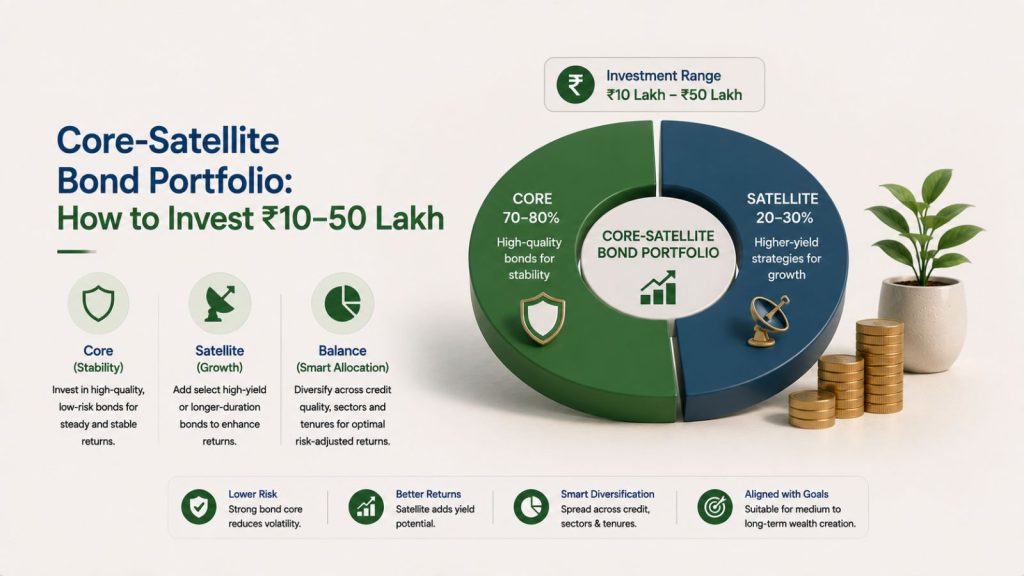
A core-satellite bond portfolio offers a practical middle ground. The core is designed around stability, liquidity, and predictable cash flows, while the satellite allocation is used selectively for higher-yielding opportunities or specific credit and duration views. For Indian investors, that could mean combining Government securities and high-quality corporate bonds with a smaller allocation to carefully evaluated credit opportunities.
The idea is simple: the core provides the foundation; the satellite is where you deliberately take additional risk for potentially higher returns.
Start investing with just ₹10K & grow your wealth with fixed return opportunities.
Invest Now

What Is a Core-Satellite Fixed Income Portfolio?
The core-satellite approach divides a portfolio into two broad parts.
The core consists of relatively stable investments that serve as a foundation of the portfolio. Examples include government securities, Treasury Bills, state development loans, and high-quality corporate or PSU (Public Sector Undertaking) bonds.
The satellite is the more flexible portion. It can include selected corporate bonds, higher-yielding securities, longer-duration opportunities, or other instruments where the investor is taking additional credit, liquidity, or interest-rate risk.
It is not about eliminating risk; it is about where you are willing to take on risk and how much of the portfolio you want to expose to that risk.
Latest Bond Update:
- Core-Satellite Bond Portfolio: How to Invest ₹10–50 Lakh
- Renewable Energy Bonds in India 2026: Green Finance & Returns

- How to Avoid TDS on Bond Interest Legally: 15G, 15H & Section 197
How Much Should You Allocate to the Core and Satellite?
There is no universal allocation because the right split depends on the investor’s time horizon, cash-flow requirements, and tolerance for volatility. As an illustrative starting point:
| Portfolio size | Core | Satellite | Possible approach |
| ₹10 lakh | 75–85% | 15–25% | G-Secs/T-Bills and high-quality bonds, with selective corporate credit |
| ₹25 lakh | 70–80% | 20–30% | Diversified G-Secs/PSU debt plus selected higher-yield bonds |
| ₹50 lakh | 65–75% | 25–35% | Broader maturity and issuer diversification plus selective credit/duration plays |
These investment ranges are illustrative only, not advice. A conservative investor with a short-term savings target may prefer a larger core allocation, while a longer-horizon investor with greater risk tolerance may prefer a larger satellite allocation. The important principle is that the satellite should remain a satellite.
How to Build the Core of an Indian Bond Portfolio
The core should primarily address three questions: how much capital risk am I taking, how easily can I access the money, and when will I need it?
Government securities are good candidates because they carry sovereign credit risk. The RBI’s Retail Direct program provides access to Treasury Bills, dated G-Secs, and State Development Loans to retail investors.
High-quality corporate and PSU bonds can complement government securities, particularly where the investor wants additional income without moving too far down the credit curve.
The core can also benefit from a maturity ladder. Spreading maturities creates regular reinvestment opportunities and reduces dependence on the interest-rate environment at any one point.
How to Use the Satellite Allocation for Higher Returns
The satellite is where an investor can take additional risk, but every additional percentage point of yield should have an identifiable explanation.
A bond with a materially higher yield than a comparable G-Sec may be compensating the investor for higher credit risk, lower liquidity, longer duration, or any combination of these factors.
That makes yield-to-maturity only the starting point of the analysis. Before buying a satellite bond, investors should understand the issuer’s leverage and cash flows, debt repayment schedule, security or collateral, seniority, covenants, rating outlook, and secondary-market liquidity. Existing exposure to the same issuer or business group also matters.
A 9% YTM is not necessarily better than a 7% YTM if the additional two percentage points do not sufficiently compensate for the risks involved.
How to Diversify a ₹10–50 Lakh Bond Portfolio
There is no single answer to how many bonds an investor should hold; the idea is to avoid significant concentration while still keeping the number of bonds manageable enough to monitor.
For a ₹10 lakh investment, it may be more effective to choose a few quality securities than to purchase 15-20 very small securities. With a ₹25-50 lakh portfolio, an investor may be able to purchase from a wider selection of issuers and maturities without making every holding economically insignificant. Prior to investing, an investor may wish to set a limit for how many securities they are willing to buy from individual issuers. The appropriate limit will depend on the issuer’s credit quality and the investor’s broader risk framework.
Common Core-Satellite Bond Portfolio Mistakes
The biggest mistake is allowing the satellite allocation to gradually become the core. Other common errors include:
- Chasing the highest YTM without understanding why it is high
- Treating a credit rating as a substitute for independent analysis
- Concentrating too much exposure in one issuer or business group
- Ignoring duration because a security has a high credit rating
- Assuming every listed bond can be sold quickly
- Building around coupon rates rather than actual cash-flow requirements
- Holding too many small positions that are difficult to monitor
For a sizeable fixed-income portfolio, repeatable portfolio construction is generally more valuable than finding one spectacular bond.
How to Review and Rebalance a Bond Portfolio
A core satellite portfolio needs to be reviewed regularly in order to analyze changes in credit rating, the financial position of issuers, concentration of maturity, interest rate conditions, and upcoming cash requirements.
This does not mean that each bond that has moved in price needs to be sold. If the original investment thesis holds and the security is intended to be held to maturity, holding may still make sense. The important question is whether the portfolio still reflects the investor’s original risk and liquidity objectives.
FAQs on Core-Satellite Bond Portfolios
A core-satellite portfolio divides the bond allocation into a core of relatively stable, high-quality debt and smaller satellite allocations to bonds offering higher yields or exposure to specific sectors and issuers.
G-Secs, T-Bills, SDLs, and selected high-quality corporate or PSU bonds can form the core, depending on the investor’s objectives, liquidity needs, and risk tolerance.
Satellite holdings are smaller positions taken to potentially enhance portfolio returns. They may include higher-yielding corporate bonds, NBFC bonds, or specific sector exposures, but they generally carry greater credit or liquidity risk.
No. YTM should be assessed alongside credit quality, duration, liquidity, security structure, taxation, and the likelihood of receiving the promised cash flows.
Not necessarily. Investors who prioritize maximum capital preservation may prefer a simpler portfolio dominated by high-quality government and highly rated debt. The satellite component makes sense only if the investor understands and can tolerate the additional risks.
Disclaimer
Fixed returns do not constitute guaranteed or assured returns. Investments in corporate debt securities and municipal debt securities/securitized debt instruments are subject to credit risks, market risks, and default risks, including delay and/or default in payment. Read all the offer-related documents carefully. This blog/article should not be construed as financial advice or as an offer or recommendation to buy or sell any security or any products/services of/on GoldenPi or any product/services of its third-party client(s). For a detailed calculation of YTM, visit our website. T&C’s Apply.