|
Getting your Trinity Audio player ready...
|
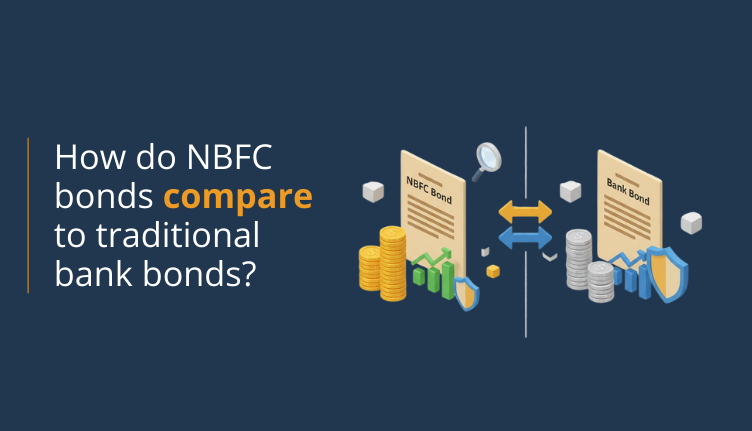
When investors look beyond fixed deposits (FDs), bonds issued by NBFCs and banks emerge as popular investment options. While both are debt instruments that promise regular interest payments, they differ in terms of:
- Risk profile
- Regulatory oversight
- Return potential
Are you looking to invest in them? Before committing funds, read this article to first understand how NBFC vs Traditional Bank Bonds differ on several parameters.
What are NBFC Bonds?
NBFC bonds are “debt instruments” issued by Non-Banking Financial Companies (NBFCs) to raise capital for their lending and business operations. By investing in an NBFC bond, you are simply extending a loan to the issuing NBFC. In return, you receive regular interest and the principal amount at maturity.
Usually, NBFC bonds are riskier than bank fixed deposits and offer a comparatively higher interest rate to compensate for this additional risk. Now, to further your understanding, check out the various types of NBFC bonds commonly issued in the market.
Some Common Types of NBFC Bonds
Realise that NBFCs raise money from investors by issuing different types of debt instruments. Usually, these instruments vary based on:
- Tenure/ duration
- Return structure
- Risk level
Some are short-term borrowing instruments, while others are meant for long-term funding. As an investor, you can choose from the several options mentioned below, based on your income needs, risk tolerance limit, and investment horizon:
| Type of Instrument | Usual Tenure (only an estimate) | Return Structure | Key Features |
|---|---|---|---|
| Commercial Papers (CPs) | Up to 1 year | Issued at a discount and redeemed at face value |
|
| Non-Convertible Debentures (NCDs) | 1 to 10 years | Fixed or periodic interest |
|
| Market-Linked Debentures (MLDs) | Usually 1 to 5 years | Linked to market indices or securities |
|
| Subordinated Debt | Medium to long term | Periodic interest |
|
| Perpetual Debt | No maturity date | Periodic interest (paid as long as the issuer chooses) |
|
| Secured Bonds | Varies | Periodic interest |
|
| Unsecured Bonds | Varies | Periodic interest |
|
Note: The above table mentions some common NBFC bond types and their features, referred to from secondary sources. Investors must do their own research before investing.
What are Traditional Bank Bonds?
Just like NBFC bonds, “bank bonds” are also loans that investors give to the issuer, which in this case are banks. Such issuing banks usually issue bonds to raise money for their business and meet capital requirements.
In return, the bank also pays interest at regular intervals and returns the original amount to the investor when the bond matures. Usually, bank bonds are considered “low risk”; however, their safety entirely depends on:
- The type of bank bond
and
- Its position in the repayment hierarchy
Also, since banks have strong balance sheets and high credit ratings, this could lower the chance of default compared to many other borrowers. Now, let’s have a look at the different types of bank bonds and their liquidity sequence.
Types of Bank Bonds
Besides accepting demand deposits from the general public, several banks also issue bonds to:
- Raise long-term capital
and
- Meet regulatory capital requirements set by the Reserve Bank of India (RBI)
While all bank bonds represent loans from investors to banks, they differ in maturity, repayment priority, and risk level. For more clarity, let’s check out their several types below:
| Type of Bank Bond | Maturity | Interest Payment | Security | Key Characteristics |
|---|---|---|---|---|
| Secured Bonds | Fixed tenure | Periodic | Backed by specific bank assets | Lower risk due to asset backing |
| Unsecured Bonds | Fixed tenure | Periodic | No asset backing | Depends on the bank’s credit strength |
| Floating Rate Bonds | Fixed tenure | Linked to the benchmark rate | Secured or unsecured | Interest rate changes with market rates |
| Callable Bonds | Fixed tenure + comes with a call option | Periodic | Secured or unsecured | The bank can redeem before maturity |
| Non-Callable Bonds | Fixed tenure | Periodic | Secured or unsecured | Cannot be redeemed early by the bank |
| AT-1 Bonds (Additional Tier – 1) | Perpetual (no maturity) | “Discretionary” periodic interest | Unsecured | It is the highest risk bank bond as:
and
|
| Subordinated Bonds | Medium to long term | Periodic | Unsecured | Repaid after senior creditors and divided into four categories:
|
Note: The above table mentions some common traditional bank bond types and their features, referred to from secondary sources. Investors must do their own research before investing.
Repayment Sequence in the Event of Liquidation
When an issuer bank is liquidated, its available funds are distributed in a predetermined order, known as the repayment hierarchy or liquidity sequence. Investors holding lower-priority instruments face higher risk because repayment happens only after higher-priority claims are settled.
For a better understanding, check out the repayment order (first to last) below:
- Senior secured creditors
- Subordinated Tier III bonds
- Subordinated Tier II bonds (Upper)
- Subordinated Tier II bonds (Lower)
- Subordinated Tier I bonds
- Additional Tier I bonds
- Equity shareholders
NBFC vs Traditional Bank Bonds: How Do They Differ?
At first glance, bonds issued by NBFCs and banks look similar, as both are loans where investors earn regular interest. But the real difference lies in:
- Who issues them
- How they are regulated
- Where they stand in terms of risk + capital protection
Realise that these factors directly influence returns and investor suitability. Now, to improve your understanding and pick the right financial product, see how NBFC vs traditional bank bonds differ on various aspects:
| Aspect | NBFC Bonds | Traditional Bank Bonds |
|---|---|---|
| Issuer | Non-Banking Financial Companies | Scheduled commercial banks |
| Primary Purpose | Fund lending and business operations | Meet capital and regulatory requirements |
| Regulator | Reserve Bank of India (RBI) | Reserve Bank of India (RBI) |
| Comparative Returns | Could be higher than traditional bank bonds | Could be lower than NBFC bonds |
| Common Types of Bonds |
|
|
| Tenure | Short to long term | Mostly medium to long term |
| Investor Protection by DICGC (Deposit Insurance and Credit Guarantee Corporation) | No | No |
To Sum It Up, Both NBFC and Bank Bonds are Debt Products Differing in Terms of Risk and Returns
So now you know both NBFC vs traditional bank bonds are two distinct debt instruments that differ in terms of:
- Risk profile
- Creditworthiness
- Interest rates
- Return potential
- Bond types
- Capital hierarchy
- Investor protection rules
As an investor, you may pick between these two products based on your risk appetite and the need for capital safety. Still, if you need a reference:
- NBFC bonds may suit investors looking to earn higher yields and willing to accept higher credit risk.
and
- Bank bonds may appeal to investors who prioritize capital protection and stronger regulation.
If you are searching for a list of NBFC bonds or bank bonds and want to invest online, you may visit the Goldenpi platform. Here, you can explore multiple investment options along with important details such as issuer information, credit ratings, coupon rates, and maturity dates.
NBFC vs Traditional Bank Bond FAQs
How to evaluate NBFC bonds?
Before investing in any NBFC bonds, you may first look at their credit rating [AAA (highest) to D (junk)] issued by leading agencies like CRISIL, ICRA, Acuite, and more. Next, assess its
balance sheet strength, asset quality, and repayment track record. Also, check whether the bond is secured or unsecured, its maturity period, and interest payment terms.
NBFC vs Traditional Bank Bond: Which financial product is safer?
As per industry understanding, traditional bank bonds could be safer than NBFC bonds. That’s largely because banks operate under tighter regulatory oversight, maintain higher capital reserves, and usually carry stronger credit ratings.
Are unsecured bonds subordinated?
No, unsecured bonds are senior bonds, which are ranked above subordinated debt instruments [Tier I, Tier II (Upper + Lower), and Tier III bonds] in the repayment hierarchy. The term “unsecured” only means there is no asset backing.
AT-1 bonds are perpetual. Can I sell them in the secondary market?
Yes, AT-1 bonds can be sold in the secondary market at the prevailing prices. However, some AT-1 bonds have low liquidity, and selling them before they are called by the issuer (by exercising the call option) may lead to capital losses.
Disclaimer:
This information is for general information purposes only. GoldenPi makes no guarantee on the accuracy of the data provided here; the information displayed is subject to change and is provided on an as-is basis. Nothing contained herein is intended to or shall be deemed to be investment advice, implied or otherwise. Investments in the debt securities/ municipal debt securities/ securitised debt instruments are subject to risks, including delay and/ or default in payment. Read all the offer-related documents carefully.
Bonds or non-convertible debentures (NCDs) are regulated by the Securities and Exchange Board of India and other government authorities. GoldenPi Securities Private Limited is a registered debt broker and acts as a distributor and not as a manufacturer of the product.