If you follow Indian debt markets, you’ve seen headlines like “CRISIL revises outlook to negative” or “ICRA places ratings on watch with negative implications.” Both sound alarming, and both are easy to confuse. A negative outlook and a rating watch are not the same thing, and the difference matters if you hold corporate bonds, NCDs, NBFC fixed deposits, or debt mutual funds. This guide explains what each signal means, how Indian rating agencies use them, and how to respond without overreacting.
Start investing with just ₹10K & grow your wealth with fixed return opportunities.
Invest Now

What Is a Credit Rating Outlook?
A credit rating tells you how likely a borrower is to repay on time. An outlook tells you which way that rating may move over the medium term, usually the next one to two years.
Outlooks generally come in four flavors:
- Positive: the rating could be upgraded
- Stable: the rating is likely to stay where it is
- Negative: the rating could be downgraded
- Developing: the rating could move either way, depending on events
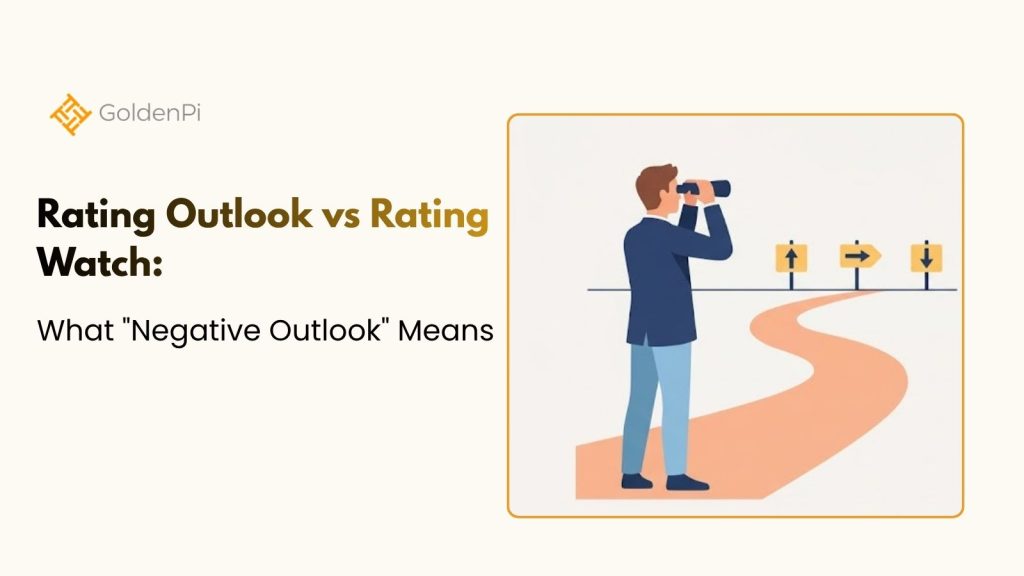
The key point is that an outlook is a direction of travel, not a decision. The agency is saying, “Based on what we see, a change is possible, but we’re not there yet.”
What Does a “Negative Outlook” Mean?
A negative outlook means the agency sees stress building slowly, but not enough to cut the rating today. Typical triggers include:
- Weakening profits or cash flows over a few quarters
- Rising debt without matching earnings growth
- Slow recovery in a sector the company depends on
- Pressure on asset quality, common for NBFCs and microfinance lenders
Imagine a real estate developer rated AA whose collections have slowed while debt has risen. The agency isn’t predicting a default. It’s saying that if things don’t improve over the next year or so, AA may become AA-.
Importantly, a negative outlook is not a guarantee of a downgrade. Plenty of issuers see it revised back to stable after earnings recover or promoters bring in capital.
What Is a Rating Watch?
A rating watch is a sharper, more time-bound signal. (Terminology varies: CRISIL, ICRA and India Ratings say “Rating Watch”, while CARE says “Credit Watch.”) The agency places a rating on watch when a specific event has happened or is expected soon, and its impact on credit quality needs assessing. Examples include a merger or acquisition, a large debt-funded capex plan, a regulatory action, a promoter stake sale or a pending court ruling.
Agencies tag a watch with a direction: negative implications, positive implications or developing implications. A watch is typically resolved within roughly three months, though it can be extended if the event is still unfolding.
Here the agency is saying, “Something has happened, and we’ll tell you shortly what it means for the rating.”
- Rating Outlook vs Rating Watch: What “Negative Outlook” Means
- How to Do a Demat-to-Demat Transfer in India: CDSL Easiest Step-by-Step Guide
- Beyond the Rupee: Decoding SEBI’s ‘Second Shelf’ for Global Bonds
Rating Outlook vs Rating Watch: Key Differences
| Feature | Rating Outlook | Rating Watch |
| What it signals | Possible direction of rating over time | A rating review triggered by a specific event |
| Typical time frame | 1–2 years | Short-term, usually around 3 months |
| Trigger | Gradual trends in financials or the sector | A defined event (merger, regulatory action, large borrowing) |
| Likelihood of rating change | Moderate | Higher and faster |
| Direction options | Positive, stable, negative, developing | Positive, negative, or developing implications |
| Investor response | Monitor closely. | Review your exposure promptly. |
If an outlook is a weather forecast, a watch is a storm warning with a clear cause.
Why Do These Signals Matter to Indian Investors?
In India, ratings aren’t just labels. They shape how money flows.
SEBI’s scheme categories set rating-linked limits for debt funds. For instance, corporate bond funds must keep at least 80% of assets in AA+ and above papers, and some funds choose to stay with AAA-rated issuers only. Banks factor ratings into loan pricing, and insurers and pension funds follow rating-linked investment norms. A downgrade can therefore trigger forced selling, wider yields, and costlier borrowing for the issuer.
The 2018 IL&FS episode remains the textbook lesson. The group’s ratings fell from the top category to default territory within weeks, and many investors who had treated the earlier AAA as permanent were caught off guard. The takeaway isn’t that agencies always warn in time, but that ratings can move fast, so you shouldn’t rely on the label alone.
Rating actions are also public. Agencies publish press releases on their websites, and listed issuers disclose them to stock exchanges, so tracking these signals is easy.
The same logic applies at the sovereign level, only more slowly. S&P held a positive outlook on India from May 2024 and upgraded the sovereign rating to BBB in August 2025. That was an outlook turning into an actual rating change.
How Should You React to a Negative Outlook or Watch?
Don’t panic, but don’t ignore it either. A practical approach:
- Read the rationale. Agencies publish a note explaining why, which tells you whether the issue is temporary or structural.
- Check your exposure. In a debt fund, review the top holdings. For direct bonds or NCDs, consider how much of your portfolio sits with one issuer.
- Watch the stated triggers. The note usually lists what could lead to a downgrade, such as debt rising beyond a specified multiple of earnings. Track those numbers.
- Treat a watch as more urgent. A negative outlook gives you time. A watch often leads to a decision within weeks.
- Think about liquidity. Lower-rated papers can be hard to sell quickly, so waiting for an actual downgrade may leave you with fewer exits.
Common Misunderstandings
“Negative outlook means the company will default.” No. An outlook speaks to rating direction, not default. Many issuers with negative outlooks remain comfortably investment grade.
“A stable outlook means everything is fine.” Not necessarily. Ratings can change without a prior outlook shift, especially after sudden events.
“Outlook” and “watch” are interchangeable. They aren’t. An outlook reflects slow-moving trends, while a watch responds to a specific event and works on a shorter clock.
The Bottom Line
A negative outlook is an early, slow-burning caution. A rating watch is a near-term alert tied to a specific event. Neither is a verdict, but both are useful signals for anyone holding Indian corporate debt. Read the rationale, track the stated triggers and keep position sizes sensible so a downgrade becomes a manageable event rather than a shock.
Frequently Asked Questions
A Negative Outlook means the rating agency sees factors that could lead to a downgrade if credit conditions deteriorate or expected improvements fail to materialize. It does not mean a downgrade is certain or that the issuer has defaulted.
An outlook reflects the potential direction of a rating over a period of time, while a Rating Watch typically signals uncertainty arising from a specific event whose credit implications are not yet clear. A Negative Outlook suggests possible downward pressure; a Watch with Negative Implications indicates that a downgrade may become more likely once the uncertainty is resolved.
A Stable Outlook indicates that the rating agency expects the rating to remain broadly unchanged over the relevant outlook period. It does not mean the issuer is free from risk or that its financial performance cannot deteriorate.
A Positive Outlook indicates that a rating upgrade may be possible if the issuer’s credit profile improves as expected. The agency will assess whether the improvement is sustainable before changing the rating. An upgrade is not guaranteed.
There is no fixed duration applicable to every rating agency or issuer. The outlook remains until the agency revises it, changes the rating or takes another rating action. CRISIL describes outlooks as covering a medium-term horizon of approximately one to two years, while the precise approach varies by agency.
The duration depends on how quickly the triggering event and its credit implications can be assessed. CRISIL says a Rating Watch is typically resolved in about 90 days, although the actual timing may vary with the circumstances.
Yes. A Stable Outlook does not prevent an unexpected downgrade. A significant deterioration in cash flow, a default, regulatory action or another material development can prompt a rating change without a prior change in outlook.
Disclaimer
Fixed returns do not constitute guaranteed or assured returns. Investments in corporate debt securities and municipal debt securities/securitized debt instruments are subject to credit risks, market risks, and default risks, including delay and/or default in payment. Read all the offer-related documents carefully. This blog/article should not be construed as financial advice or as an offer or recommendation to buy or sell any security or any products/services of/on GoldenPi or any product/services of its third-party client(s). For a detailed calculation of YTM, visit our website. T&C’s Apply.