Government Gold Bonds, also called Sovereign Gold Bonds or SGBs, are paper gold instruments issued by the RBI. They are priced in grams of gold, pay 2.5% interest a year and have an 8-year tenure backed by a sovereign guarantee. Fresh issuance has been paused since February 2024.
Indian families have always bought gold for weddings, festivals and long-term savings. In 2015, the government introduced Government Gold Bonds as a smarter alternative to keeping physical gold. These bonds track gold prices, pay 2.5% interest a year and need no bank locker for storage.
Example: Your sister’s wedding is five years away and the family wants to buy 50 grams of gold for the occasion. At today’s rate of around ₹15,700 per gram for 24-karat gold, that’s nearly ₹7.85 lakh. Storing it safely costs money, theft worries never fade and making charges eat the value with every remake.
A Government Gold Bond solves all that. You buy paper gold today at the current gold rate. Five years later you get back the gold value at that point, plus 2.5% interest collected every year.
What Are Government Gold Bonds?
Government Gold Bonds and Sovereign Gold Bonds (SGBs) are the same product. Two names for one instrument, launched in November 2015 under the Gold Monetisation Scheme.
Each bond is priced in grams of gold. Buy one bond and you own the right to one gram at the issue price. The RBI issues these on behalf of the central government, so they’re also called RBI gold bonds, sitting under the broader umbrella of gold backed bonds in India.
Start investing with just ₹10K & grow your wealth with fixed return opportunities.
Invest Now

How Government Gold Bonds Work
The mechanics of this gold bond investment are straightforward. When a bond is issued, its price is set close to the prevailing gold rate. At today’s 24-karat rate of around ₹15,700 per gram, a fresh bond would cost about ₹15,700 per unit.
The bond pays 2.5% interest a year, credited every six months. At maturity, eight years from issue, you get back the current market value of one gram of gold plus the final interest instalment.
A real example helps. The SGB 2020 series was issued at a gold bond price of ₹5,051 per gram. By April 2026 premature redemption, the gold price had climbed to ₹15,254. That’s a 202% capital gain over six years, plus 2.5% interest every year. Hard to argue with that math.
Related Post
- SGB Discontinued: 5 SGB Alternatives to Invest in Gold in 2026

- Best SGB Alternatives in 2026: Gold ETFs, Funds & More

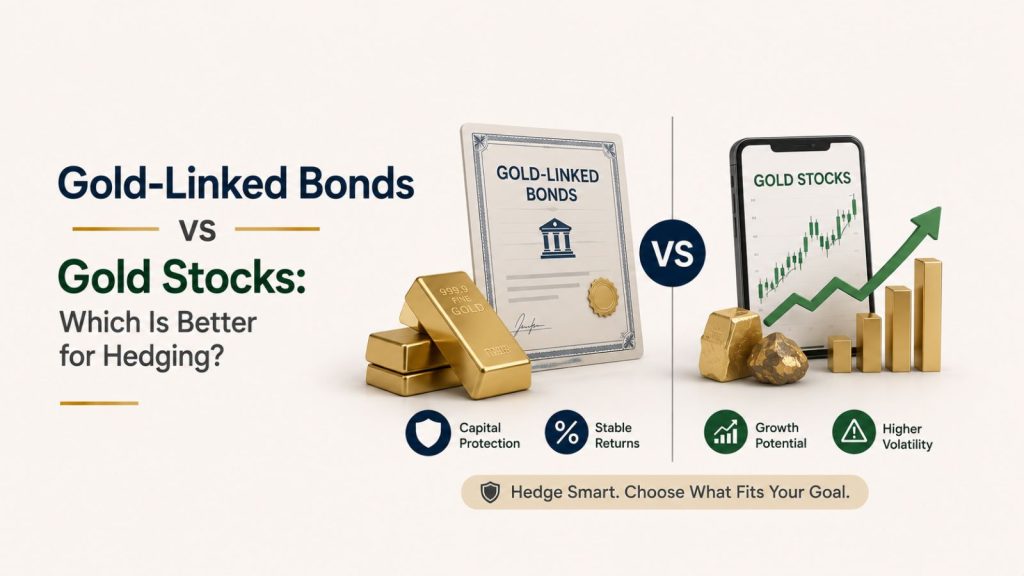
- Gold-Linked Bonds and Portfolio Hedging: When Gold Debt Beats Gold Mining Stocks
Safety of Government Gold Bonds
This is where Government Gold Bonds really shine. Each bond carries a sovereign guarantee. In plain words, the Government of India promises to pay you the gold value at maturity. India has never defaulted on a domestic bond, so the practical risk is essentially zero. You also don’t worry about storage, theft, or purity. The bond sits safely in your demat account.
The only real risk is gold prices falling. If gold drops over your holding period, the redemption value drops too. The 2.5% interest income keeps coming no matter what.
Tax Treatment Under Budget 2026
The 2.5% interest was always taxable at slab rate. Nothing has changed there. What did change is the capital gains tax treatment at maturity. Earlier, anyone holding an SGB till the 8-year mark got tax-free maturity. Budget 2026 narrowed that exemption.
The new rules:
- Direct RBI subscribers before 1 April 2026 still get tax-free maturity
- Anyone who bought after that or from the secondary market pays capital gains tax at maturity
- Early exit on the exchange attracts capital gains tax, with indexation if held long-term
The tax-free exit, once the scheme’s most attractive feature, now applies only to old direct subscribers.
How to Buy Government Gold Bonds Today
The RBI has not issued a fresh tranche since February 2024. The Finance Ministry called the scheme too expensive, since gold prices rose faster than they had budgeted for.
You can’t apply for new Government Gold Bonds today. But you can buy older series on the secondary market, where existing bonds trade between investors on NSE and BSE.
To buy an online gold bond from the existing SGB stock:
- Log into your demat account on your broker’s app or website
- Search for “SGB” to see listed series on NSE and BSE
- Check the current trading price
- Place a buy order like any other listed bond
Government Gold Bonds vs Other Gold Investment Options
Indians have several ways to own gold today, from physical jewellery to gold ETFs to NBFC Gold Loan Backed Bonds. Each works differently on returns, income and safety.
| Option | Returns | Income | Backing |
| Government Gold Bonds | Gold price + 2.5% | Half-yearly | Sovereign guarantee |
| Gold Loan Backed Bonds | 8.5% to 9.5% fixed | Regular interest | Collateralized bonds, gold pool |
| Gold ETFs | Gold price only | None | Fund company |
| Physical Gold | Gold price minus making charges | None | You |
Government Gold Bonds beat physical gold on safety, storage and the 2.5% income. They lose to Gold Loan Backed Bonds on cash flow, since 2.5% is much smaller than the 8.5% to 9.5% gold bond rates on NBFC NCDs. For pure gold exposure with full government backing, Government Gold Bonds remain the cleanest route.
Recent Post:
- Sweep-In FD Explained: How Auto-Sweep Accounts Work in India

- RBI Hikes Repo Rate to 5.50%: Calibrated Tightening, Forecasts & What Comes Next

- State Borrowing Surge: Impact of SDLs on India’s Bond Yields
Risks to Consider Before Investing
Even the safest fixed-income investment has some risks.
- Gold prices can fall. Your bond value moves with the metal
- Limited liquidity. Not every series trades actively
- Long lock-in. Premature redemption only kicks in from year 5, on interest payment dates
- Capital gains tax now applies to most new buyers via the secondary market
Government Gold Bonds? FAQs
Government Gold Bonds are paper gold instruments issued by the RBI, also called Sovereign Gold Bonds or SGBs. Each bond represents one gram of gold and pays 2.5% interest a year.
The Government Gold Bond scheme has been paused for fresh issuance since February 2024. Older series still trade on NSE and BSE.
Government Gold Bonds can be bought online through your demat account with any registered broker, listed on NSE and BSE like any other bond.
The best gold bond rates have come from older tranches like the 2016, 2017 and 2020 series. Significant gold price growth on top of the 2.5% fixed interest made them among the best gold bonds for long-term exposure with sovereign backing.
Government Gold Bonds: Final Take for Investors
Government Gold Bonds remain the simplest, safest way to own gold on paper in India. Within the family of gold backed bonds, they offer the strongest safety net through the sovereign guarantee, plus half-yearly interest and zero storage costs. Budget 2026’s tax changes have dented the appeal for new buyers, but for long-term gold price exposure with government backing, they remain a useful gold investment alongside other fixed-income choices.
Ready to Invest?
Visit GoldenPi to explore current gold bond options. Compare yields, ratings and tenures in one place and invest online with as little as ₹10,000.
Ready to Invest?
Visit GoldenPi to explore current bond options. Compare yields, ratings, and tenures in one place and invest online with as little as ₹10,000.
Disclaimer:
Fixed returns do not constitute guaranteed or assured returns. Investments in corporate debt securities and municipal debt securities/securitized debt instruments are subject to credit risks, market risks, and default risks, including delay and/or default in payment. Read all the offer-related documents carefully. This blog/article should not be construed as financial advice or as an offer or recommendation to buy or sell any security or any products/services of/on GoldenPi or any product/services of its third-party client(s). For a detailed calculation of YTM, visit our website. T&C’s Apply.