|
Getting your Trinity Audio player ready...
|
ICRA is among the largest credit rating agencies in India, which analyzes the financial strength of firms and financial institutions in order to assess their creditworthiness. The core aim of ICRA is to determine whether an issuer has sufficient resources to fulfill its liabilities on time.
Put simply, ICRA can be considered an independent body analyzing the state of finance of the borrower and awarding it a rating depending on the level of risk. Such ratings can help potential investors to estimate the probability of timely repayment of their money.
ICRA ratings are now widely applied in connection with various types of financial assets, ranging from corporate bonds and NCDs (non-convertible debentures) to fixed deposits, commercial papers, and bank loans. Financial institutions, mutual funds, banks, and individual investors use such ratings when making their investments.
Importance of ICRA Ratings
For instance, there are two bonds with slightly differing yields available for consideration. The first one has an ICRA AAA rating and provides a return of 7.5%, while the second has only a BBB rating and offers 10%. Which is expected yield, not a guaranteed ROI. If the BBB issuer defaults, your actual ROI could be negative 100%. Therefore, it looks better only if the investor is willing to take on substantial risk.
ICRA ratings allow for evaluating the risk related to a particular debt instrument.
For retail investors, ratings act as a shortcut to understanding credit risk. Instead of analyzing complex financial statements, investors can use ratings as a starting point for evaluating the safety of an investment.
How Does ICRA Rate Bonds?
What many investors want to know about ICRA bond ratings is how ICRA rates bonds.
In evaluating bond ratings, ICRA looks at various aspects like growth in revenues, profitability, level of debt, liquidity, and the ability to generate cash flows. Also considered are the industrial positioning of the business firm, competitive strength, and growth potential.
Management is another key element. Strong financial firms might face problems in their operations if there are issues with governance and the decisions made by the management. Therefore, ICRA looks at management experience, corporate governance, and strategic direction while rating bonds. The combination of all these aspects results in a rating for the issuer.
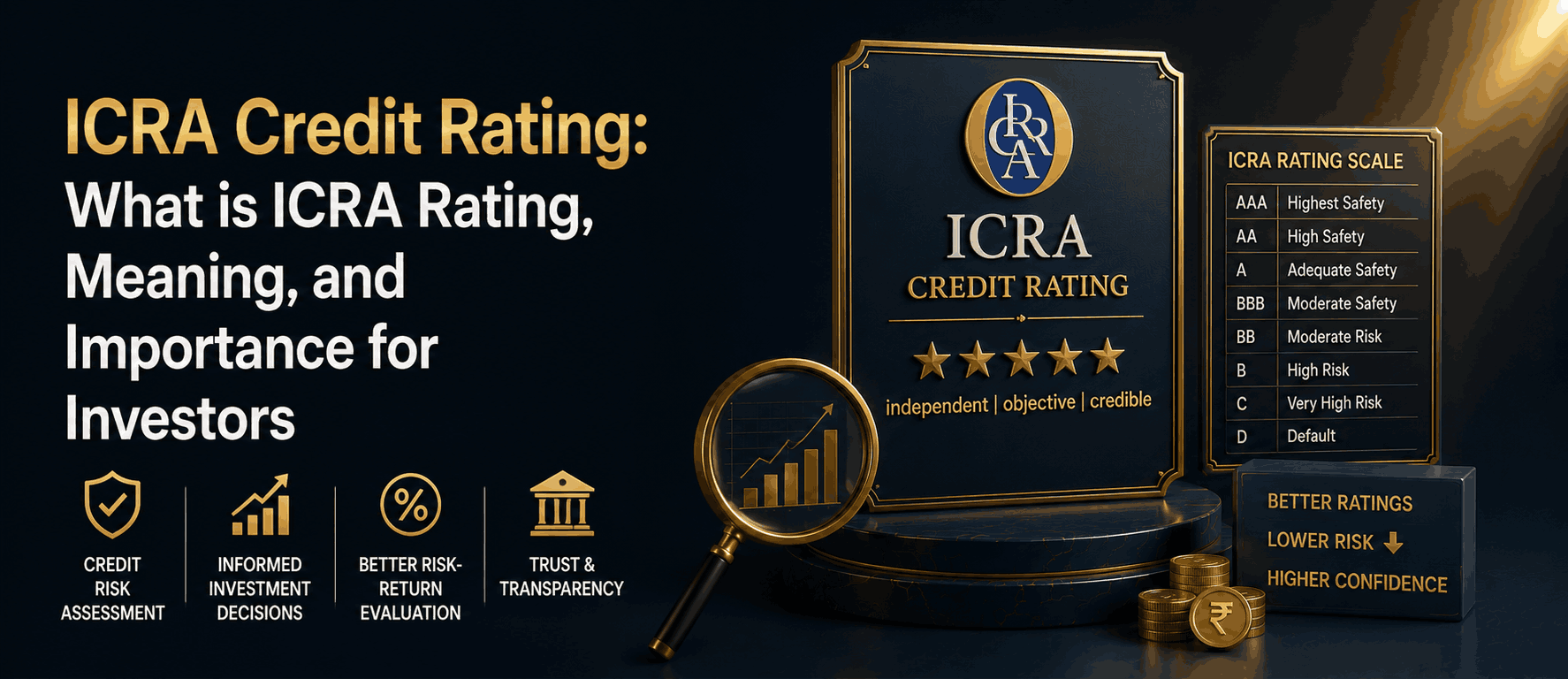
The ICRA credit rating scale in India ranges from AAA to D, with AAA representing the highest level of safety and D indicating default.
Here’s a simple breakdown:
| Rating | Meaning |
| AAA | Highest degree of safety |
| AA | High degree of safety |
| A | Adequate degree of safety |
| BBB | Moderate degree of safety |
| BB | Moderate risk of default |
| B | High risk of default |
| C | Very high risk of default |
| D | Default |
Think of the rating scale as a risk ladder. As you move down the scale from AAA to D, the level of risk increases while investor confidence decreases.
Recent Post:
- ICRA Credit Rating Agency: What is ICRA Rating, Meaning, and Importance for Investors
- Gold Price and Bond Market in India: Understanding the Relationship in 2026

- Government Securities in India 2026: Types, How to Buy & Why They Are a Safe Investment

What Does an ICRA Rating Mean for Investors?
The understanding of the meaning of the ICRA rating for an investor is important before making any investment.
It is usually misunderstood by many people that a rating is an indication to either buy or sell the bond. The truth is that a credit rating is just an expression of the ability of the entity issuing the bond to pay its debt back.
Investors should view ratings as an assessment of the level of risk involved rather than an indicator of gains. To put it into perspective, high ratings like those of AAA bonds tend to give low returns since they pose low levels of risk. Conversely, lower-rated bonds give investors better returns in exchange for their high risk.
The risk-return relationship is among the most basic concepts in bond investments.
How to Evaluate ICRA-Rated Bonds in India Before Investing
When exploring bond investments, many investors look specifically for ICRA-rated bonds in India as a measure of credit quality and financial stability. An ICRA rating can provide valuable insights into an issuer’s ability to meet its debt obligations, helping investors assess the level of risk associated with a bond.
However, a credit rating should not be the sole factor driving an investment decision. While highly rated bonds generally indicate lower credit risk, investors should also evaluate important factors such as yield, tenure, liquidity, issuer fundamentals, and overall market conditions.
For instance, a bond with an ICRA AAA rating may offer strong safety but could provide relatively lower returns compared to lower-rated alternatives. On the other hand, bonds with moderate ratings may offer higher yields but require investors to accept greater risk. Therefore, understanding the balance between risk and return is essential.
The most effective approach is to use ICRA ratings as a starting point for analysis rather than a final investment decision. Combining credit ratings with thorough research can help investors build a well-diversified and risk-appropriate bond portfolio.
ICRA vs CRISIL: Which Is Better?
ICRA and CRISIL are both highly recognized and respected credit rating agencies of the country. These two agencies do almost the same thing through a methodology that is equally stringent in nature.
ICRA has a highly competent research capability and comprehensive coverage of corporate debt markets. CRISIL, on the other hand, is the biggest credit rating agency in the Indian subcontinent.
Instead of discussing which one is a better credit rating agency, the important thing is to understand the rating as well as the financial position of the issuer concerned.
Understanding ICRA’s Rating Methodology
The ICRA rating methodology gives a complete analysis of an issuer’s ability to make payments.
Several dimensions are considered while making the ratings. These include financial risk, business risk, management efficiency, liquidity position, and industry prospects. The performance of a firm in bad market conditions is also taken into account.
It is necessary because credit risk not only depends on the present status of a company but also on its future. The future of a company needs to be assessed while considering its risk factors.
Through the combination of both qualitative and quantitative analysis, ICRA ratings provide objective information to investors.
Effective Use of ICRA Rating by Investors
For novice investors, ICRA ratings can be helpful in selecting bonds. An easy way is to check the ratings first before considering any other aspects. These can be return on investment, maturity period, etc.
Safe investments are usually AAA or AA-rated bonds, whereas those who wish to get high returns can go for A or BBB-rated bonds. But one thing should be kept in mind: there is a higher risk involved in the latter case.
Conclusion
The ICRA is an important part of India’s financial system because it helps investors determine the level of credit risk associated with the investments through its user-friendly rating system. From the AAA category, meaning that it is the safest investment, down to the D category, representing default, the ICRA rating system from AAA to D offers useful information about the issuer’s financial stability.
It is crucial for investors to learn about what ICRA is, the ICRA rating process, and how to interpret the ratings provided. Though ratings cannot be the only thing that will guide investment, it is a useful way for investors to make better judgments regarding their investment decisions.
In a world where there are many types of bonds out there, ICRA ratings can help investors make the most appropriate choices.
Ready to Invest?
Visit GoldenPi to explore current bond options. Compare yields, ratings, and tenures in one place and invest online with as little as ₹10,000.
Disclaimer:
Fixed returns do not constitute guaranteed or assured returns. Investments in corporate debt securities and municipal debt securities/securitized debt instruments are subject to credit risks, market risks, and default risks, including delay and/or default in payment. Read all the offer-related documents carefully. This blog/article should not be construed as financial advice or as an offer or recommendation to buy or sell any security or any products/services of/on GoldenPi or any product/services of its third-party client(s). For a detailed calculation of YTM, visit our website. T&C’s Apply.
Credit rating agencies are independent financial evaluation institutions that perform granular research audits on an issuer’s operational sheet, fiscal cash leverage, and capital history to systematically calibrate their ability to clear liabilities seamlessly on time.
Yes. Issues assigned with ICRA’s flagship highest-tier AAA rating demonstrate the highest degree of structural fiscal safety. Capital default vulnerabilities inside these parameters are mathematically minimal.
Both baseline platforms deploy incredibly stringent quantitative matrix filters mapping credit leverage, coverage metrics, and business stability. Rather than tracking execution differences, investors should directly parse the baseline corporate balance sheet strength of individual target issues
The primary threat is structural default risk. Instruments carrying sub-investment or moderate speculative credit markings (such as BBB or lower) distribute elevated yields explicitly because they embed a mathematically real probability of interest suspension or wholesale core capital default.
No. Credit ratings evaluate default likelihood vectors exclusively; they do not construct buy, sell, or asset execution advice. Portfolios must systematically balance individual risk limits against tenure metrics, market yield curves, and localized asset liquidity profiles.