|
Getting your Trinity Audio player ready...
|
You might have started the year 2026 with an allocation of about 70% in equities and 30% in bonds. But is it still the same? The answer could be a “NO”. Gradually, market fluctuations influence your portfolio mix and drift it from your intended or comfortable targets. This increases your overall portfolio risk and leaves you more exposed to equity volatility (possibly more than you’re comfortable handling!).
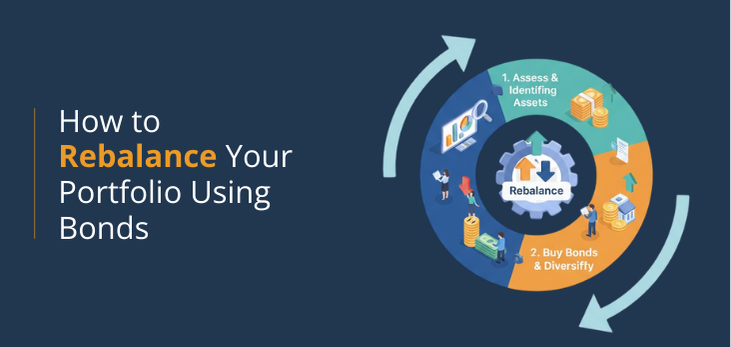
So, what’s the solution? You need to do “portfolio rebalancing”, which means adjusting your asset classes in a way so they continue to match the level of risk and return you originally planned for.
Read this article to understand what portfolio rebalancing means, why bonds are a popular choice for bringing your portfolio back to balance, and how you can rebalance following some simple steps.
What is Portfolio Rebalancing, Really?
“Rebalancing” means resetting your portfolio back to the plan you started with. Usually, when you invest, you start by choosing a mix (let’s say, 60% equity + 40% bonds). But most asset classes don’t grow in sync! Sometimes, the market price of your shares might increase in value, while bonds fall or stay flat.
The impact? Your portfolio slowly drifts away from the mix you originally wanted (in the instant case, the 60/40 split). This makes your portfolio riskier than you planned, because now a bigger chunk of your money is sitting in equities.
Okay, so how can you fix this? You may perform portfolio rebalancing as follows:
| What You Do | What It Means | Why You May Do It |
| Sell investments that have grown too much (say, equities after a rally) | You reduce the portion of assets that have become bigger than your target allocation. |
|
| Move that money into safer assets (say, bonds) | You invest the proceeds into assets that are currently below your target allocation. |
|
Why You May Use Bonds for Portfolio Rebalancing?
Be aware that portfolio rebalancing works because different assets behave differently. It is a well-established fact that both equities and bonds (the two major asset classes) have an inverse relationship. And that’s why several investors prefer making asset allocation to bonds to manage/reduce their equity risk.
But how does this happen? Usually, equities fluctuate in the market. But bonds are comparatively less volatile and offer pre-determined income. Also, bonds perform relatively better than equities in weak market phases, particularly during:
- Economic slowdowns
or
- Rate cuts
In such situations, bonds may hold value or even rise, which offers a cushion when equities fall.
How to Do Portfolio Rebalancing Using Bonds?
The first step is to understand where your money currently is. As an investor, you must check your investment levels:
- How much is in equity?
- How much in bonds?
- How much in gold, real estate, or cash?
Next, calculate the percentage each asset holds in your total portfolio. After making this calculation, you may follow these steps:
Step I: Set Your Target Allocation
Your target mix could be based on:
- Age
- Risk appetite
- Investment horizon
- Financial goals
For example (only for illustrative and educational purposes),
- A young investor with a long horizon may prefer 70% equity and 30% bonds.
- A risk-averse investor might choose 50% equity and 50% bonds.
- A retired person may prefer 30% equity and 70% bonds.
Now, this target mix becomes your guide for all portfolio rebalancing decisions. Always remember that there is no “correct” mix, but only the one that suits you.
Step II: Identify Deviations
Now compare your current allocation to your target allocation. Let’s say your target is 60:40 (as determined in Step I). But due to a market rally, your portfolio becomes:
- Equity: 70%
and
- Bonds: 30%
This means equities are overweight by 10%, and bonds are underweight by 10%.
Step III: Buy, Sell, or Redirect Money to Rebalance the Mix
Once you notice that your portfolio has drifted away from your target allocation, the next step is to restore the balance. You can do this in two ways:
| Method | What You Do | Why It Helps |
| Option 1: Sell What’s Overgrown | Sell part of the asset class that has become larger than your target (say, equities after a rally). |
|
| Option 2: Buy What’s Less | Make fresh bond investments if they are below your target allocation. |
|
Step IV: Use Different Types of Bonds for Diversification
The bond market in India offers many choices. As an investor, you may invest in different types of bonds with varying risk levels and maturities.
Your diversification technique could be to mix:
- Government securities (G-Secs): Lower risk due to sovereign guarantee
- State development loans (SDLs): Safe and comparatively higher returns than G-secs
- Corporate/ PSU bonds: Competitive returns depending on credit rating
- Gilt funds: Invest in government securities
- Debt mutual funds: Invest in corporate bonds of varying durations and credit ratings
By splitting your bond investments across categories, you may reduce portfolio risk and improve stability.
An Example of Portfolio Rebalancing
Let’s say you start with ₹6 lakh in equity and ₹4 lakh in bonds. Your target is 60:40. Now, after a year:
- The equity becomes ₹9 lakh
and
- Bonds become ₹4.2 lakh
As a result, now equity is 68% and bonds are 32%. To restore the balance, you decided to:
- Sell 8% of your equity shares
and
- Invest the proceeds into bonds
In this way, you restored the mix to 60:40.
To Conclude, Portfolio Rebalancing is About Sticking To Your Original Plan!
So now you know that portfolio rebalancing is a technique through which you can restore the original risk level of your portfolio. Usually, you reduce the equity percentage and divert the proceeds into bonds. Alternatively, some investors avoid selling equities altogether and prefer making fresh bond investments to bring the portfolio back to its intended mix.
The advantage? Both approaches may keep your portfolio balanced + aligned with your original plan. If you are searching for investment-grade bonds to rebalance your portfolio in 2026, you may visit the GoldenPi platform.
Here you can find various options, including AA or AAA-rated bonds, PSU bonds, high-yield bonds, short-term bonds, and more!
Portfolio Rebalancing FAQs
1. When to do portfolio rebalancing?
There is no “right” time, but several investors prefer doing it annually or semi-annually. Alternatively, you can do rule-based portfolio rebalancing, for example, when the deviation increases by 5 to 10% from your target allocation.
2. What is an ideal portfolio target allocation?
There is no single ideal mix. Your allocation depends on your age, investment style, and risk appetite. A conservative investor may prefer more bonds, while an aggressive investor may choose higher equity exposure. Remember that the “right” mix is simply the one that matches your risk tolerance limit.
3. Why use bonds for portfolio rebalancing?
Bonds are comparatively less volatile and perform better than equity shares during weak economic conditions. Also, they offer regular interest income. After a market rally, by shifting some of your equity gains into investment-grade corporate bonds, you can lower your overall portfolio risk.
4. Should I sell equities or make a fresh investment to rebalance my portfolio?
Both work, and the choice depends on you! Selling equities keeps your portfolio size roughly the same, while making fresh investments in bonds increases your overall portfolio value. Investors often choose between these options based on applicable taxes and their long-term financial goals.
Disclaimer:
This information is for general information purposes only. GoldenPi makes no guarantee on the accuracy of the data provided here; the information displayed is subject to change and is provided on an as-is basis. Nothing contained herein is intended to or shall be deemed to be investment advice, implied or otherwise. Investments in the securities market are subject to market risks. Read all the offer-related documents carefully before investing.
Bonds or non-convertible debentures (NCDs) are regulated by the Securities and Exchange Board of India and other government authorities. GoldenPi Securities Private Limited is a
registered debt broker and acts as a distributor and not as a manufacturer of the product.