Most investors hold gold to own something that does well when everything else does badly. That is a hedge. But the two common ways to own gold do not both do that job: one tracks the metal’s price, and the other is a share in a business that digs it out of the ground. In a crisis, they can move in opposite directions.
Getting this right is the whole of portfolio hedging with gold. Buy the wrong form of gold investment, and your hedge can fall when you need it most. Good gold investment here means matching the form to the job.
Start investing with just ₹10K & grow your wealth with fixed return opportunities.
Invest Now

Why Mining Stocks Are Not a Clean Hedge
A gold mining share looks like a gold play. It is really an equity, with two features portfolio hedging should not have.
The first is operational leverage. A miner’s costs are largely fixed, so when gold rises, most of the extra revenue becomes profit. A 10% rise in gold can lift a good miner’s earnings 20% to 30%, attractive on the way up. But in reverse, when gold falls, profits fall faster, and the share drops far more than the metal. In June 2026, a major gold miner’s index fell over 15% in one month [1].
The second is equity-market correlation. Mining shares are still shares. In a market crash, they often fall with everything else, even when gold is steady [2]. A hedge that drops when the market drops is not doing its job.
So mining stocks are amplified gold, not protection: fine for betting on rising gold, but wrong for a hedge.
Latest Gold-Backed Bond Updates:
- SGB Discontinued: 5 SGB Alternatives to Invest in Gold in 2026

- Best SGB Alternatives in 2026: Gold ETFs, Funds & More

- Gold-Linked Bonds and Portfolio Hedging: When Gold Debt Beats Gold Mining Stocks
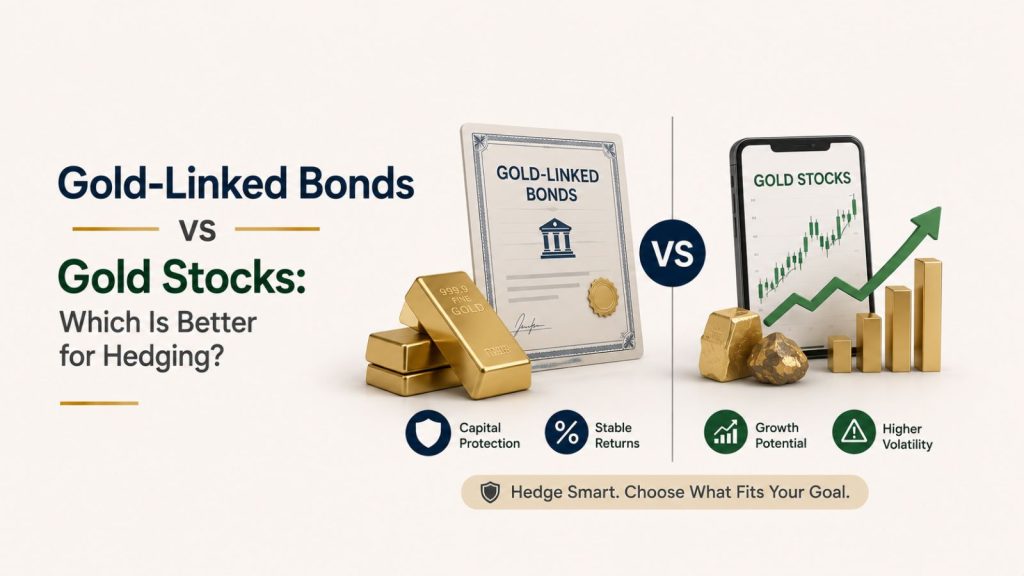
What Gold Debt Does Differently
Gold-linked bonds, such as Sovereign Gold Bonds, track the metal directly: no mine, no costs, no management, and no equity risk. When gold rises 10%, the bond rises about 10%, not 30%, and when gold falls, it falls in step, not faster.
For portfolio hedging, that plainness is the point. The hedge should move with gold and nothing else, whatever the market or a company does.
Gold debt adds two things physical gold and mining shares lack: it pays interest, and it has no storage or purity worries, sitting in your demat account. For portfolio hedging, gold investment through bonds beats jewelry or mining shares.
Gold Bonds vs Gold Mining Stocks: The Real Comparison
Based on the qualities portfolio hedging needs, the gold bonds vs. gold mining stocks question almost answers itself. Here is the scorecard:
On tracking the metal, the bond wins: it follows gold directly; the stock follows gold plus the market plus company risk.
On crash behavior, the bond wins again: it follows gold, while the stock can fall with the market even if gold holds, which a gold allocation in a portfolio should avoid.
On the upside in a bull run, the stock wins: operational leverage lifts miner earnings faster than the metal. But that contest is rarely about gain alone.
That last point is key. The choice is not which is better in the abstract but which fits the job: for protection, the right gold investment is the bond; for an aggressive bet on rising gold, the mining stock is the fit, at a much higher risk.
How Much Gold, and in Which Form
A common rule of thumb puts a gold allocation in a portfolio at 5% to 10%. The figure is personal, and this is not advice. Enough to matter in a crisis, without so much that it drags long-run returns that tend to sit there.
The more useful question is which form it takes. If the gold allocation is meant to hedge, most of that gold allocation in the portfolio belongs in the direct-tracking form, gold debt, or a gold ETF, not mining shares.
Gold is also a well-known inflation hedge, and gold bonds are a clean way to own it: when prices rise and cash loses value, gold has historically held purchasing power. Gold bonds capture that without equity noise. They also pay interest while they lie in your account. A mining stock depends on costs and the market, so gold bonds do the job more directly.
Frequently Asked Questions
Historically, yes. Gold has tended to hold or gain value during inflation, currency weakness, and market stress, when other assets struggle. That is why a small gold allocation in portfolio construction is common, and a gold allocation in a portfolio usually includes some. It is a diversifier, not a growth engine; the point is stability, not return.
For protecting purchasing power, yes, in the right form. Direct gold exposure, through gold debt or a gold ETF, hedges cleanly. Mining shares do not, because they carry equity risk. So for portfolio hedging, gold works only in the form that tracks the metal.
The cleanest way is to hold gold in a form that tracks the metal directly, such as gold-linked bonds, so it works without equity risk. Sizing it to a modest share, commonly 5% to 10%, is how most approach gold investment for portfolio hedging.
It depends on the goal, the heart of the gold bonds vs gold mining stocks choice. For a hedge, gold debt or a gold ETF tracks the metal with no equity risk. For upside, mining stocks offer leverage at higher risk. For portfolio hedging, most prefer the direct-tracking form. That is the gold bonds vs gold mining stocks verdict.
For inflation, gold bonds are cleaner. They track the metal, which has historically preserved purchasing power. A mining stock also depends on costs and the market, so gold bonds beat it by being directly related to gold.
Conclusion
Gold earns its place in portfolio hedging as protection, and the form you choose decides whether it delivers that or something else.
For portfolio hedging, mining stocks are amplified gold. They can beat the metal in a bull run, but their operational leverage and equity risk mean they can fall hard in exactly the conditions a hedge is meant for. Gold debt tracks the metal directly, pays interest, and carries no equity risk, so the gold bonds vs gold mining stocks call usually goes to the bond.
The takeaway in portfolio hedging: match the form to the purpose. For a hedge, use the direct-tracking form and size it modestly. For an aggressive bet on rising gold, mining stocks offer more, but you are buying leveraged equity, not protection. They are tools for different jobs.
Sources
- Gold miners index June 2026 decline, ETF.com
- Gold mining stocks behave like gold or equities? – Science Direct
- Gold’s role as an inflation and safe-haven hedge, VanEck