If you’re retired, semi-retired, or simply appreciate the reliability of a predictable sum of money flowing into your account every month, you’re likely considering POMIS and bonds. Both offer stable cash flows with low volatility, but each of them has unique characteristics that impact the savings return, safety, taxation, and the cost of exit in case you change your plans. Let’s break it down plainly.
Start investing with just ₹10K & grow your wealth with fixed return opportunities.
Invest Now

Post Office Monthly Income Scheme (POMIS) Explained
POMIS is about as simple as fixed income gets. You deposit a lump sum, and the post office pays you a fixed monthly interest for five years. The rate is currently 7.4% per annum [1], a rate that has remained unchanged since April 2024 and is reviewed quarterly by the government.
A few things make POMIS distinct:
- Maximum investments for an individual account and a joint account are ₹9 lakh and ₹15 lakh, respectively, with an initial investment of only ₹1,000 [1].
- Interest is fully taxable and does not qualify for the Section 80C deduction, but there’s no TDS, so tax reporting responsibility sits entirely with you.
- After the rate is confirmed, it stays the same for the subsequent 5 years, even if the government revises rates later, which is a considerable positive if rates are expected to drop.
- Premature exit isn’t allowed before one year; closing between one and three years attracts a 2% deduction from the principal and, between three and five years, a 1% deduction [1].
Example: If Meera were to invest ₹9 Lakh in POMIS, she would earn roughly ₹5,550 a month at 7.4%, which is modest but is a government-guaranteed and predictable return on her investment.
Worth noting: for the July-September 2026 quarter, the Senior Citizen Savings Scheme would earn you 8.2% p.a. [1], which would be more attractive than POMIS if you qualify by age.
Bonds for Monthly Income: RBI Bonds, NCDs and PSU Paper
“Bonds” is a broad basket, so let’s split it into the three types relevant for income seekers.
RBI Floating Rate Savings Bonds (FRSB 2020):
The coupon is currently 8.05% [2], resetting every six months, equivalent to the NSC rate plus a 0.35% spread. The catch: interest is paid half-yearly, not monthly, and the tenure carries a hard seven-year lock-in, relaxed only for senior citizens.
Corporate bonds / NCDs:
These offer genuine variety in payout frequency. AAA-rated corporate NCDs are currently trading at around a 7.5–9.0% yield, AA-rated paper at around 9.0–11.0%, and A-rated bonds higher still, reflecting the extra credit risk you’re taking on. Some newer platforms even structure NCDs with monthly coupons specifically for retirees.
PSU bonds:
These bonds are among the safest in the corporate bond space. The coupons for 2026 fall broadly in the 7.0% to 7.5% range, considering their close government support. They’re often used as a middle ground between POMIS-level safety and NCD-level yield.
An example: Rajesh, who is comfortable taking a moderate level of risk for monthly cash flow, invests half of Rs 10 lakhs in an AAA NCD, which offers nearly 8% monthly interest, and the rest in POMIS. The investment provides a balance of safety and yield.
Latest Bond Updates:
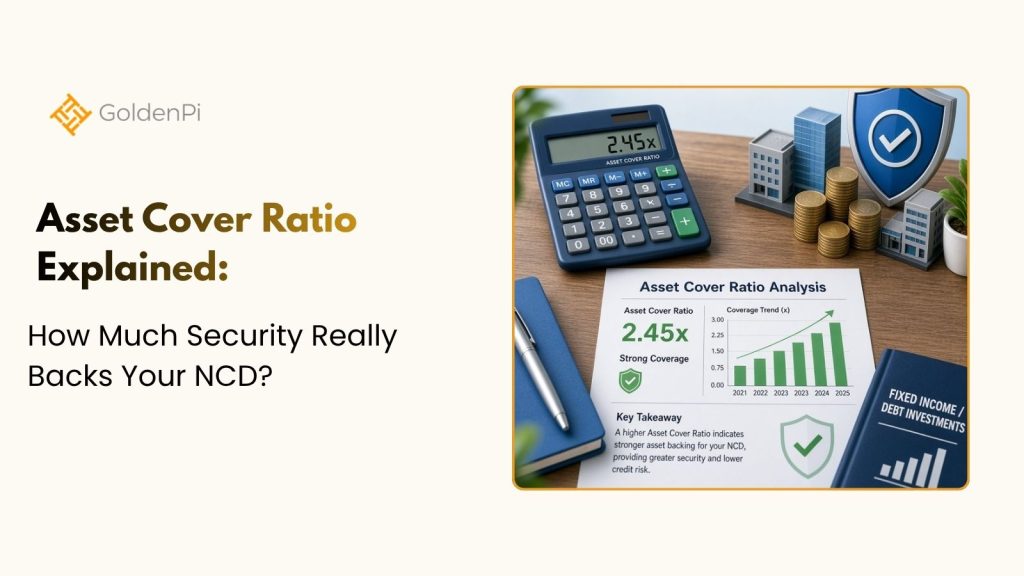
- Asset Cover Ratio Explained: How Much Security Really Backs Your NCD?
- JSW Paints Plans 4- and 5-Year Bonds to Refinance Akzo Acquisition Debt

- YES Bank AT1 Bond Verdict: Bondholders Seek Clarity on Coupon Payments

POMIS vs Bonds: Head-to-Head Comparison
| Feature | Post Office MIS | RBI Floating Rate Bonds | Corporate NCDs / PSU Bonds |
| Current rate | 7.4% p.a. | 8.05% p.a. (resets half-yearly) | 7.0%–11% p.a. (varies by rating/issuer) |
| Payout frequency | Monthly | Half-yearly | Monthly, quarterly, or annual (issuer-dependent) |
| Tenure | 5 years | 7 years (lock-in) | Typically 2–7 years |
| Safety | Sovereign-backed | Sovereign-backed | Depends on issuer rating; PSU bonds near-sovereign |
| Tax treatment | Fully taxable, no TDS | Fully taxable, TDS above ₹10,000 | Fully taxable, TDS above ₹5,000 |
| Liquidity | Restricted, with a penalty before 3 years | Very limited; only seniors can exit early | Tradable on exchange (if listed) |
Which One Should You Choose in 2026?
For a smaller corpus, POMIS is still one of the best choices for zero risk and predictable cash flow with no market exposure: starting an account is simple, does not require a demat, and the monthly payouts are in line with most people’s budget cycles. For people willing to skip the monthly payout, the RBI Floating Rate Bond currently has a better listed rate with equal sovereign safety, an excellent option for the “park and forget” bucket of the fixed income portfolio. If your goal is monthly cash flow with the potential of a higher payday and you can take a bit of credit risk, AAA- or AA-rated NCDs and PSU bonds are worth looking into through SEBI-registered online bond platforms to browse trusted issuers.
For most conservative investors, a sensible way to manage safety and yield is to ladder among these investment options rather than placing a large portion into one.
Frequently Asked Questions
It depends on the bond’s coupon, purchase price, and yield to maturity. MIS offers a government-notified rate, while bond income can vary considerably across issuers, ratings, and maturities. A higher bond yield usually comes with additional risk.
MIS generally carries lower credit risk because it is part of the government’s small-savings framework. Corporate bonds depend on the issuer’s ability to make interest and principal payments, so investors face credit/default risk in addition to market and liquidity risks.
Interest from both MIS and most taxable bonds is generally taxable as income at the applicable tax rate. However, the exact tax treatment can differ depending on the bond and the investor’s circumstances. Post-tax income, rather than the headline rate, should be compared.
Yes, but premature closure is subject to the scheme’s prescribed conditions and applicable deductions. Investors should check the prevailing rules before closing an account early.
Depending on the bond, investors can face credit/default risk, interest-rate risk, liquidity risk, and price volatility. Government securities generally have much lower credit risk, while corporate bonds require greater issuer-level due diligence.
Sources
Disclaimer
Fixed returns do not constitute guaranteed or assured returns. Investments in corporate debt securities and municipal debt securities/securitized debt instruments are subject to credit risks, market risks, and default risks, including delay and/or default in payment. Read all the offer-related documents carefully. This blog/article should not be construed as financial advice or as an offer or recommendation to buy or sell any security or any products/services of/on GoldenPi or any product/services of its third-party client(s). For a detailed calculation of YTM, visit our website. T&C’s Apply.