The US Federal Reserve recently increased its benchmark interest rate for the first time in three years. Led by Fed Chair Kevin Warsh, the central bank raised the rate by 25 basis points (0.25%), pushing the target range to 3.75%-4.00% from the earlier 3.5%-3.75% range. The main drivers behind this decision are sticky inflation—fueled by the ongoing West Asia crisis and surging global energy costs—along with a consistently strong US labor market.
While this looks like an internal policy tweak designed to tackle US domestic inflation, its financial repercussions can be felt across the globe. For an emerging market like India, the impact is immediate.
Here is exactly how a policy shift in America lands straight on your kitchen table.
1. The Great Capital Flight: The Interest Rate Differential
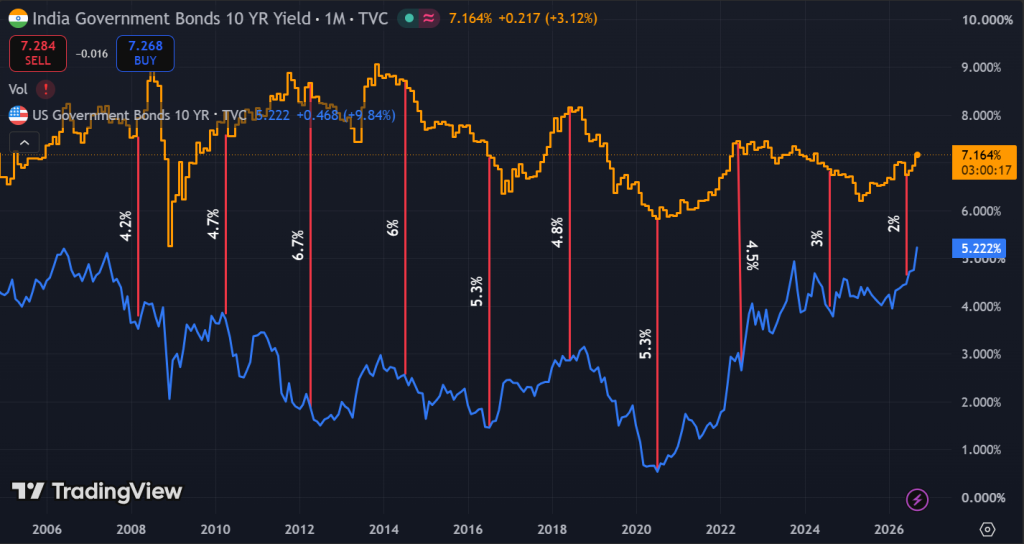
When the US Fed hikes interest rates, US Treasury bonds begin offering safer, highly attractive returns. Right now, the US 10-year Treasury bond is yielding around 5.00% – its highest level since the 2007 Global Financial Crisis.
Meanwhile, India’s 10-year Government Bond (G-Sec) is offering around 7.00%. The gap between these two rates is just 2%. This gap is known as the Interest Rate Differential.
Historically, this yield difference hovered between 4% and 6%, which made Indian markets attractive to foreign investors. For example, back in 2013, India’s 10-year bond yielded 9% while the US 10-year bond yielded 3% – a comfortable 6% cushion. Today, that cushion has shrunk to just 2%. Furthermore, because US bonds pay out in US Dollars (USD), they completely eliminate currency risk for foreign funds.
Latest Bond Updates:
- RBI October MPC Meeting Minutes: Inflation Spreading, and More Rate Hikes Possible
- RBI Rejects All 224 T-Bill Bids as Yields Surge: Impact on Liquidity and Rates
- Surety Bonds in India: Meaning, Types, Benefits & How They Work

When this interest gap narrows, it creates a “currency trap” that triggers a massive outflow of money from India.
Let me explain with an example:
- The Inflow: An investor brings $1,000 to India when the exchange rate was 85 USD/INR. They convert this capital into ₹85,000.
- The Indian Return: They invest this money into a 10-year Indian Government Bond offering a 7% yield. One year later, their investment grows to approximately ₹91,000 (₹85,0001.07).
- The Currency Depreciation: Over that same year, due to the West-Asia War and US Interest rate hike, the global demand for dollars surged, causing the Indian Rupee to depreciate from 85 to 96 USD/INR.
- The Repatriation: The investor decides to exit and converts their ₹91,000 back into US Dollars at the new rate of 96 (₹91,000/96). They receive just $948.
Despite making a nominal 7% profit inside India, the investor suffers a net loss of over 5% in absolute Dollar terms due to currency erosion.
To protect their principal capital from this currency trap, FPIs aggressively sell off Indian assets and rush back to the US market. This massive dollar outflow weakens the Indian Rupee even further.
Start investing with just ₹10K & grow your wealth with fixed return opportunities.
Invest Now

2. The Macroeconomic Domino Effect—From Washington to Your Kitchen Table
When the US Fed hikes rates and the Rupee weakens, it triggers a chain reaction that directly impacts your daily budget. This happens because India imports over 85% of its crude oil requirements, and oil is globally traded exclusively in US Dollars.
When the Rupee slides, India’s national import bill automatically spikes. This is called “Imported Inflation”.
Let’s understand with an example how a weak currency changes prices at your local market:
The Oil and Grocery Math:
- The Baseline: Let’s say global crude oil is sitting flat at $100 a barrel.
- At 85 USD/INR: When the Rupee was stronger at ₹85, that barrel cost India ₹8,500.
- At 96 USD/INR: Today, with the Rupee depreciated to ₹96, that exact same barrel costs India ₹9,600.
Notice what happened here: Global oil didn’t get more expensive. Our money just got weaker.
The Cost Passed to Consumers:
The government and oil marketing companies (OMCs) cannot simply absorb that ₹1,100 difference as a loss. Instead, they are forced to pass it on to you at the petrol pump.
When petrol and diesel prices go up, the cost of running every delivery truck, freight train, and logistics bike in India rises. The tomatoes on your dinner table didn’t change, but the truck bringing them from the rural farm to your local city store suddenly became 15% more expensive to run.
To protect its margins, the supermarket passes that extra shipping cost directly onto you. This is the exact mechanism of inflation: A falling Rupee creates expensive fuel. Expensive fuel creates expensive groceries.
“Right now, India is facing a double whammy of a depreciating Rupee (which has hit 96 against the USD) and soaring Brent crude prices (now at USD 105 per barrel). This combination has amplified the economic pressure, prompting FPIs to aggressively pull capital out of the Indian market and causing the Rupee to take a severe hit.”
The RBI’s Immediate Two-Step Action Plan
To break this vicious cycle and protect the economy, the Reserve Bank of India (RBI) must step in immediately. They have two main weapons to fight this fire:
Weapon 1: Selling Forex Reserves (The Immediate Shield)
To arrest the falling rupee, the RBI actively enters the foreign exchange market. They sell US Dollars from India’s vast stash of Foreign Exchange (Forex) reserves and buy Indian Rupees. By flooding the market with dollars and absorbing rupees, they artificially create demand for the local currency to halt its freefall.
RBI Recently sold nearly $15 Billion of its forex reserve to defend the Indian rupee currency.
https://economictimes.indiatimes.com/news/economy/indicators/indias-forex-reserves-fall-14-88-billion-to-765-90-billion-in-week-ended-september-18/articleshow/134484520.cms?from=mdr
Weapon 2: Defensive Interest Rate Hikes (The Structural Brake)
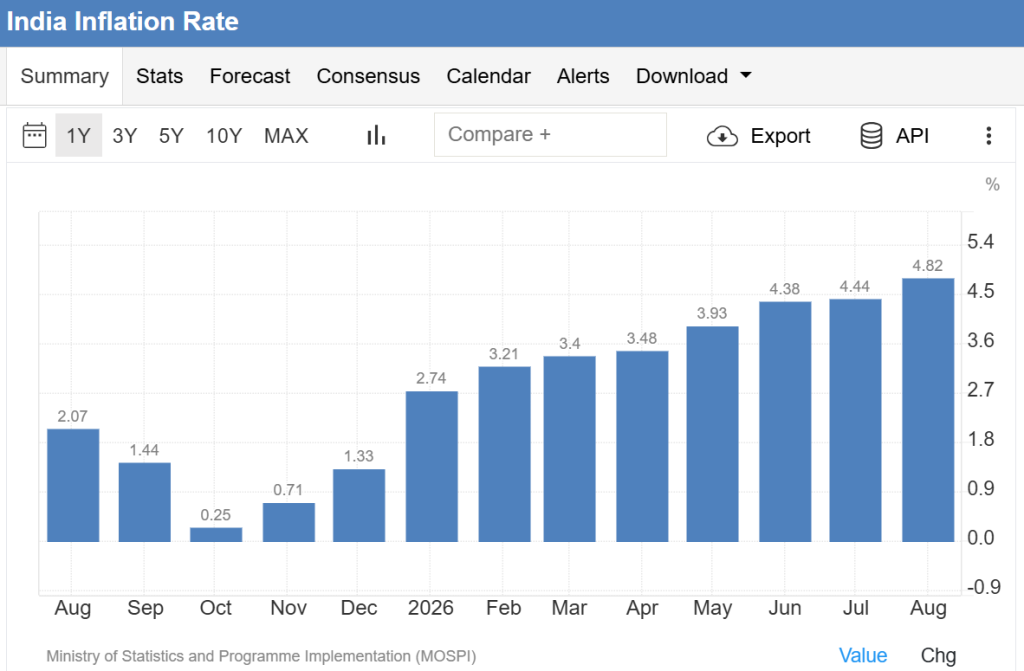
When the US changes its interest rates, the RBI must respond to prevent global investors from pulling money out of India. However, the RBI’s main focus is managing India’s own internal economic pressures:
- Rising Costs: As shown in the Inflation Graph, India’s cost of living has steadily climbed from 0.25% in Oct 2025 to 4.82% in Aug 2026.
- A Weaker Rupee: A falling currency is making essential imports (like oil) more expensive, driving up daily grocery bills.
If selling foreign reserves fails to steady the Rupee, a defensive local interest rate hike is highly possible. In fact, SBI Research, Nomura, and ICICI Securities predict a 0.25% hike at the upcoming RBI meeting on October 5th-7th.
If the RBI chooses to raise rates, it could trigger a domestic shift:
- Bank loans for everyday consumers and expanding businesses could become costlier.
- Monthly EMIs on your home, car, or personal loans might tick upward.
Nothing is guaranteed until the votes are cast. Will the RBI implement a preemptive hike to shield the Rupee, or choose to hold the line? We will know for sure this October.
Frequently Asked Questions (FAQs)
When the US Federal Reserve increases interest rates, yields on safe US Government bonds rise. This narrows the interest rate differential between the US and India, causing Foreign Portfolio Investors (FPIs) to pull their dollars out of Indian markets to seek safer returns at home. As dollars exit India, the higher demand for USD weakens the Indian Rupee.
The interest rate differential is the gap between the bond yields of two countries. Historically, India’s 10-year government bonds yielded 4% to 6% more than US Treasury bonds, making the risk of investing in an emerging market highly attractive. When this gap shrinks significantly, the incentive disappears, triggering capital flight.
India relies heavily on imports for over 85% of its crude oil requirements, which are bought exclusively in US Dollars. When the Rupee depreciates, India must spend more local currency to purchase the exact same amount of oil. This “imported inflation” spikes domestic fuel costs, which trickles down into higher transportation fees for daily items like groceries.
The Reserve Bank of India primarily utilizes a two-step stabilization strategy:
A: Forex Intervention: Selling US Dollars from its foreign exchange reserves and buying back Indian Rupees to artificially prop up local currency demand.
B: Defensive Rate Hikes: Raising domestic interest rates to restore an attractive yield differential for global investors, even though it raises domestic borrowing costs.