|
Getting your Trinity Audio player ready...
|
This guide compares a gold mutual fund vs a gold ETF vs an SGB in simple words and helps you decide which is the best gold investment 2026 offers and whether to hold or sell SGB units you already own.
Start investing with just ₹10K & grow your wealth with fixed return opportunities.
Invest Now

The Three Ways to Own Gold on Paper
You do not need to buy real gold to invest in gold. Three paper options let you own gold without a locker. Knowing how each works is the start of any gold mutual fund vs. gold ETF vs. SGB choice, so we take them one by one.
A gold ETF is a fund that trades on the stock market, just like a share. Each unit stands for a small amount of gold. You need a demat account to buy it, and the price moves with gold all day.
A gold mutual fund is a fund that buys a gold ETF for you. You do not need a demat account. You buy it like any mutual fund, through an app, and you can start a monthly SIP.
An SGB, a Sovereign Gold Bond, is a gold bond from the government. It tracks gold and also pays 2.5% interest a year. The catch: the government stopped selling new ones, so you can only buy old bonds on the stock market. This is why any gold mutual fund vs. gold ETF vs. SGB pick now looks different from a few years ago.
Gold ETF vs SGB: How They Compare
Start with the two that trade on the market, the first step in a gold ETF vs. SGB look. In a gold ETF vs. SGB look, both follow the gold price, but one pays extra. That is the first split in the gold mutual fund vs. gold ETF vs. SGB story.
An SGB pays 2.5% interest a year on top of the gold price. A gold ETF pays nothing extra. So for the same rise in gold, the SGB gives you a little more, which is a big point in the gold mutual fund vs. gold ETF vs. SGB story.
But there are catches with the SGB. No new ones are sold, so you must buy old bonds on the market, and they can cost more than the gold is worth. A gold ETF is easy to buy any day, at a fair price close to gold. So a gold ETF wins on ease, while an SGB wins on that 2.5% income, if you can buy it at a fair price.
Gold Mutual Fund vs. Gold ETF: The Key Difference
Now the two funds, a gold mutual fund vs. a gold ETF, look. In a gold mutual fund vs. gold ETF choice, the big difference is how you buy them, not what they hold.
A gold ETF needs a demat account and trades on the market. A gold mutual fund does not need a demat account. It simply buys a gold ETF on your behalf, and you buy it like any mutual fund. If you do not have a demat account or you want a monthly SIP, the gold mutual fund vs. gold ETF answer points to the fund.
The trade-off is cost. Because a gold mutual fund holds an ETF, you pay the ETF’s fee plus the fund’s own small fee. So it costs a little more than owning the ETF directly. That is the price of not needing a demat account, and it is the heart of the gold mutual fund vs. gold ETF vs. SGB cost question.
A Simple Gold Fund Comparison India Table
Here is a quick gold fund comparison India investors can use at a glance, covering all three side-by-side.
| Feature | Gold ETF | Gold Mutual Fund | SGB |
| Demat account needed | Yes | No | Yes |
| Extra interest | None | None | 2.5% a year |
| Yearly fee | Low | A little higher | None |
| Can you buy new? | Yes | Yes | No, only old ones |
| SIP possible | No | Yes | No |
Read this gold ETF vs SGB and gold mutual fund comparison table this way. In this gold fund comparison in India, if you want the lowest cost, the gold ETF is best. If you want no demat and an SIP, the gold mutual fund fits. In this gold fund comparison in India, if you want the 2.5% interest, an old SGB stands out. This comparison shows there is no single winner, only the right fit for you, which is what a fair gold fund comparison in India should do.
Latest SGBs Updates:
- SGB Maturity Payout 2026: Tax Calculation for Existing Holders
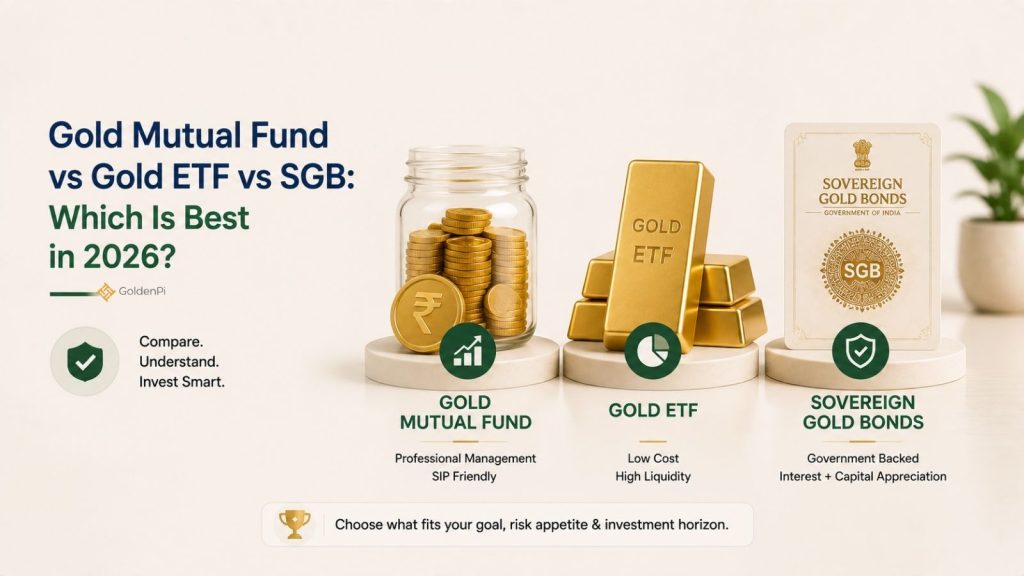
- Gold Mutual Fund vs Gold ETF vs SGB: Which Is Best in 2026?
- Best SGB Alternatives in 2026: Gold ETFs, Funds & More

Should You Hold or Sell SGB Units You Own?
Many people already own SGBs from past years. For them the question is not what to buy, but whether to hold or sell SGB units. This is a separate choice from the rest.
Here is the simple case to hold or sell SGB units you have. If you were the original buyer from the government and you hold to the end, your gain at maturity is still tax-free. That is a strong reason to keep them. Selling early throws that benefit away, so for most original holders, the answer to holding or selling SGB is “hold.”
There is a time to think about selling. If you urgently need the money, or if the market price is unusually high above the gold value, selling can make sense. But as a rule, if you can hold to maturity, the tax-free gain plus the 2.5% interest makes the better call in the hold or sell SGB decision.
Which Is the Best Gold Investment in 2026?
So in the gold mutual fund vs. gold ETF vs. SGB race, which one wins? The honest answer is that the best gold investment 2026 offers depends on you, not on one option being best for all.
For most new buyers, a gold ETF is the top pick because it is cheap, easy, and close to the gold price. If you have no demat account or want an SIP, a gold mutual fund is the route for you, for a slightly higher fee. And if you already hold an old SGB bought from the government, holding it is often the best choice, thanks to the 2.5% interest and tax-free maturity you already locked in.
So the gold mutual fund vs. gold ETF vs. SGB answer is not one name, and that is fine. For new money, the best gold investment is usually a gold ETF or a gold mutual fund. In the gold ETF vs. SGB choice for old holdings, old SGBs are usually worth keeping. Pick the gold that matches how you invest, and hold gold as one small part of a wider plan, not the whole of it.
Frequently Asked Questions
There is no single winner in the gold mutual fund vs. gold ETF vs. SGB choice. A gold ETF is the cheapest and easy to trade. A gold mutual fund needs no demat and allows an SIP. An SGB pays 2.5% interest but is only sold second-hand now. The best fit depends on your needs.
For new money, a gold ETF is usually the best gold investment 2026 offers, since new SGBs are not sold and second-hand ones can cost a premium. But if you can buy an SGB at a fair price and want the 2.5% interest, it still has a place in a gold ETF vs. SGB choice.
A gold ETF trades on the market and needs a demat account. A gold mutual fund buys an ETF for you and needs no demat. An SGB is a government gold bond that pays 2.5% interest. That, in short, is the difference this gold fund comparison in India explains.
Over the same period, an SGB usually edges ahead because it adds 2.5% interest to the gold price while the funds do not. But you can only buy old SGBs now. Among new buys, a gold ETF and a gold mutual fund track gold closely, so returns are similar before fees.
It depends on you. In a gold mutual fund vs. gold ETF choice, the ETF costs a little less but needs a demat account. The mutual fund costs a little more but needs no demat and allows an SIP. Cost favors the ETF; ease favors the mutual fund.
For existing holders, yes, especially if you bought from the government and can hold to maturity, which shapes the hold or sell SGB call. For new buyers, only old bonds are available, so check the price against gold before you buy into any gold ETF vs. SGB decision.
A gold ETF is the closest and the best gold investment 2026 offers for most people, followed by a gold mutual fund if you want no demat and an SIP. Neither pays the 2.5% interest an SGB did, but both track gold cheaply and are easy to buy.
Disclaimer
Fixed returns do not constitute guaranteed or assured returns. Investments in corporate debt securities and municipal debt securities/securitized debt instruments are subject to credit risks, market risks, and default risks, including delay and/or default in payment. Read all the offer-related documents carefully. This blog/article should not be construed as financial advice or as an offer or recommendation to buy or sell any security or any products/services of/on GoldenPi or any product/services of its third-party client(s). For a detailed calculation of YTM, visit our website. T&C’s Apply.