Imagine an HNI with a ₹10 crore financial portfolio.
A part of it is invested in equities. Some are in real estate and gold. And a sizeable portion sits in fixed-income investments – corporate bonds, NCDs and Government Securities. The portfolio may have several different issuers and maturities. But there is one common thread. Almost everything is linked to India and the rupee.
Now, suppose this investor wants to diversify a part of the fixed-income portfolio beyond India – perhaps through US Treasuries, global corporate bonds (UK, Japan, Germany) or other USD-denominated instruments. Until now, that meant entering a separate investment ecosystem. SEBI’s latest move could potentially make that boundary less rigid.
Start investing with just ₹10K & grow your wealth with fixed return opportunities.
Invest Now

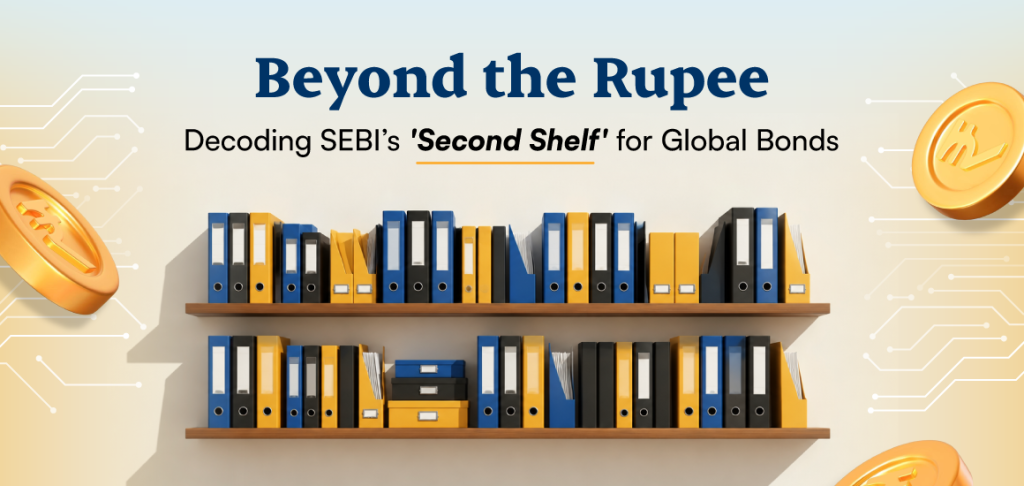
A second shelf
On August 14, 2026, SEBI expanded the scope of products that can be offered through Online Bond Platform Providers, or OBPPs. Among the additions are eligible products, securities and services regulated by the International Financial Services Centres Authority (IFSCA)- Gift City
At first glance, this may look like a small regulatory change. But the more interesting part is what it could eventually enable.
Think of an OBPP as having two shelves. The first one is familiar.
Shelf 1: India
Corporate Bonds | NCDs | G-Secs | SDLs | T-Bills
The second shelf could potentially open access to eligible products available through the GIFT-IFSC ecosystem.
Shelf 2: Global / IFSC
Eligible international bonds | US Treasuries | USD-denominated fixed-income products | Other eligible global investment opportunities
The exact products available will depend on the platform’s arrangements, product eligibility and the applicable regulatory framework. And this does not mean that every foreign security is suddenly available to every Indian investor. All investments remain subject to applicable FEMA guidelines, Overseas Investment regulations, and the Liberalised Remittance Scheme (LRS) – which permits individuals to remit up to $ 250,000 per financial year – alongside relevant product-specific terms.
Still, the potential architecture is interesting.
Indian investor → OBPP → GIFT-IFSC → Eligible global investment products
That could create a much cleaner bridge between India’s digital investment platforms and the global investment ecosystem being developed in GIFT City.
The bigger opportunity may be fixed income
For an Online Bond Platform, global fixed income is perhaps the most natural place to begin. Take our ₹10 crore investor again. Suppose ₹3 crore is allocated to fixed income. Diversification today could mean holding a G-Sec, a PSU bond, an NBFC bond and a few corporate bonds.
The investor has diversified across issuers. But the entire portfolio is still largely exposed to the same broad economy, interest-rate environment and currency. Adding a portion of eligible global fixed-income products could introduce another layer of diversification. The portfolio could potentially include Indian bonds alongside US Treasuries, investment-grade global corporate bonds, supranational bonds or other eligible international fixed-income instruments.
Latest Bond Updates:
- Beyond the Rupee: Decoding SEBI’s ‘Second Shelf’ for Global Bonds
- G-Sec STRIPS Explained: Zero-Coupon Sovereign Paper for Retail
- Cumulative vs Non-Cumulative FD: Which Payout Option Earns More?
The objective isn’t necessarily to chase the highest yield. A US Treasury may offer a lower yield than an Indian corporate bond. But the two investments represent exposure to different sovereigns, economies, and currencies. For a large portfolio, that changes the conversation.
Instead of only comparing: Which Indian bond gives me 8%?
An investor could potentially start thinking about: How much of my fixed-income portfolio should be linked to India, and how much should be diversified across global markets?
That is a very different approach to portfolio construction.
And then there is the rupee
For many Indian investors, almost their entire financial portfolio is denominated in rupees. That is perfectly reasonable when future expenses are also largely in rupees.
But HNIs and UHNIs increasingly have global financial needs – A child’s overseas education. International healthcare. Travel. Overseas businesses. Retirement abroad. These expenses may be denominated in dollars or other foreign currencies. If the rupee depreciates, those expenses become more expensive in rupee terms.
Holding a portion of the portfolio in eligible USD or other foreign currency denominated assets can therefore provide currency diversification and potentially help match part of the portfolio with future foreign-currency liabilities. Of course, this is not guaranteed protection against rupee depreciation. Currency movements can work both ways, and a global bond still carries credit, interest-rate and liquidity risks.
International does not mean risk-free. But it does add another dimension to portfolio construction.
GIFT City becomes the bridge
This is where the role of GIFT-IFSC becomes important. GIFT City is being developed as India’s international financial centre and a gateway connecting India with global financial markets. The SEBI change potentially allows OBPPs to become another distribution layer within this larger ecosystem.
That means the development is bigger than simply saying: “OBPPs can now offer foreign bonds.”
It is about potentially connecting an Indian investor who is already comfortable buying domestic bonds online with eligible international investment opportunities available through an IFSCA-regulated ecosystem. And fixed income could be only the starting point. The revised framework covers eligible products, securities and services regulated by IFSCA. Depending on the products permitted and the arrangements developed by platforms, the opportunity could eventually extend to other eligible global products and services as well.
But for OBPPs, the fixed-income angle remains particularly interesting. The platform that currently helps an investor compare an Indian corporate bond with a G-Sec could eventually help them think about a portfolio that includes exposure beyond India’s borders.
The real change
SEBI has not opened the doors for every Indian investor to buy anything listed anywhere in the world. There are still regulatory limits, product eligibility requirements, FEMA rules, LRS conditions , taxation and additional risks to consider. But the direction of travel is worth watching.
For years, the question for a bond investor was largely: Which bond should I buy?
This new framework could eventually make the question broader: How should I build my bond portfolio?
For a retail investor, the answer may still lie entirely within India. But for an HNI or UHNI with a large portfolio, global liabilities and a long investment horizon, the ability to potentially diversify across countries and currencies could become increasingly relevant.
The biggest takeaway from SEBI’s August 14 move, therefore, may not be another product added to an Online Bond Platform. It may be the creation of a second shelf.
One shelf for India. And another that could potentially open a window to the world.
Conclusion: A step in the right direction
SEBI’s August 14 move is a positive step for India’s bond market. For platforms, it opens the door to serving investors with truly global needs, and for GIFT City, it is another step towards becoming the gateway it was designed to be. For investors, it points to more choice as the ecosystem matures.
Frequently Asked Questions
On August 14, 2026, SEBI expanded the scope of products that can be offered through OBPPs to include eligible products, securities and services regulated by the International Financial Services Centres Authority (IFSCA) – GIFT City. IFSCA-regulated products can be shown under a different tab or on a separate platform, and they arerequired to be clearly labelled as international or overseas instruments so that investors can tell them apart from domestic bonds.
Not automatically. The change opens the door to eligible products available through the GIFT-IFSC ecosystem, which could include international bonds, US Treasuries or other USD-denominated fixed-income products. The exact products available will depend on the platform’s arrangements, product eligibility and the applicable regulatory framework, and investments remain subject to FEMA guidelines, Overseas Investment regulations and the Liberalised Remittance Scheme (LRS).
GIFT City is being developed as India’s international financial centre and a gateway connecting India with global financial markets. For bond investors, it could act as the bridge between Indian online bond platforms and eligible international investment products, allowing an investor who is comfortable buying domestic bonds online to consider exposure beyond India.
Yes. Investments are subject to FEMA guidelines, Overseas Investment regulations and the Liberalised Remittance Scheme (LRS), which permits individuals to remit up to USD 250,000 per financial year. Product-specific terms may also apply, so it is important to check the conditions of each product before investing.
No. Holding eligible USD or other foreign-currency-denominated assets can provide currency diversification and may help match part of a portfolio with future foreign-currency expenses, such as overseas education or healthcare. But it is not guaranteed protection against rupee depreciation. Currency movements can work both ways, and a global bond still carries credit, interest-rate and liquidity risks. International does not mean risk-free.
Disclaimer
Fixed returns do not constitute guaranteed or assured returns. Investments in corporate debt securities and municipal debt securities/securitized debt instruments are subject to credit risks, market risks, and default risks, including delay and/or default in payment. Read all the offer-related documents carefully. This blog/article should not be construed as financial advice or as an offer or recommendation to buy or sell any security or any products/services of/on GoldenPi or any product/services of its third-party client(s). For a detailed calculation of YTM, visit our website. T&C’s Apply.