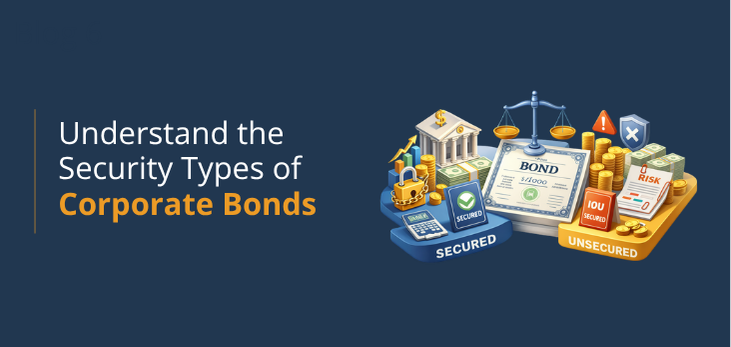
Corporate bonds aim to collect funds for the day-to-day operations and expenditures of private corporations. Investing in these debt instruments means loaning an amount to a company in exchange for a particular return. Financing with corporate bonds is easier and quicker for companies compared to the application verification process for bank loans. Likewise, investors prefer these bonds over many other investment tools because of their higher rate of return.
Talking about returns, a significant risk of default remains in corporate bonds. Credit ratings and many other parameters can help analyze the risk levels associated with different corporate bonds in India. That said, it is crucial to have an accurate understanding of the events in case of a default. Returns will be issued; however, the payout sequence and rate of returns for investors can be different during a default depending on the type of security of the bond they are invested in.
Despite the higher returns offered by the corporates, there is some default risk associated with it, which could be foreseen with the credit ratings offered by the credit rating agencies. Or even if it is defaulted, what’s the best-case scenario for you?
Join us as we explore the security types of corporate bonds for better financial planning and management.
Key Takeaways
- The funds raised by the corporations are utilized for company expenditures and operations.
- In exchange for returns, investors loan money to corporates.
- Financing through bonds is much easier and faster compared to bank loans.
- Credit ratings and other parameters can help you mitigate the risk of default.
- Understanding the types of security will help you know the payout sequence and the rate of recovery in times of default.
Security Types of Corporate Bonds
Needless to say, there are different types of corporate bonds in India. Classifications are made based on various factors, including security. Imagine this! There is a structure lined with bonds. The higher the placement, the greater the security, and the greater the security, the higher the priority in payouts in case of a default!
Secured Bonds > Unsecured Bonds
Before we get into the payout ranking structure, allow us to establish the basic ground! Corporate bonds can either be secured by some sort of collateral or backed by no collateral and called unsecured. Secured bonds are prioritised and will be paid out before unsecured bonds. The company can use industrial equipment, a factory, a warehouse, or any other asset as collateral that will be sold to recover the returns if there is a default.
Here’s a fun fact: In the capital structure, bonds come first, and equity or stocks follow. Bonds (all secured and unsecured) are paid first and in full in case of default due to bankruptcy or any other reason. Stockholders receive payouts after bondholders and might not get paid if there aren’t enough funds.
Below are the security types of corporate bonds in India and their rankings.
1. Senior Secured Bonds
Senior securities are the highest priority in the capital structure. They are backed by specially designated collateral. In the event of default or company liquidation, the senior security bondholders will receive the returns before any other bondholders.
2. Senior Unsecured Bonds
Second to the senior secured bonds are the senior unsecured bonds. Although they lack collateral backing, bondholders are in a privileged position and receive returns faster than others in the unsecured category.
3. Junior/Subordinated (Unsecured) Bonds
The only security the junior or subordinated bonds have is the issuing company’s credit ratings. If the company defaults, there is no collateral to be sold to facilitate bondholders in this category. After paying the senior secured and unsecured bondholders, they will receive payouts from the remaining funds.
Junior or subordinated bonds further have different tiers with priority in the following descending order:
- Tier 1
- Tier 2
- Tier 3 and so on!
4. Guaranteed and Insured Bonds
A third party backs guaranteed and insured bonds. The process is similar to having collateral; in case the bond-issuing company defaults, the respective third party takes charge and generates returns to the bondholders. Corporate bonds with backing from a group entity or municipal bonds with a government entity’s backing are examples of guaranteed and insured bonds.
Here are a few factors to remember:
- Investors should assess both the issuer’s credit rating and the guarantor’s creditworthiness when evaluating guaranteed or insured bonds.
- The third party’s credit rating is crucial and should be checked along with the bond issuer’s credit rating.
- Two levels of security indicate high safety, but they don’t necessarily translate into complete security.
- Guaranteed and insured bonds generate lower yields than corporate bonds as their interest rates tend to be lower.
Convertible Bonds
Convertible bonds generate interest payments but can be converted into common stock shares, hence the name. The convention can happen at the bondholder’s discretion at certain times in the bond’s life. The selected stock or equity must be from the same issuer as the bond, and the conversion will occur at a preset stock price, regardless of the current rate. Note that while the conversion option offers convenience, the bonds offer lower interest rates.
Start investing with just ₹10K & grow your wealth with fixed return opportunities.
Invest Now

Recovery Rate for Different Security Types of Corporate Bonds

As the bond matures, the bondholders receive the principal investment amount and the accumulated interest. However, the preset return amount no longer holds as a bond default. The recovery rate refers to the reduced percentage of the total bond value one receives in case of a default, and the remaining amount is termed LGD (loss-given default).
Let’s assume, you are investing INR 1 lakh in a bond with a 40% recovery rate. In that case, you will receive INR 40,000 and the remaining INR 60,000 will be LGD.
The relationship between priority on the capital structure and the payout rank continues here. While the recovery rate can vary based on the bond issuing company and various other aspects like the company’s debt-to-asset ratio and the capital structure, secured bonds will have higher recovery rates than unsecured bonds. Within the categories, the recovery rate will go from higher to lower from Tier 1 to the rest. When comparing investment options, understanding the recovery rates for corporate bonds or stocks is crucial for making informed decisions.
Invest in the Top Corporate Bonds with GoldenPi

In the sea of options in India’s corporate bond sector, analysing and comparing all bonds to find the most suitable individual investment option is time and effort-consuming. Finding a reliable platform with the best investment options and a smooth investment process is the same. GoldenPi ticks all the correct boxes!
Even a quick visit to GoldenPi will introduce you to an easy-to-access, comprehensive investment platform where all the top plans and schemes are listed with the latest interest rates, credit ratings, and other essential factors. As you explore a bit more, you will find all the information and suggestions about the bonds and types of bonds you need to make the smartest financial decisions. The icing on the cake is the simple 3-step investment process. Complete KYC, choose the bond, and make the payment!
Invest and seamlessly monitor your investments on our platform!
FAQs about Corporate Bonds
1. What are the security types of corporate bonds and their importance?
Corporate bonds can be secured or unsecured, and this will influence the recovery and the payout priority for an investor. Secured ones are usually backed by collateral and in case of default, they are first paid, whereas unsecured ones rely solely on the credit ratings of the company to invest. You can make better decisions in your financial planning knowing these distinctions while choosing the right corporate bond investment.
2. How do you choose the best corporate bond?
Pick a corporate bond with the highest credit ratings to ensure security. Besides, analyze the returns and other aspects of the bond to ensure it is suitable for your financial goals.
3. How does the debt-to-asset ratio influence the recovery rate?
The two have an inverse relationship. The lower the debt-to-asset ratio, the higher the recovery rate will be.
4. How do I avoid the risk of default?
Every bond, excluding government bonds, has a risk factor. The best way to reduce it is to choose a secured bond with high credit ratings.
5. What are partially convertible bonds?
Partially convertible bonds are the ones where a percentage of the bonds are converted into stocks.
6. What are the highest corporate bond interest rates currently?
At present, corporate bond investments can offer as high as 14.67 interest rates. However, rates can fluctuate over time. Check out GoldenPi for the latest updates on corporate bond interest rates.
7. Are corporate bond returns taxable?
The taxation of corporate bonds depends on whether the bonds are listed or unlisted. Interest income from bonds is taxed according to the investor’s income tax slab. Capital gains tax applies when bonds are sold before maturity. The applicable tax treatment may vary depending on the holding period and current tax regulations.
8. Is KYC compulsory for investing in corporate bonds?
KYC is a must on GoldenPi for corporate bond investment. The process is fairly simple. You can update all documents online and complete the KYC quickly.
Disclaimer:
This information is for general information purposes only. GoldenPi makes no guarantee on the accuracy of the data provided here; the information displayed is subject to change and is provided on an as-is basis. Nothing contained herein is intended to or shall be deemed to be investment advice, implied or otherwise. Investments in the securities market are subject to market risks. Read all the offer-related documents carefully before investing.
Bonds or non-convertible debentures (NCDs) are regulated by the Securities and Exchange Board of India and other government authorities. GoldenPi Securities Private Limited is a registered debt broker and acts as a distributor and not as a manufacturer of the product.


