
The Reserve Bank of India turned away every bid in its latest Treasury Bill auctions. It was a rare move that came just two weeks after the central bank raised interest rates for the first time since February 2023. T-bill cut-offs act as a benchmark for short-term rates, so accepting the bids would have been read as a signal that those rates are rising further. The rejection came amid a bond selloff that pushed borrowing costs to multi-year highs. The decision shows the RBI choosing to control the message on rates while the government has no urgent need for cash.
What Happened at the Auctions
The government had scheduled ₹23,000 crore in Treasury bill sales on October 21, 2026: ₹8,000 crore each through 91-day and 182-day T-bills, and ₹7,000 crore through 364-day T-bills. The RBI accepted no bids across all three maturities and did not state a reason. Although bids were received, market participants suggested that investors were seeking higher yields than the RBI was willing to accept.
| Tenor | Bids received* | Notified amount | Bids accepted |
| 91-day | 77 | ₹8,000 crore | 0 |
| 182-day | 68 | ₹8,000 crore | 0 |
| 364-day | 79 | ₹7,000 crore | 0 |
| Total | 224 | ₹23,000 crore | 0 |
Start investing with just ₹10K & grow your wealth with fixed return opportunities.
Invest Now

Why the RBI Said No
- Tight fund flows: Market players cited GST-related outflows and money blocked mainly in the Jio Platforms IPO, which pushed bidders to ask for higher rates.
- Signalling risk: Paying high rates could have suggested the RBI wants elevated short-term rates.
- Government cash cushion: The government’s balance was about ₹5.3 lakh crore, so it did not urgently need the money.
- Policy fit: The report noted that the decision gels with the RBI’s “calibrated tightening” narrative.
Latest Bond Updates:
- RBI October MPC Meeting Minutes: Inflation Spreading, and More Rate Hikes Possible
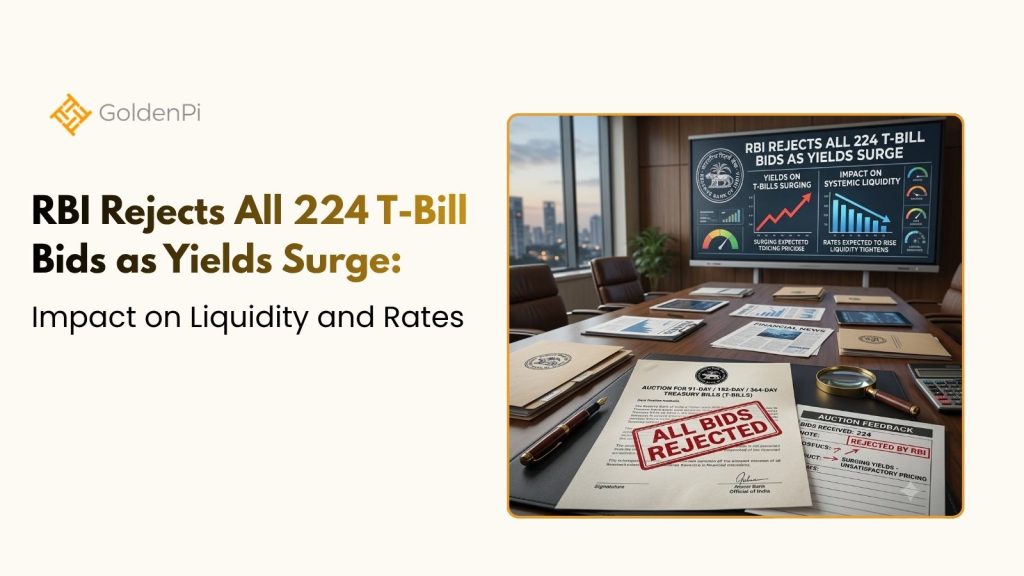
- RBI Rejects All 224 T-Bill Bids as Yields Surge: Impact on Liquidity and Rates
- Surety Bonds in India: Meaning, Types, Benefits & How They Work

The Market and Policy Backdrop
The 10-year government bond yield settled at 7.44%, its highest since November 2022. The rupee closed at a six-week high of 94.46 on Wednesday, helped by Jio IPO inflows and RBI intervention, even as oil rose above $110 a barrel.
The policy shift came on 7 October. The MPC unanimously raised the repo rate by 25 basis points to 5.50% and changed its stance to “calibrated tightening”, with one member, Dr. Ram Singh, among those preferring to stay neutral. The MPC said the new stance means rate cuts are off the table in the near term, leaving a hike or a pause as the options. CPI inflation rose to 4.8% in August, and the RBI projects 5.2% for 2026-27.
Who Is Affected
The government is the most directly affected party, since it raised nothing at this round. With its cash balance at about ₹5.3 lakh crore, though, its short-term funding is not under strain, which is why the RBI could afford to refuse. Banks, insurers and mutual funds, the main buyers of T-bills, feel the impact differently. Tight liquidity pushes them to demand more from short-dated paper, and the rejection tells them the RBI will not simply accept those terms. For borrowers, the stakes are indirect but real. Short-term benchmarks feed into other borrowing costs, which is why the central bank is wary of letting T-bill yields set the pace for the wider market.
What to Watch Next
- The next T-bill auction: It will show whether bidders ease their demands.
- The December MPC (2-4 December): Market commentary points to another hike, with one report citing a 50 bps move. That is analyst speculation, not guidance from the RBI.
- Liquidity after the Jio IPO: Funds returning to the system could ease pressure.
- Oil and the rupee: Both could shape inflation and the rate path.
The Bottom Line
By rejecting all 224 bids, the RBI refused to pay up for short-term money the government did not need. With a cash balance of about ₹5.3 lakh crore, the Centre could afford to wait, and the central bank used that room to avoid signalling that short-term rates are climbing further. The move fits a policy picture of a recent repo rate hike to 5.50%, a “calibrated tightening” stance and bond yields at their highest since 2022.
For markets, the message is that the RBI wants to set the pace on rates itself. The next T-bill auction and the December MPC meeting will show whether bidders adjust their expectations or the RBI has to accept higher yields.
Disclaimer
Fixed returns do not constitute guaranteed or assured returns. Investments in corporate debt securities and municipal debt securities/securitized debt instruments are subject to credit risks, market risks, and default risks, including delay and/or default in payment. Read all the offer-related documents carefully. This blog/article should not be construed as financial advice or as an offer or recommendation to buy or sell any security or any products/services of/on GoldenPi or any product/services of its third-party client(s). For a detailed calculation of YTM, visit our website. T&C’s Apply.


