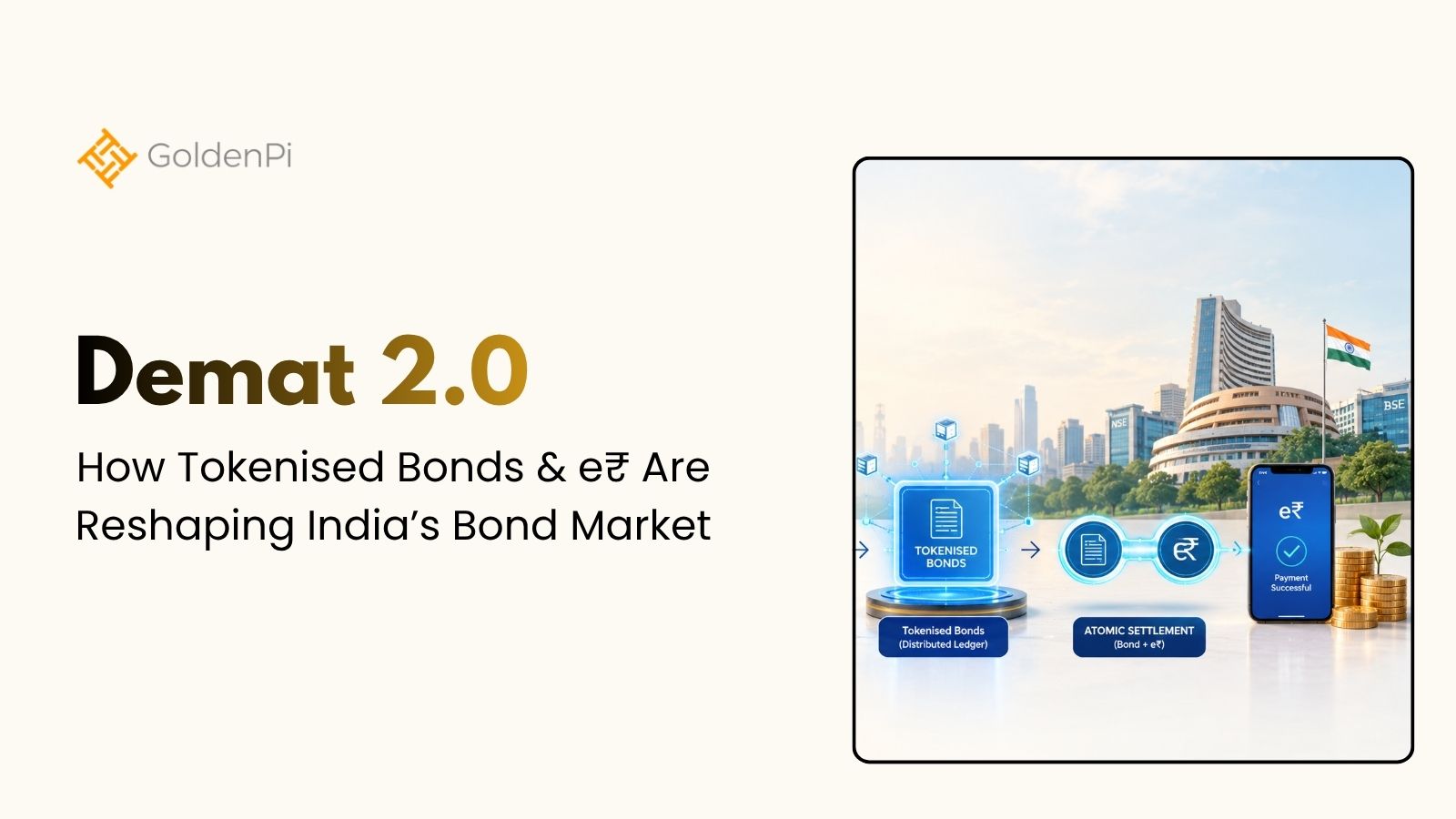
India’s bond market has just received one of its biggest infrastructure upgrades in years. On 10 September 2026, SEBI and RBI launched “Demat 2.0,” a trial project for issuance and settlement of tokenized corporate bonds using a distributed ledger and settling the tokens in wholesale e-Rupees (e₹-W). If you follow debt markets, it’s worth understanding now. It changes how bonds are issued, settled, and serviced, without changing what a bond legally is. Here is how Demat 2.0 works, what it has achieved so far, and where it could go.
Start investing with just ₹10K & grow your wealth with fixed return opportunities.
Invest Now

What Is Demat 2.0, and Why Did SEBI and RBI Launch It?
RBI Governor Sanjay Malhotra and SEBI Chairman Tuhin Kanta Pandey announced the pilot at Global Fintech Fest in Mumbai. Tokenized bonds retain the same ISIN, issuer obligations, coupon, maturity, covenants, rating, and investor rights as conventional demat bonds.
Early numbers are small but significant [1]. REC raised ₹500 crore through a ₹100 crore base issue and a ₹400 crore green-shoe option, while L&T raised ₹500 crore through its tokenized bond issue. REC’s issue was conducted through NSE’s Electronic Bidding Platform and received ₹796 crore of bids, or about 8 times its ₹100 crore base issue. REC accepted ₹500 crore at a coupon rate of 7.30%.
The timing makes sense. As per SEBI’s chairman, there has been an increase in outstanding corporate bonds from ₹20 lakh crore in FY2015-16 to ₹61 lakh crore; however, deepening of the bond market will require a broad base of issuers, efficient price discovery, greater participation, and better secondary-market liquidity. Demat 2.0 targets the plumbing behind those goals.
How Does DLT Change the Way Corporate Bonds Work?
Currently, issuers, registrars, depositories, trustees, and banks maintain separate ledgers, and a lot of work needs to be done to ensure that these ledgers are consistent. Distributed ledger technology (DLT) replaces that with one shared, tamper-evident record.
This is not a public blockchain and has nothing to do with crypto. The pilot runs on a private, permissioned DLT network operated by depositories.
The practical gain shows up after issuance. A coupon payment normally means pulling bondholder details, calculating entitlements, and instructing payments around a record date. Demat 2.0 uses smart contracts, which are self-executing rules on the ledger, to automate interest payments and redemption.
What Role Does the Wholesale e-Rupee Play in Bond Settlement?
Don’t confuse this with the retail digital rupee. The wholesale version is meant for institutional settlement.
The idea isn’t new. The RBI launched its wholesale digital rupee pilot in November 2022 for secondary-market government securities. Its reasoning was that settling in central bank money reduces the need for settlement guarantee infrastructure or collateral.
Demat 2.0 extends that logic to corporate bonds. The platform links to the RBI’s Unified Market Interface, allowing atomic settlement, where bond and payment move simultaneously. Think of a property registration where the keys and the check change hands at the same instant, so neither side can walk away halfway.
Old Bond Process vs Demat 2.0: A Quick Comparison
| Feature | Current process | Demat 2.0 pilot |
| Record of ownership | Separate records across intermediaries | Shared ledger owned by depositories |
| Settlement | Securities and cash move through separate channels. | Atomic: bond and e₹-W move together |
| Settlement risk | Gap between delivery and payment | Designed to remove that gap |
| Interest and redemption | Manual steps via registrars and banks | Automated via smart contracts |
| Legal status of the bond | Unchanged | Unchanged (same ISIN and rights) |
| Who can use it | Existing market participants | Phase 1: institutional issuance only |
These rows reflect how the pilot is designed to work. Real efficiency gains will only be visible at scale.
What Does It Mean for Investors and Issuers?
If the pilot scales, the likely benefits are:
- Faster, safer settlement, since payment and delivery happen together.
- Lower operational load, with fewer reconciliations and less manual servicing.
- Cleaner audit trails from a single source of truth.
- A route to wider participation, as the roadmap moves from institutions to retail.
This matters more as volumes rise. CRISIL Ratings projects the corporate bond market could nearly double to around ₹100 trillion by FY2030. Infrastructure built for today’s volumes will strain at that scale.
Latest Bond Updates:
- RBI Repo Rate Hike 2026: Bond Yields Surge to 7.24% as RBI Turns Hawkish
- Joint FD Rules: Either-or-Survivor vs. Former-or-Survivor & Tax Implications
- Beyond the Repo Rate Hike: What the RBI’s ‘Calibrated Tightening’ Means for Your Wallet
Challenges and What to Watch Next
This is a controlled, sandbox-stage pilot, and there is no secondary trading yet. Stage II will introduce secondary-market trading, and SEBI does not plan a separate tokenized exchange. Retail access comes later. Track these questions:
- How quickly secondary trading goes live and on which platforms.
- Whether smaller and lower-rated issuers join, beyond REC, L&T, and IIFL.
- How the ledger connects with existing depositories, exchanges, and banks.
- What safeguards apply to cybersecurity and data privacy.
- When and how retail investors get access.
The bottom line: Demat 2.0 isn’t a new asset class. It rebuilds how an existing one moves. The first Demat revolution digitized holding. This one aims to digitize the whole lifecycle, from issue to settlement to servicing. Watch the secondary-market rollout, because that is where liquidity will be proven or not.
Frequently Asked Questions
Demat 2.0 is SEBI’s September 2026 pilot for tokenised corporate bonds. It uses distributed ledger technology (DLT) to represent corporate bonds digitally and connects the tokenized securities with wholesale digital-rupee settlement.
Tokenized corporate bonds are conventional debt securities represented digitally on a DLT-based system. Tokenization changes how the security is recorded, transferred, and settled; it does not automatically change the bond’s underlying economic terms.
The RBI’s wholesale digital rupee is used for settlement of the tokenized bond transactions. This connects the digital representation of the security with central bank digital money for the payment leg.
No. UPI is a payment system that facilitates transfers between bank accounts, while the e-Rupee is a central bank digital currency issued by the RBI. Demat 2.0’s settlement mechanism uses the wholesale digital rupee rather than treating UPI as the underlying settlement asset.
The RBI’s wholesale digital rupee is used for settlement of the tokenized bond transactions. This connects the digital representation of the security with central bank digital money for the payment leg.
No. UPI is a payment system that facilitates transfers between bank accounts, while the e-Rupee is a central bank digital currency issued by the RBI. Demat 2.0’s settlement mechanism uses the wholesale digital rupee rather than treating UPI as the underlying settlement asset.
Atomic settlement means the securities and payment legs of a transaction are designed to settle together, reducing the risk that one side is delivered while the other side remains unsettled. Demat 2.0 links the tokenised bond and wholesale digital-rupee settlement infrastructure for this purpose.
Potential benefits include more streamlined issuance and settlement, improved record-keeping, programmable processing of certain corporate actions, and closer integration between securities and payment infrastructure. These are potential or pilot-stage benefits, not guarantees of improved liquidity or returns.
Investors still face the normal risks of the underlying bond, including credit, interest rate, and liquidity risks. The tokenized infrastructure also introduces technology, cybersecurity, and operational and interoperability considerations.
Sources
Disclaimer
Fixed returns do not constitute guaranteed or assured returns. Investments in corporate debt securities and municipal debt securities/securitized debt instruments are subject to credit risks, market risks, and default risks, including delay and/or default in payment. Read all the offer-related documents carefully. This blog/article should not be construed as financial advice or as an offer or recommendation to buy or sell any security or any products/services of/on GoldenPi or any product/services of its third-party client(s). For a detailed calculation of YTM, visit our website. T&C’s Apply.