If you’re looking for a secondary source of income, bonds and fixed deposits may be some of the best options currently available to you. But what if you need more variety? Are there other investment options that could provide you with regular income?
Fortunately, there are a few. InvITs and REITs are special investment vehicles that could give you what you’re looking for. In this article, we’ll explore what these two investment options are. We’ll also compare REITs and InvITs vs. Bonds in India to understand how they differ from one another.
What are Infrastructure Investment Trusts (InvITs)?
An Infrastructure Investment Trust in India (InvIT) is an investment vehicle that pools money from multiple investors. This money is then invested in infrastructure assets like roads, power transmission lines, pipelines, and energy projects. The revenue generated by the infrastructure assets that the InvIT owns and operates is then distributed to its investors.
Start investing with just ₹10K & grow your wealth with fixed return opportunities.
Invest Now

What are Real Estate Investment Trusts (REITs)?
A Real Estate Investment Trust (REIT) is also a pooled investment vehicle. It uses the pooled money from multiple investors to own and operate income-generating real estate assets. These include office spaces, shopping malls, and business parks. The rental income from these real estate assets, after accounting for the various expenses and taxes, is distributed to the investors.
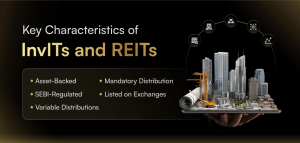
Key Characteristics of InvITs and REITs
It is important to know what makes REITs and InvITs distinct from other investment options. Here are five key features of these trusts.
Key Characteristics of Bonds
Asset-Backed
Both REITs and InvITs are backed by income-generating infrastructure or real estate assets. The returns you get are tied directly to the performance of these physical assets.
Mandatory Distribution
InvITs and REITs are mandated by law to distribute at least 90% of their net earnings to their investors. The REIT and InvIT distributions could help you create a secondary source of income.
Listed on Exchanges
REITs and InvITs are listed on stock exchanges like the NSE and the BSE. This gives you the flexibility to purchase and sell units of these trusts at any time.
SEBI-Regulated
Investment trusts like InvITs and REITs are registered and regulated by the Securities and Exchange Board of India (SEBI). This provides investors with a meaningful layer of protection and peace of mind.
Variable Distributions
The REIT and InvIT distributions can fluctuate from time to time. This is because of the variations in the income generated by the assets. Several factors, like occupancy rates, lease renewals, infrastructure asset utilisation rates, and economic activity, can influence the assets’ income-generating ability.
How Do REITs and InvITs Work?
Assume there’s an Infrastructure Investment Trust in India that owns and operates several toll roads throughout the country. Each time a vehicle uses these roads, the InvIT generates toll revenue. About 90% of the net revenue, after accounting for all expenses and taxes, is distributed to its investors.
Say you invest ₹10 lakh in it. In exchange, you get units of the InvIT. If the per-unit value is ₹100, you’ll get around 10,000 units.
Assume the InvIT generates a net revenue of around ₹30 crores in 6 months. It chooses to distribute 90% of its net revenue to its investors, which comes up to ₹27 crores (₹30 crores x 90%). The InvIT distribution rate per unit comes to around ₹1.50. Since you own 10,000 units, you would get a payout of ₹15,000.
Real Estate Investment Trusts also work in the same way. The only difference is that instead of investing in infrastructure assets, REITs invest in real estate assets.
What are Bonds?
A bond is a financial instrument that’s issued to raise capital. It can be issued by either corporations or governments.
When you invest in a bond, you’re essentially lending your capital to the issuing organisation for a particular period of time, known as the bond tenure. In exchange, the bond issuer pays interest at a predetermined rate. At the end of the bond tenure, the amount you invested is returned to you.
Key Characteristics of Bonds
Before we compare InvIT and REIT vs. bonds, let us quickly look at some of the key features of this fixed-income instrument.
- Fixed Payments: For most bonds, the interest rate (coupon rate) is fixed. So, when you invest in them, you know exactly how much interest you’ll earn and when you will receive it.
- Predetermined Tenure: All bonds have a maturity date that’s clearly communicated to you upfront. Moreover, at the end of the bond’s tenure, your initial investment amount is returned.
- Transparent Credit Ratings: Bonds that are issued by companies are assigned credit ratings by agencies like CRISIL, ICRA, and CARE. These ratings give you a clear and standardised way to determine the creditworthiness of the issuer before you invest.
- Tradable on Exchanges: Most bonds in India are listed and traded on the stock exchanges. This gives you an option to liquidate your investments before the bond matures.
- Extensive Choice: With bonds, the number of choices available is high. This is because they are issued by private corporations, public sector undertakings, central governments, and state governments. As a result, you have the freedom to invest in bonds that match your risk appetite and financial goals.
How Do Bonds Work?
An information technology company needs ₹50 crores to expand its business. It decides to issue a bond to raise the required funds. The tenure of the bond is 10 years, and the interest that the company is willing to pay is 9% per annum. The interest payments will be made twice a year (semi-annually).
Say you invest ₹20 lakh. In this case, you will receive interest of ₹90,000 every six months (₹1,80,000 per annum) for 10 years. At the end of the tenure, the bond will mature, and the company will return the initial investment amount of ₹20 lakh to you.
A Detailed Comparison of REITs and InvITs vs. Bonds in India
Now that you understand how these instruments work, let’s compare REITs and InvITs vs. Bonds in India. This will highlight the key differences and help you choose the one that’s right for you.
| Particulars | REITs | InvITs | Bonds |
|---|---|---|---|
| Issuer | Investment trusts | Investment trusts | Central government, state governments, and corporations |
| Underlying Asset | Commercial real estate assets like office parks and shopping malls | Infrastructure assets like roads and transmission pipelines | Company’s assets or its creditworthiness |
| Nature of Returns | Variable distributions | Variable distributions | Fixed coupon payments |
| Income Consistency | Moderate, linked to occupancy rate and rental income | Moderate, linked to infrastructure asset performance and utilisation | High |
| Return of Principal | Not available | Not available | Available |
| Return Potential | Moderate to high | Moderate to high | Moderate |
| Risk Level | Moderate to high | Moderate to high | Moderate |
| Liquidity | Moderate | Moderate | Moderate to high |
| Regulation | Regulated by the SEBI | Regulated by the SEBI | Regulated by the RBI and the SEBI |
| Ways to Invest | Through stockbrokers and stock exchanges | Through stockbrokers and stock exchanges | Through RBI Direct, OBPP, or stock exchanges |
REITs and InvITs vs. Bonds in India: Which is the Right Choice for You?
With the InvIT and REIT vs. bonds comparison done, let’s look at which of these investment options makes the most sense for you.
If you prefer income predictability and return of principal, bonds are among the ideal investment options available to you. Whether you choose to invest in government securities (G-Secs), corporate bonds, or non-convertible debentures (NCDs), you can expect regular interest payments at predefined intervals and return of your initial investment amount on maturity.
If you’re comfortable with a certain degree of market volatility and variability in the payouts you receive, REITs and InvITs could be an option you could consider. REITs, especially, give you exposure to India’s growing commercial real estate sector. On the other hand, InvITs could be the right choice if you wish to expose your portfolio to the infrastructure sector.
However, it’s important to note that REITs and InvITs, as fixed-income instruments, are not exactly free from risk entirely. A quick comparison of REIT vs. FD or InvIT vs. NCD will show that both investment trusts don’t offer a return of principal like bonds. So, if you wish to get your principal investment amount back, you must sell your holdings on the exchanges.
Build Your Fixed-Income Portfolio Today
Understanding the differences between REITs and InvITs vs. bonds in India is crucial as it helps you make the right investment decision.
If you’re a conservative investor who values income predictability, GoldenPi offers bonds across credit ratings and fixed deposits with RBI-licensed banks. Through the platform, you can also discover and invest in NCD IPOs as well.
That said, if you wish to build a resilient long-term fixed-income portfolio, consider diversifying by including REITs and InvITs into the mix as well. This will help reduce concentration risk without sacrificing returns.
FaQs on REITs and InvITs vs. Bonds in India
Are InvITs and REITs fixed-income instruments?
Not really. Real Estate Investment Trusts and Infrastructure Investment Trusts in India are hybrid financial instruments. They are mandated by law to distribute 90% of the profits they generate to the investors. While this might lead to regular income payments, they are hardly fixed and can fluctuate from time to time.
How liquid are InvITs and REITs compared to bonds?
When you compare InvITs and REITs vs. bonds, you can see that all three investment vehicles are listed and actively traded on stock exchanges. However, liquidity varies depending on the instrument. InvITs and REITs are less liquid than government bonds but may be more liquid than certain corporate bonds.
What is the difference between REIT and InvIT distributions and bond coupon payments?
Bond coupon payments are often fixed, so you know the exact amount you will receive. However, REIT and InvIT distributions may fluctuate depending on the cash flows generated by the underlying assets.
Are InvIT and REIT distributions taxable in India?
Yes. REIT and InvIT distributions are taxable under section 115UA of the Income Tax Act, 1961. The distributions from these investment vehicles are taxed at the income tax slab rates applicable to investors. Meanwhile, capital gains tax is applicable on the profits derived from the sale of REIT and InvIT units.
How safe are InvITs and REITs?
REITs and InvITs may be relatively safer compared to equities and certain corporate bonds. However, they are not completely free from risk. The payouts from these investment options depend on multiple factors like asset performance, occupancy rates, and market conditions.
Disclaimer:
This information is for general information purposes only. GoldenPi makes no guarantee on the accuracy of the data provided here; the information displayed is subject to change and is provided on an as-is basis. Nothing contained herein is intended to or shall be deemed to be investment advice, implied or otherwise. Investments in the securities market are subject to market risks. Read all the offer-related documents carefully before investing.
Fixed Deposit schemes are regulated by the Reserve Bank of India. GoldenPi Securities Private Limited is a registered debt broker and acts as a distributor and not as a manufacturer of the product.