
While you’ve been looking for alternatives to the tried and tested fixed-income products such as fixed deposits, government securities, and plain old NCDs, you may have come across covered bonds. They are in a sweet spot: they are not a “corporate bond,” but they pay a rate that is easily higher than what you get in your bank account. Covered bonds are a worthy option for those who prefer a secure bond with a good return, particularly for Indian investors. This article explains how they function in the Indian scenario and whether they make sense in your debt portfolio.
What Are Covered Bonds? The Dual Recourse Explained
So, covered bonds, essentially debt instruments issued by banks, non-banking financial companies, or housing finance firms, have a dedicated pool of assets backing them, like home loans, vehicle loans, or gold loans. The thing that sets them apart from your typical NCD is the concept of dual recourse.
Covered bonds, also known as dual recourse bonds, offer bondholders two avenues to recover their money if the issuer hits financial trouble: direct repayment from the issuer, using its other assets, and, as a backup plan, by liquidating the cover pool that secures the bonds.
To put it simply: imagine a housing finance company issues covered bonds worth ₹100 crore, backed by a ₹120 crore pool of home loans. If the company defaults, you’re not left abandoned as a bondholder. The cover pool, which is basically ring-fenced thanks to an equitable assignment of assets to a special purpose vehicle, is still available to you. And here’s the clever part: these assets stay on the issuer’s balance sheet, so they’ve got a vested interest, which discourages them from giving out poor-quality loans.
This over-collateralization, where there are more assets in the pool than bonds issued, is a major credit enhancement feature and one of the most defining aspects of these bonds.
Start investing with just ₹10K & grow your wealth with fixed return opportunities.
Invest Now

How Covered Bonds Differ from Other Debt Instruments
Here’s how to distinguish between covered bonds and other debt instruments:
| Feature | Covered Bonds | Regular NCDs | Asset-Backed Securities |
| Backed by the issuer’s balance sheet | Yes | Yes | No |
| Backed by an asset pool | Yes | No | Yes |
| Assets stay on the issuer’s balance sheet | Yes | Yes | No (transferred to SPV) |
| Over-collateralization | Typically yes | No | Sometimes |
| Issuer retains credit risk of the pool | Yes | N/A | No |
| Typical rating | High (often AAA/AA+) | Varies | Varies |
So investors in asset-backed securities are stuck, only able to go after the asset pool if things go south. Covered bonds, on the other hand, offer a couple of recovery options, which makes them inherently safer, all things being equal.
Recent Bond News:
- Asset Cover Ratio Explained: How Much Security Really Backs Your NCD?
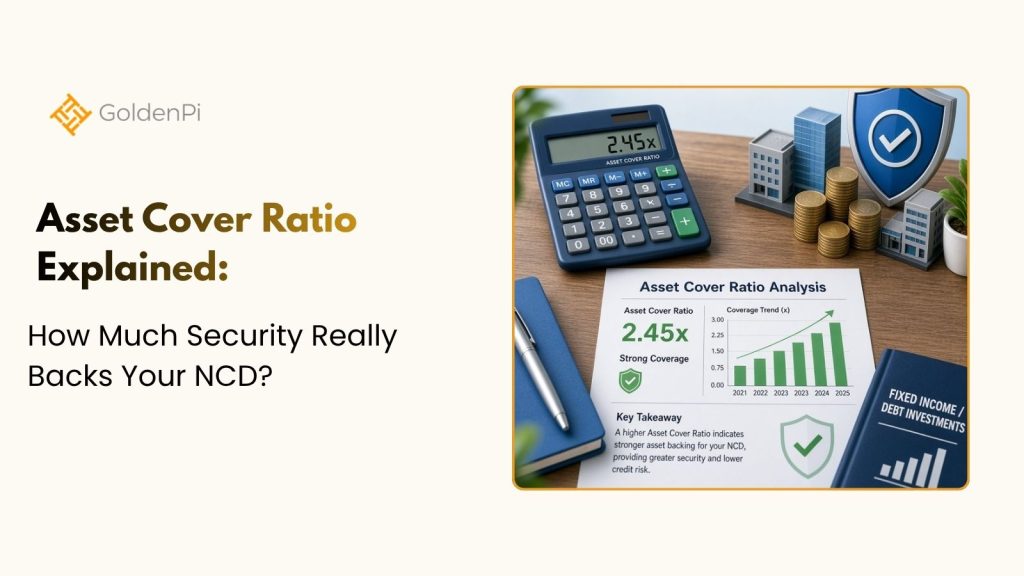
- JSW Paints Plans 4- and 5-Year Bonds to Refinance Akzo Acquisition Debt

- YES Bank AT1 Bond Verdict: Bondholders Seek Clarity on Coupon Payments

The Indian Covered Bond Market: Where Things Stand
The covered bond market in India is in a whole other dimension compared to its European counterpart: We’re talking over 250 years of history. One major distinction lies in the legal setup: India doesn’t have a specific law governing covered bonds, so they’re all contractual; basically, a deal between the issuer and the bondholder.
It’s worth understanding this as an investor because in Europe, covered bonds get explicit statutory protection. In India, the protection of the cover pool and investors’ priority claims relies on the fine print of the contract and the broader Insolvency and Bankruptcy Code (IBC) framework. No dedicated law has meant slow adoption from institutions, historically speaking. Covered bond issuance saw a massive spike in FY2021, before RBI regulations on loan exposure transfers created uncertainty for the market.
So, despite all the regulatory noise, covered bonds have somehow managed to find their footing in India’s retail bond investing scene, and it’s largely thanks to fintech platforms. Companies like GoldenPi have been instrumental in making these bonds super accessible to individual investors, usually by offering ones issued by non-banking financial companies (NBFCs) and housing finance companies (HFCs).
What Yields Can You Expect
Covered bonds in India typically offer somewhere between 9% and 12.75% interest, but the actual rate you get depends on who’s issuing the bond and, more importantly, the quality of the assets backing it. To give you a measure, the 10-year government security benchmark is hovering around 7%. But here’s the thing: covered bonds from mid-tier NBFCs with top-notch collateral pools tend to offer rates in the 9-11% range, which is a pretty significant premium.
So the higher yield isn’t random: it’s partly because these covered bonds in India are usually held till maturity since they offer low liquidity, and they can be tough to evaluate.
Risks to Keep in Mind
Covered bonds are safer than your unsecured debt, but they’re not completely risk-free. Here’s what you have to keep an eye on:
- Counterparty/issuer credit risk: The issuer is your first line of defense, and if they’re some weak NBFC or HFC, you might have to fall back on the cover pool, which can cause problems in recovery.
- Cover pool quality: A pool of home loans from prime borrowers is very different compared to one that’s backed by subprime or stressed assets, so make sure you check the pool composition disclosures.
- Liquidity risk: Most covered bond issuances in India aren’t actively traded, so if you need to bail before maturity, finding a buyer can be tough.
- Regulatory uncertainty: Since India doesn’t have a dedicated covered bond law, investor protections are dependent on contractual and IBC provisions, which is better than nothing, but not as solid as having a proper legislative framework in place.
- No DICGC protection: Unlike bank FDs, covered bonds don’t get any protection from the Deposit Insurance and Credit Guarantee Corporation, so the ₹5 lakh safety net is out of the picture.
Taxation of Covered Bonds in India
Taxation follows the same rules as the category of bonds they fall under. For listed bonds: if you’ve held them for 12 months or more, you’re looking at long-term capital gains, which get taxed at 12.5%, with no indexation. But if you’ve held them for less than 12 months, gains are classified as short-term, and you’ll get taxed at your applicable slab rate. Unlisted bonds are a bit of a special case: if they’re transferred, redeemed, or matured on or after 23 July 2024, they’re always treated as short-term capital gains, and you’ll get taxed at your slab rate.
Interest income is taxed as income from other sources at your slab rate. And if you’re getting more than ₹10,000 in annual interest from a single issuer on listed bonds, you’ll get hit with 10% TDS. For tax efficiency, you want to go with listed covered bonds and hold them to maturity, or at least for over 12 months.
Covered Bonds Frequently Asked Questions
They’re debt securities issued by banks or non-banking financial companies (NBFCs) that are backed by a specific pool of assets—think high-quality housing loans or gold loans. Now, if the issuer hits a rough patch financially, investors have a couple of options: they can either collect regular payments from the issuer or, if the issuer defaults, they can make a claim directly on the underlying assets.
They’re structurally safer than corporate bonds, all thanks to the cover pool. Even if the financial institution that issued the bond goes bankrupt, the assets backing it are legally segregated, so the cash flows from those assets will keep on paying out to bondholders. This significantly reduces the risk of default.
It depends on how the covered bonds are structured: Interest income is typically taxed at your applicable income tax slab rate, falling under “Income from Other Sources.”
If the bonds are listed on a recognized stock exchange and you’ve held them for over 12 months, any profits you make from selling them are considered Long-Term Capital Gains (LTCG) and taxed as such. If you hold them for less than 12 months, those short-term capital gains are taxed at your slab rate.
Covered bonds are ideal for moderate-risk to conservative investors looking to diversify their debt portfolios. If you are looking for higher returns than standard bank FDs but want stronger safety nets than what typical corporate NCDs (Non-Convertible Debentures) offer, covered bonds provide an excellent middle ground.
Ready to Invest?
Visit GoldenPi to explore current bond options. Compare yields, ratings, and tenures in one place and invest online with as little as ₹10,000.
Disclaimer:
Fixed returns do not constitute guaranteed or assured returns. Investments in corporate debt securities and municipal debt securities/securitized debt instruments are subject to credit risks, market risks, and default risks, including delay and/or default in payment. Read all the offer-related documents carefully. This blog/article should not be construed as financial advice or as an offer or recommendation to buy or sell any security or any products/services of/on GoldenPi or any product/services of its third-party client(s). For a detailed calculation of YTM, visit our website. T&C’s Apply.