Whenever it comes to investing for the long term, two major types of investments are commonly debated amongst investors; these are long-term bonds and long-term stocks. Both of these investment types are critical for wealth creation, portfolio diversification, and financial planning; however, they function quite differently.
Many investors prefer investing in stocks due to their higher growth possibilities, while others prefer investing in bonds due to the stability that they provide and their reliable source of interest income. The best choice among these two types of investments is often determined by a combination of a person’s financial goals, overall risk tolerance, time horizon for investing, and current market conditions.
In today’s volatile economy, being aware of the differences between long-term bonds and long-term stocks is critical when building a balanced long-term investment portfolio.
What Are Long-Term Bonds?
Long-term bonds are fixed-rate, debt securities that typically have a maturity date more than 10 years in the future.
Long-term bonds may be issued by various types of issuers, including:
- Governments
- Corporations
- Banking Institutions
- Government-funded authorities
When an investor purchases a bond, he or she is effectively loaning the issuer money in exchange for
- Interest payments received periodically
- Principal amount when bond matures
Long-term bonds are generally viewed as more stable investments than equities because they result in reliable sources of cash flow.
Some examples include the following:
- Government securities (G-Secs)
- Corporate Bonds
- Tax Exempt Bonds
- Infrastructure Bonds
The return received on a bond is usually referred to as its “yield.”
Start investing with just ₹10K & grow your wealth with fixed return opportunities.
Invest Now

What Are Long-Term Stocks?
Equity investments that are held for an extended period of time (more than one year) with the aim of acquiring wealth through appreciation of value are referred to as long-term investments in stocks.
When purchasing stock shares in a company, investors become part owners of that company.
Stock investments can generate value to investors in the following ways:
- Increasing value of individual shares (capital increase)
- Dividends
- Expansion of the company
- Compounding value of dividends over time
Long-term investments in stocks historically have produced higher rates of return than many conventional fixed-yield investments, but they come with greater volatility (risk).
Long-term investments in stocks typically are associated with:
- Economic growth
- Increasing earnings per share (EPS) due to business expansion (growth).
- Innovation and improvements in productivity
Recent Post:
- Rating Outlook vs Rating Watch: What “Negative Outlook” Means

- How to Do a Demat-to-Demat Transfer in India: CDSL Easiest Step-by-Step Guide

- Beyond the Rupee: Decoding SEBI’s ‘Second Shelf’ for Global Bonds

Long-Term Bonds vs Long-Term Stocks: The Core Difference
Long-term bonds and long-term stocks are distinctly different in terms of their potential risks and rewards.
Long-Term Bonds –
Offer fixed or steady income for a known period of time and experience little to no change in value during this period. Long-term bonds have lower volatility than long-term stocks.
However, although long-term bonds are a safer investment than are long-term stocks, they do not provide investors with the same potential for appreciation of their investment as do long-term stocks.
Long-Term Stocks –
Provide greater risk to an investor because of their potential for higher-than-average annualized returns, as well as greater volatility than do long-term bonds. Long-term stocks have the potential to increase substantially in value.
To summarize, bonds are regarded as stable investments, while stocks are considered investments with the greatest potential for long-term capital appreciation.
Consequently, the majority of investors include some of both types of investments in their investment portfolio in order to achieve their financial objectives.
Return Potential: Bonds vs. Stocks
Investors favor stock investment over bond investment for long-term investing because of return potential. Historically, stocks have had a better long-term performance than bonds, as companies can increase their profits and grow their earnings and expand their operations.
Long-Term stock returns will come from the following:
- Capital appreciation
- Dividend payments
- Compounding growth
While Bond’s long-term returns come from:
- Coupon payments
- Limited Capital Appreciation
In addition, although stocks may have significantly higher return potential than bonds, stocks also have more volatile short-term variations as well.
High-Yield Bonds:
- SGB Discontinued: 5 SGB Alternatives to Invest in Gold in 2026

- Best SGB Alternatives in 2026: Gold ETFs, Funds & More

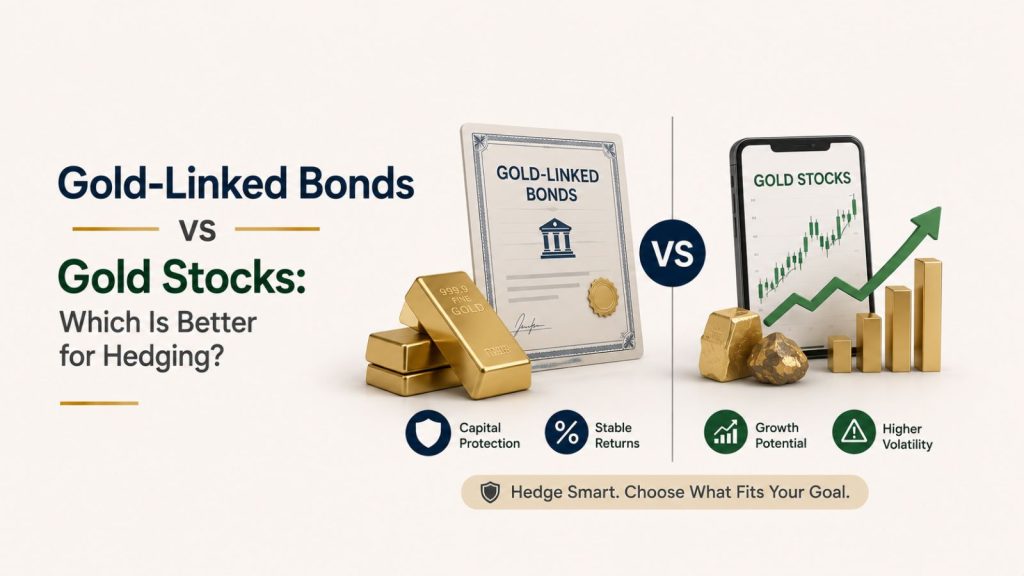
- Gold-Linked Bonds and Portfolio Hedging: When Gold Debt Beats Gold Mining Stocks
Risk Comparison Between Bonds and Stocks
One of the main reasons investors prefer stocks over bonds for long-term investing is return potential.
Historically, stocks have generally outperformed bonds over long investment periods because companies can grow earnings, expand operations, and increase profitability.
Long-Term Stock Returns
Stocks can generate returns through:
- Capital appreciation
- Dividend income
- Compounding growth
Long-Term Bond Returns
Bond returns mainly come from:
- Coupon interest payments
- Limited capital appreciation
While stocks may deliver higher returns, they also experience sharper short-term fluctuations.
Risk Comparison Between Bonds and Stocks
Risk is one of the biggest factors in the long-term bonds vs long-term stocks debate.
Bond Risks
Long-term bonds face risks such as the following:
- Interest rate risk
- Inflation risk
- Credit risk
- Liquidity risk
If interest rates rise, bond prices usually fall.
Stock Risks
Stocks are affected by:
- Market volatility
- Economic slowdowns
- Company performance
- Global market sentiment
Equity markets can experience significant short-term declines during economic crises or market corrections. However, over long periods, stocks have historically recovered from downturns more effectively than many other asset classes.
Stability and Predictable Income
Due to their predictable stream of income, conservative investors typically prefer investing in longer-term bonds.
Bondholders will usually receive:
- Fixed coupon interest payments,
- Scheduled maturity repayment
Therefore, bonds are ideal investments for:
- Retired individuals,
- Income-hungry investors,
- Conservative portfolios.
In contrast to bonds, stockholders are typically paid out dividends, but the amount paid as a dividend is not guaranteed.
The short-term stock price of stocks may vary erratically as well making them typically less predictable than bonds.
Inflation’s Impact on Bonds vs. Stocks
Inflation affects both bonds and stocks differently.
Inflation and Bonds
Inflation can reduce the real purchasing power of fixed bond income.
If inflation rises sharply:
- Bond yields may increase
- Existing bond prices may fall
- Real returns may weaken
Inflation and Stocks
Stocks may perform better during moderate inflation because companies can sometimes pass higher costs to consumers through price increases. Businesses with strong pricing power may continue growing earnings even during inflationary periods.
This gives equities a potential advantage over bonds in long-term inflation-adjusted wealth creation.
Interest Rate Impact on Long-Term Bonds
The performance of long-term bonds has a strong correlation to changes in interest rates.
When interest rates are increased by the Reserve Bank of India, the following typically occurs:
- – Bond yields increase
- – Prices of existing bonds decrease
Bonds with longer durations (i.e., maturity dates in excess of ten years) tend to be significantly impacted by changes in interest rates.
Interest rates also affect the stock market; however, the effect is sector- and economic cycle-dependent.
What Is The Better Investment In Times Of Economic Instability?
In times of economic uncertainty, many investors will look to invest in safer assets (like government bonds).
Many people view bonds as defensive investments because they tend to provide the following:
- Preservation of capital
- Relative stability of income
- Lower volatility than stocks
Many people will experience the largest stock price corrections during times of economic uncertainty due to the following:
- Slower earnings growth of most public companies
- Poor sentiment from investors towards equities
- A sense of terror or panic in the financial markets
Nevertheless, stocks typically have significant rallies once the business cycle turns to a healthy phase.
Wealth Creation: Bonds vs Stocks
For long-term wealth creation, stocks have historically been more effective than bonds because of compounding growth.
Equity investments benefit from:
- Business expansion
- Earnings growth
- Innovation
- Economic development
Bonds are better suited for:
- Income stability
- Risk reduction
- Portfolio diversification
This is why many financial advisors recommend combining both asset classes instead of choosing only one.
Portfolio Diversification: Why Both Matter
A balanced investment portfolio often includes both bonds and stocks.
Why Investors Include Bonds
- Reduce portfolio volatility
- Generate regular income
- Protect during market downturns
Why Investors Include Stocks
- Increase long-term growth potential
- Beat inflation over time
- Build wealth through compounding
The allocation between bonds and stocks usually changes depending on:
- Age
- Financial goals
- Risk tolerance
- Market outlook
Younger investors often allocate more toward equities, while older investors may gradually increase bond exposure.
Long-Term Bonds vs Long-Term Stocks in India
Retail investors in India are investing more in both bonds and equities.
Bond Market Growth
Factors contributing to the growth of India’s bond market include:
- Government Securities
- Corporate Bonds
- Digital Bond Platforms
- Debt Mutual Funds
Equity Market Growth
Factors contributing to the growth of India’s equities include:
- SIP (Systematic Investment Plan) Investments
- Dematerialized (Demat) Account Usage
- Mutual Funds
- Retail Trading Activity
Investors in India are now more aware of the need to have a diversified portfolio through multiple asset classes.
Tax Treatment of Bonds Versus Stocks
Tax treatment also plays an important role in investment decisions.
Bonds: Interest earned from bonds is usually taxed. Depending on the bond type and how long you own it, capital gains may be taxed.
Stocks: Capital gains from stock investments are taxed depending on how long you have owned the stock. Any dividends received from stock investments may also be taxed.
Tax efficiency can vary based on the investor’s income tax rate and the way their investments are structured.
Who Should Invest in Long-Term Bonds?
Long-term bonds would generally appeal to:
- Conservative Investors
- Retirees
- Investors Who Are Looking for Income
- Investors Who Prefer to Have Lower Volatility
Capital preservation usually takes precedence over aggressive growth in these situations.
Who Should Invest in Long-Term Stocks?
Long-term stocks may be suitable for:
- Young investors
- Growth-oriented investors
- Long investment horizons
- Investors comfortable with volatility
Equities generally require patience and discipline to navigate market fluctuations successfully.
Long-term bonds or long-term stocks: Frequently Asked Questions
It depends on the investor’s financial goals, risk tolerance, and investment horizon. Stocks generally offer higher growth potential, while bonds provide stability and predictable income.
Yes, stocks are generally more volatile and riskier than bonds, especially in the short term.
Bonds can generate stable income, but stocks have historically delivered stronger long-term wealth creation due to higher growth potential.
Combining both helps balance growth and stability while reducing overall portfolio risk.
Inflation can reduce the real value of fixed bond income and may negatively impact bond prices.
Government bonds are often considered safer during economic uncertainty because they usually experience lower volatility than equities.
Many retirement portfolios include both stocks for growth and bonds for income stability and risk management.
Ready to Invest?
Visit GoldenPi to explore current bond options. Compare yields, ratings, and tenures in one place and invest online with as little as ₹30,000.
Conclusion
There’s no single answer to the question of long-term investment choices—long-term bonds or long-term stocks.
Long-term wealth accumulation potential is generally better with a stock investment, whereas bonds generally provide a steady income stream with less instability and risk. Each economy has very different characteristics of its respective economy that demand different allocations to the two, so holding both types of assets is useful for all investors as a definite part of each investor’s diversified investment portfolio.
It will be important for investors in India as they develop their long-term wealth and financial security to continue to learn how to do it.
Disclaimer:
This information is for general information purposes only. GoldenPi makes no guarantee on the accuracy of the data provided here; the information displayed is subject to change and is provided on an as-is basis. Nothing contained herein is intended to or shall be deemed to be investment advice, implied or otherwise. Investments in the securities market are subject to market risks. Read all the offer-related documents carefully before investing.
Bonds or non-convertible debentures (NCDs) are regulated by the Securities and Exchange Board of India and other government authorities. GoldenPi Securities Private Limited is a registered debt broker and acts as a distributor and not as a manufacturer of the product.