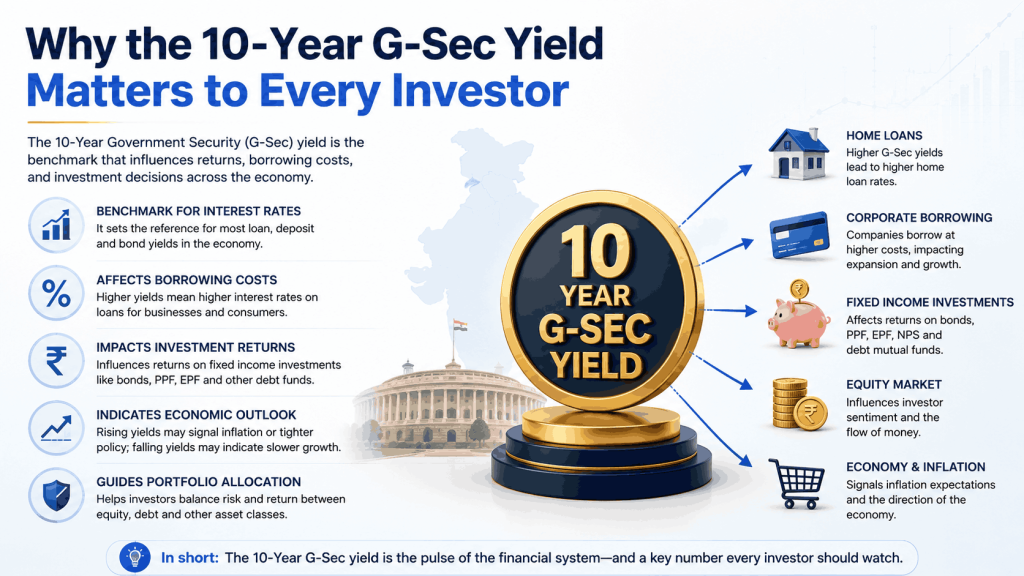
The 10-Year Government Securities (G-Sec) yield is widely considered the ultimate financial barometer of an economy. It dictates long-term borrowing costs, sets the baseline for the safest possible returns, and serves as the foundational anchor for pricing all other financial assets.
Honestly, few numbers in the Indian financial sphere get as much attention from economists, fund managers, and market pundits as the 10-year government security yield. But let’s be real, for your average retail investor, these updates can seem completely irrelevant to their everyday financial choices. I mean, what’s the big deal about some government bond when you’re trying to invest through SIPs, buy a house, or build a nest egg for retirement?
Well, here’s the thing—it actually matters a lot. The 10-year G-Sec yield is basically India’s benchmark interest rate, and it has a ripple effect on all sorts of things: how bonds are valued, the returns on debt mutual funds, even how investors view the stock market, to name a few. So, taking the time to wrap your head around what it all means can be a total game-changer—it’ll give you a way better understanding of market ups and downs and the bigger economic picture too.
What Exactly Is the 10-Year G-Sec Yield?
A G-Sec, basically a type of bond issued by the Government of India, is how it borrows cash from investors. In exchange, investors get interest payments every now and then, plus their principal back when it matures. Now, the 10-year G-Sec is just that: a government bond with a ten-year maturity period. Its yield? That’s the return investors expect for lending to the government for that stretch.
It may seem like some random market stat, but it’s closely watched due to being the reference point for a bunch of other interest rates in the economy. Think of it like the base that informs all sorts of borrowing and investment decisions.
Start investing with just ₹10K & grow your wealth with fixed return opportunities.
Invest Now

Why Is It Considered India’s Benchmark Yield?
Well, the Government of India is pretty much the safest borrower around, so its 10-year bond yield is the gold standard for pricing risk.
When companies issue bonds, investors want a better yield than what they’d get from a G-Sec, because corporate borrowers are known to be riskier. Issuers often look at government bond yields when figuring out long-term lending rates. That’s why a tiny move in the benchmark yield can send ripples through the whole financial system. It’s like a domino effect.
The impact extends well beyond government bonds:
| Area | If the 10-year G-Sec Yield Rises | If the 10-year G-Sec Yield Falls |
| Debt Mutual Funds | Bond prices may decline, particularly in long-duration funds | Bond prices may rise, supporting fund performance |
| Corporate Borrowing | Companies may face higher borrowing costs | Borrowing may become relatively cheaper |
| Home Loan Rates | Lending rates may face upward pressure over time | Lending rates may become more favorable. |
| Equity Valuations | Higher yields can make equities less attractive relative to bonds | Lower yields can support higher equity valuations |
| Investor Sentiment | Markets may anticipate higher inflation or tighter monetary policy | Markets may anticipate lower inflation or easier monetary conditions |
Understanding this relationship helps explain why economists and fund managers closely track movements in the benchmark yield.
Recent Bond Updates:
- RBI October MPC Meeting Minutes: Inflation Spreading, and More Rate Hikes Possible
- RBI Rejects All 224 T-Bill Bids as Yields Surge: Impact on Liquidity and Rates
- Surety Bonds in India: Meaning, Types, Benefits & How They Work

How the 10-Year Yield Affects Debt Investors
So, for debt investors, the connection is pretty straightforward. Bond prices and yields are like two sides of a seesaw: When one goes up, the other comes crashing down. Like, when market yields start to rise, those existing bonds with lower coupon rates suddenly become way less appealing, and their prices drop. On the flip side, when yields start to decline, existing bond prices tend to shoot back up.
This has a direct impact on debt mutual funds, especially the ones dealing with long-term securities. Funds with higher duration are very sensitive to even the slightest interest rate movements, so they can end up with significant fluctuations in value as yields fluctuate, meaning these funds might score some big gains, or they might take some major losses.
For investors in debt funds, understanding the direction of benchmark yields can provide useful context for fund performance.
Why Equity Investors Should Care Too
Many investors think government bond yields are only important for bondholders. Equity investors treat it just as importantly. The 10-year G-Sec yield is like the ultimate risk-free rate—the benchmark against which all other investments are measured. So, investors constantly compare what they could get from stocks with what they’d get from relatively safer government bonds.
Now, when bond yields skyrocket, investors can get a little hesitant about investing in stocks. And let’s be real: higher yields can totally change how we think about future corporate earnings, especially in those sectors where growth expectations play a major role. It’s not like stocks will automatically tank the moment yields rise. But here’s the thing: when that benchmark yield shifts, it can really influence how investors weigh risk and return across the board.
What the Yield Can Tell Us About the Economy
The 10-year G-Sec yield gives us a glimpse into what the market expects from the future. So, when yields rise, it could mean investors are betting on a stronger economy, higher inflation, or a more hawkish monetary policy. On the other side, a falling yield might suggest the economy’s losing steam, inflation’s easing up, or interest rates could be headed for a cut.
The bond market’s always got an opinion on where the economy’s headed, and it’s not like it’s always right, but it’s definitely worth listening to. The benchmark yield is a useful indicator of investor sentiment and what people think about the bigger economic picture.
Why Retail Investors Should Pay Attention
The 10-year G-Sec yield for most retail investors is not something that needs to be checked on a daily basis. It is not a number that should be used as the basis for making all your financial decisions. But knowing what it means can help you better comprehend financial news. From debt fund returns to the interest rate, from home loans to stock market valuations, the benchmark yield is always a part of the story. Financial markets are linked, so the 10-year G-Sec yield affects much more than just bonds.
Conclusion
The 10-year G-Sec yield is far from just a bond-market figure. It provides a reference point to gauge the cost of borrowing, shapes fixed-income investments, impacts stock prices, and is an indicator of how the market is thinking about inflation and economic growth. Even if you never buy into a government bond, you’re indirectly impacted by its movements. Hence, it continues to be one of the most followed numbers in the Indian financial markets.
Frequently Asked Questions
The 10-year G-Sec yield represents the return investors earn by lending money to the Government of India for ten years through government securities. It is widely regarded as the benchmark long-term interest rate in the Indian economy.
Because it serves as a reference point for pricing many financial instruments, including corporate bonds and loans. Since government securities carry minimal credit risk, their yields provide a baseline against which other borrowing costs are measured.
Changes in the benchmark yield influence bond prices. Rising yields generally put pressure on bond prices and debt fund returns, while falling yields can support bond valuations and improve performance.
Indirectly, yes. Investors often compare potential equity returns with government bond yields. Higher yields can affect stock valuations and influence how capital is allocated between equities and fixed-income assets.
There is no need to monitor it daily. However, understanding its role can help investors better interpret developments related to interest rates, debt funds, borrowing costs, and broader market sentiment.
Ready to Invest?
Visit GoldenPi to explore current bond options. Compare yields, ratings, and tenures in one place and invest online with as little as ₹10,000.
Disclaimer:
Fixed returns do not constitute guaranteed or assured returns. Investments in corporate debt securities and municipal debt securities/securitized debt instruments are subject to credit risks, market risks, and default risks, including delay and/or default in payment. Read all the offer-related documents carefully. This blog/article should not be construed as financial advice or as an offer or recommendation to buy or sell any security or any products/services of/on GoldenPi or any product/services of its third-party client(s). For a detailed calculation of YTM, visit our website. T&C’s Apply.