If you’ve ever chosen a corporate bond or an NCD in India simply because it had an “AA” or “AAA” rating, you’re not alone; you’ve acted as retail investors often would. The rating tells you about the rating agency’s opinion of the company on the day the rating was assigned. It is a snapshot of the company at that point in time. Many things can happen after the rating is assigned.
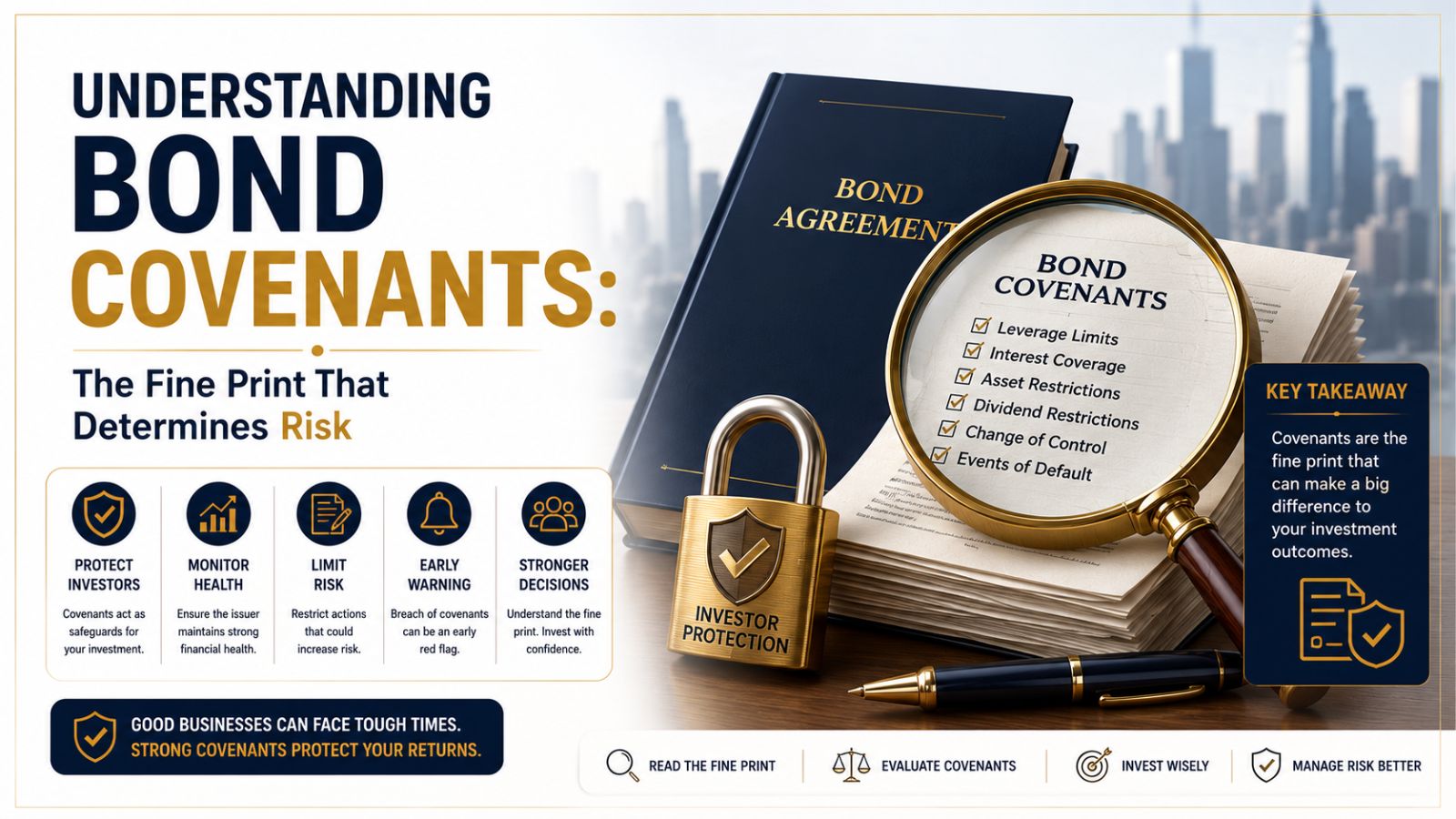
The company promoter can pledge the company’s assets to a different lender or take out a huge dividend while his interest payment to you is delayed. That’s where bond covenants come in. They are the fine print in the bond contract that carries a lot of weight in determining your risk.
The corporate bond market in India is now approximately ₹58 lakh crore, and retail participation is increasing. This has come true as a result of the birth of new online bond platforms. Understanding covenants is due diligence for retail investors in today’s market.
Start investing with just ₹10K & grow your wealth with fixed return opportunities.
Invest Now

The Credit Rating Illusion: Why “AAA” Isn’t a Guarantee
A credit rating looks backward. It is an opinion based on what has already happened and is subject to revision on only a periodic basis. Compared to that, covenants are legally binding. They establish forward-looking rules that dictate what the issuer can and can’t do for the duration your investment is outstanding.
A rating can be downgraded after the damage is done. A breach of covenant, on the other hand, provides bondholders a legal trigger to act before the company defaults. Think of a rating as a student’s report card and a covenant as house rules: The report card reflects performance in the last term, whereas the house rules prevent the student from engaging in reckless behavior for the duration of the term.
Affirmative Covenants: The “Must-Dos”
They are obligations that remain binding to the issuer once the bond is issued, for as long as it is alive. Some commonly seen in Indian NCD structures are the following:
- Issuers are required to maintain a minimum asset cover ratio, commonly 1.1x for secured bonds, although structures are often seen with a 1.5x to 2x cover. This is meant to provide a cushion to bondholders if assets are sold to recover the funds
- Payments of taxes and other government payments are to be made on time. Unpaid dues can create liabilities that rank above the positions of bondholders
- Sending periodic audited financials and compliance certificates to the debenture trustee.
- Maintaining a Debenture Redemption Reserve or Recovery Expense Fund, where applicable, and creating/registering security over pledged assets promptly
According to SEBI, the statutory auditor of the issuer is required to certify security cover and covenant compliance through a centralized system, along with each of the issuer’s quarterly financial performance reports.
Latest Bond Updates:
- Edelweiss Financial Services Limited NCD IPO

- Record Date and Coupon Payment Dates: What Happens to Interest If You Sell Mid-Tenure

- Post Office FD Rates 2026 Explained: Tenures, Quarterly Compounding, and Annual Payouts

Negative Covenants: The “Must-Nots”
These restrictions prevent management from quietly reallocating risk from shareholders to bondholders. The most common restrictions include:
- The company cannot borrow more money beyond a certain debt-to-EBITDA ratio without the consent of the trustee/bondholders
- Core/pledged assets cannot be sold, leased, or disposed of without consent
- If leverage or coverage ratios fall below previously agreed levels, dividend payouts will be restricted
- Limitations on transactions with related parties and guarantees issued to group companies
- No alteration in the nature of the corporate business or significant restructurings of the corporate entity without consent
| Covenant Type | Purpose | Typical Trigger/Example |
| Asset Cover Ratio | Ensures recoverable value backs the debt | 1.1x–2x of principal + interest |
| Leverage/Debt-to-EBITDA cap | Prevents excessive additional borrowing | Breach if new debt pushes ratio above set limit |
| Dividend restriction | Stops cash leaving to equity holders during stress | Blocked if DSCR or asset cover falls below the threshold |
| Related-party transaction limit | Prevents value siphoning to group entities | Cap on % of net worth or mandatory disclosure |
| Reporting covenant | Keeps trustee informed in real time | Quarterly/half-yearly auditor certificates |
The Technical Default Trigger: The Early Warning Bell
This is the part most retail investors don’t realize. If a company violates a covenant, like letting its asset cover drop to 1.05x against the agreed 1.5x, the company can still be in trouble even without missing any interest payments. This is regarded as a technical default, which gives the debenture trustee a reason to enter the situation and seek an accelerated payment or take other protective action, well before the company runs out of cash.
A default, in SEBI’s definition, happens if there is a delay of an interest payment by one day or of one rupee in the scheduled repayment of the principal. In this situation, the issuer would need to disclose the default to the credit rating agency. Regulators and trustees are obliged to disclose and act on covenant breaches.
What Changed in 2025
India’s bond market has suffered from covenant-related issues from IL&FS to more recent private credit incidents. Consequently, in August 2025, SEBI published a Master Circular [1] that defined the obligations of debenture trustees, requiring them to maintain ongoing supervision of both security cover and financial covenants via a Security and Covenant Monitoring System centralized by the depositories.
What this means is that trustees have to proactively monitor covenant compliance and cannot simply rely on periodic submissions of compliance certificates. Any covenant shortfall must be disclosed to the investors as soon as it occurs, rather than at the next scheduled credit rating assignment.
This is a positive development for Indian investors and means that before an investor buys an NCD or bond, they should review the debenture trust deed or the information memorandum and the covenants, not just the credit rating page.
Frequently Asked Questions
A bond covenant is a clause that details the rights of a bondholder and the responsibilities of an issuer for the life of the bond. They are legally enforceable.
Positive covenants list conditions that the issuer must fulfill, such as providing recordkeeping or maintaining insurance. Negative covenants restrict the issuer from certain activities, such as limiting the amount of borrowing and restricting the payment of dividends.
A breach of a bond covenant may trigger remedies listed in the bond agreement, such as requiring additional disclosures, active corrections, or, in some cases, an event of default.
No. Differing levels of covenant protections are common among different issuers and series of bonds. An investor should read a bond’s documents thoroughly before purchasing.
Unlike corporate bonds that are standard contracts, government bonds are governed by statutes and regulations, removing contractual covenants from the agreement.
Sources
Disclaimer
Fixed returns do not constitute guaranteed or assured returns. Investments in corporate debt securities and municipal debt securities/securitized debt instruments are subject to credit risks, market risks, and default risks, including delay and/or default in payment. Read all the offer-related documents carefully. This blog/article should not be construed as financial advice or as an offer or recommendation to buy or sell any security or any products/services of/on GoldenPi or any product/services of its third-party client(s). For a detailed calculation of YTM, visit our website. T&C’s Apply.