Have you ever filled out a fixed deposit form at a post office counter and wondered why the rate on the form doesn’t match what your account earns each year? That gap isn’t a calculation error; it is simply compounding at work. Post Office Fixed Deposits, also known as National Savings Time Deposits, are still a popular choice for conservative Indian savers in 2026 because they are backed by the government and have certain, predetermined tenures.
They also offer competitive rates, with the one-year deposit earning 6.9% and the five-year deposit earning 7.5%. This article walks you through the latest rate chart, how quarterly compounding quietly works in your favor even though you’re paid once a year, and how this scheme compares with a regular bank FD.
Start investing with just ₹10K & grow your wealth with fixed return opportunities.
Invest Now

Latest Post Office FD Interest Rates 2026 (Tenure-Wise)
Rates on small savings schemes are reviewed by the Ministry of Finance every quarter. The Post Office Time Deposit rates have remained unchanged at 6.90% to 7.50% since July–September 2023, making this an unusually long period of rate stability. The current tenure-wise rates are
| Tenure | Interest Rate (p.a.) | Effective Annual Yield* | 80C Benefit |
| 1 year | 6.90% | ~7.08% | No |
| 2 years | 7.00% | ~7.19% | No |
| 3 years | 7.10% | ~7.29% | No |
| 5 years | 7.50% | ~7.71% | Yes |
Source: India Post
*Effective yield reflects the impact of quarterly compounding on the stated rate.
A quick note on timing: these are the rates for the July-September 2026 quarter. The next revision, for October-December 2026, is typically announced by the Finance Ministry around September 30, so it’s worth double-checking the notification before you lock in a fresh deposit this month.
How Quarterly Compounding Actually Works
This is the part that confuses most people: Post Office FD interest is compounded quarterly but paid out annually. This means your money grows every quarter but only gets credited once a year.
The maturity value is calculated as
A = P × (1 + r/4)^(4t)
where P is your deposit, r is the annual rate as a decimal, and t is the tenure in years. The rate is divided by four because it compounds every quarter, and the exponent tracks how many quarters your money sits invested.
For example, a ₹100,000 deposit at the 5-year rate of 7.5% compounds at 1.875% every quarter across 20 quarters and ends up being ₹144,995, which is ₹44,995 in interest. Thus, the effective yield of 7.71% is higher than the headline yield of 7.5, which is because quarterly compounding is doing the quiet, extra work.
Why Annual Payouts Still Matter
Even though compounding happens quarterly, the interest itself is calculated quarterly and credited to your account annually. In practical terms:
- Your interest earns interest between quarters. This is why the effective yield of your investment is always higher.
- You still only receive a lump sum credit once a year, not every three months, so this isn’t a monthly-income product.
- If you need regular income instead of annual payouts, the Post Office Monthly Income Scheme (POMIS) is a better fit, though it currently runs at a different rate structure.
- The rate that you get at the time of your deposit is guaranteed to be the rate for the entire tenure, even if interest rates change subsequently.
Latest Fixed Deposit Updates:
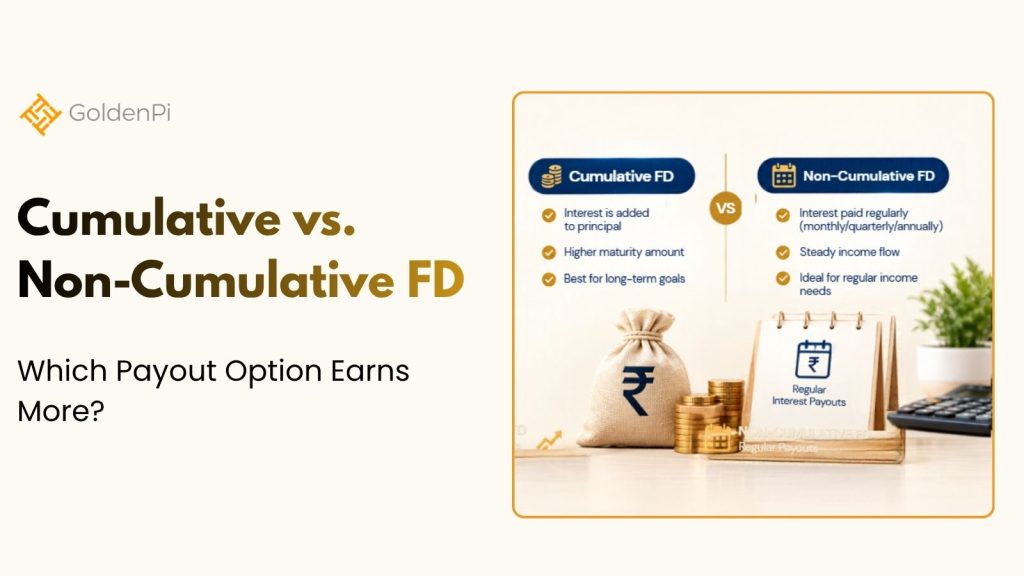
- Cumulative vs Non-Cumulative FD: Which Payout Option Earns More?
- Callable vs Non-Callable FDs: Why Non-Callable Deposits Pay More

- Sweep-In FD Explained: How Auto-Sweep Accounts Work in India

Is It Still Worth It in 2026?
Post Office FDs aren’t going to offer the highest rate on the board; some small finance banks and corporate FDs pay more. What they offer instead is certainty: a sovereign guarantee, no senior citizen rate gap, and a fixed rate that survives any mid-tenure rate cuts.
This makes them a good fit for conservative money—emergency funds, a child’s education corpus, or simply balancing out an equity-heavy portfolio. They’re less suited to anyone optimizing for post-tax returns, since interest is fully taxable with no indexation benefit.
One practical tip: rather than putting your money in a single 5-year deposit, you should ladder your deposits across different terms (1-, 2-, 3-, and 5-year deposits) so that you don’t have all your money locked up for 5 years at the rate you are getting now, and a portion of your money gets unlocked every year. And if you’re opening a fresh deposit in the next few weeks, keep an eye on the October–December 2026 rate notification before you commit, especially for the 5-year tenure.
Bottom line: Post Office FDs remain a solid, low-drama building block for a conservative portfolio in 2026. Just pair the headline rate with a little planning around tenure and timing.
Post Office FD Frequently Asked Questions
Post Office Time Deposits are available for 1, 2, 3, and 5 years. The applicable interest rate depends on the tenure selected.
The interest is calculated and compounded quarterly, although it is paid to the account holder annually.
It means interest is calculated on a quarterly basis, but the interest amount is credited to the investor’s account at the end of each year. The quarterly calculation does not mean that investors receive four separate payouts every year.
No. The standard Post Office Time Deposit structure provides for annual interest payment, not a monthly payout option. Investors looking specifically for monthly income may need to consider a different Post Office scheme.
The minimum deposit is generally ₹1,000, with deposits accepted in multiples of ₹100 thereafter. Investors should verify the latest operational rules before opening an account.
There is generally no maximum deposit limit for a Post Office Time Deposit, although the applicable scheme rules should be checked before investing a large amount.
Disclaimer
Fixed returns do not constitute guaranteed or assured returns. Investments in corporate debt securities and municipal debt securities/securitized debt instruments are subject to credit risks, market risks, and default risks, including delay and/or default in payment. Read all the offer-related documents carefully. This blog/article should not be construed as financial advice or as an offer or recommendation to buy or sell any security or any products/services of/on GoldenPi or any product/services of its third-party client(s). For a detailed calculation of YTM, visit our website. T&C’s Apply.