|
Getting your Trinity Audio player ready...
|
For years, the standard advice on gold was simple: buy a Sovereign Gold Bond. It tracked the gold price, added 2.5% interest a year, and paid out tax-free if you held it to the end. Nothing else matched it.
That door has closed for new buyers. The RBI has not issued a fresh SGB tranche since February 2024, and no issuance calendar has been announced for 2026. The government has said the scheme became too costly, since it had to pay both the rising gold price and the 2.5% interest. So anyone who wants fresh gold exposure now needs the SGB alternatives that 2026 can actually offer.
This is a real gap. The search for SGB alternatives is not about finding one perfect replacement, because none exists. It is about knowing the trade-offs of each option for gold investment after SGBs stopped, so your choice fits your needs. This guide lays out the SGB alternatives available in 2026, one by one.
Start investing with just ₹10K & grow your wealth with fixed return opportunities.
Invest Now

Can You Still Buy SGBs on the Secondary Market?
Yes, but with a catch, and this shapes the case for the SGB alternatives that follow. You cannot subscribe to a new SGB from the RBI, but old SGB series still trade on the NSE and BSE. You can buy them there through a demat account.
The catch is the tax. From 1 April 2026, the tax-free maturity applies only to the original subscribers who bought at the RBI issue and held to the end. If you buy an SGB on the exchange today, your gain at maturity is taxed at 12.5%. The single biggest reason people loved SGBs, the tax-free exit, no longer applies to a secondary buyer.
There is also a price quirk. Because supply is fixed and demand for the interest is high, secondary SGBs sometimes trade above the actual gold price. So a secondary SGB is not always the bargain it looks like, which is why the SGB alternatives below deserve a proper look rather than defaulting to the exchange.
Gold ETFs: The Closest SGB Alternative
For most investors, a gold ETF is the nearest of the SGB alternatives to an SGB itself. In any gold ETF vs SGB 2026 comparison, the ETF wins on availability, simply because you can buy it any day.
A gold ETF is a fund that trades on the stock exchange and tracks the domestic gold price. One unit is a tiny slice of gold, so you can start small. You need a demat account, the same as for shares, and you buy and sell during market hours at a price that closely follows gold.
Here is the honest gold ETF vs. SGB 2026 scorecard. In the gold ETF vs. SGB comparison, the ETF matches gold’s price just as an SGB does, and it is easy to buy and sell. But it pays no interest, where an SGB paid 2.5% a year, and it charges a small yearly fee, usually around 0.5% to 1%, that an SGB did not. On tax, the gold ETF vs. SGB picture is level: a gold ETF held over a year is taxed at 12.5% on the gain, the same rate a secondary SGB now faces. So in the gold ETF vs. SGB 2026 choice for a new buyer in 2026, the ETF is close, minus the lost interest.
Gold Mutual Funds: SGB Alternatives Without a Demat Account
Not everyone has a demat account, and among the SGB alternatives a gold mutual fund helps here. It is one of the few SGB alternatives that needs no demat account at all.
A gold fund, sometimes called a gold fund of funds, is a mutual fund that puts your money into a gold ETF for you. You buy it like any mutual fund, through an app or a distributor, with no demat account required. It also allows a monthly SIP, so you can add a fixed amount to gold every month, which suits steady savers.
The trade-off is cost. Because the fund invests in an ETF, you pay the ETF’s fee plus the fund’s own fee, so it costs a little more than holding the ETF directly. For gold investment after SGB stopped, a gold fund trades a bit of extra cost for the convenience of no demat account and easy SIPs. For many first-time gold buyers, that is a fair deal.
Digital Gold vs Bonds: Convenient but Unregulated
Among the SGB alternatives, digital gold is the easiest to start and the hardest to trust. In any digital gold vs. bonds comparison, convenience is its strength and regulation is its weakness.
Digital gold lets you buy small amounts of gold online through apps, which store the physical gold for you. You can buy a few rupees’ worth in seconds. That ease is why it has grown fast. But here is the crucial point in the digital gold vs. bonds question: digital gold is not regulated by SEBI or the RBI. In November 2025, SEBI warned the public that digital gold sits outside its rules, with no investor protection.
That warning matters. An SGB was a government security, and a gold ETF is a regulated, listed fund. Digital gold has no backing. So in the digital gold vs. bonds trade-off, you gain convenience but give up the safety net that both SGBs and ETFs carry. For a small, short-term amount, it can be fine, but for serious gold savings, the digital gold vs. bonds comparison favors the regulated SGB alternatives.
Latest Bond Updates:
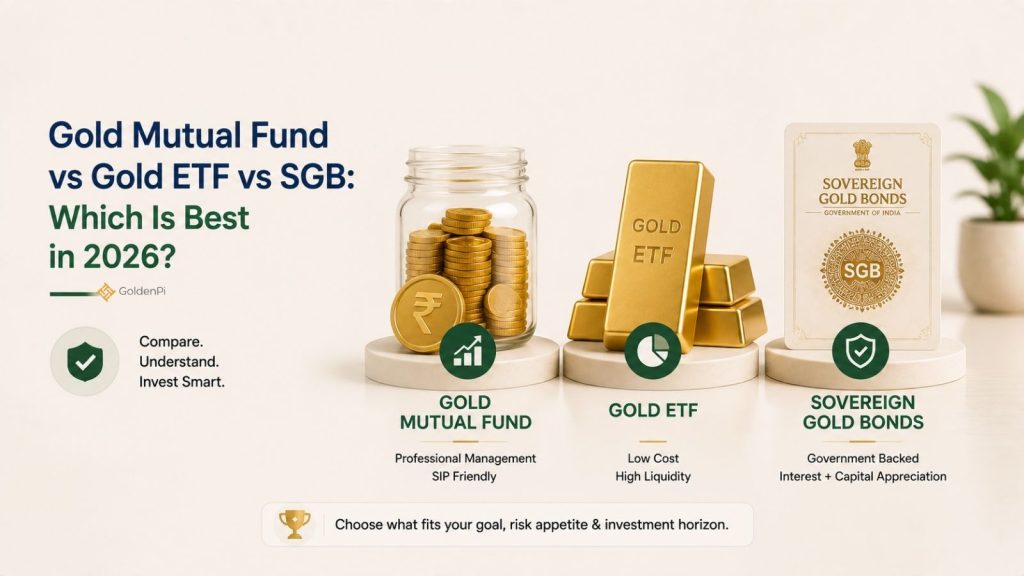
- Gold Mutual Fund vs Gold ETF vs SGB: Which Is Best in 2026?
- Bonds for Freelancers & Self-Employed: Managing Irregular Income

- Buying SGBs in Secondary Market 2026: Tax Rules & Returns
Physical Gold: The Old Habit, With Old Problems
Physical gold, coins, bars, and jewelry are the SGB alternatives families know best and the ones with the most hidden costs. It is a familiar choice among gold investments after SGB stopped, but rarely the smartest.
When you buy physical gold, you pay a making charge or a dealer premium above the metal’s value. When you sell, you may face questions about purity and get less than the market rate. You also carry the cost and worry of storing it safely. None of these applied to an SGB, which existed only on paper.
For gold investment after SGB stopped, physical gold makes sense mainly if you want the metal itself for use or for tradition. As a pure investment, its extra costs make it the weakest of the common SGB alternatives investors consider in 2026.
What No SGB Alternative Can Replace
It helps to be honest about what the SGB alternatives cannot recover. No SGB alternatives in 2026 can match two things the Sovereign Gold Bond gave you.
The first is the 2.5% annual interest. Every alternative here, ETF, fund, digital, or physical, gives you only the gold price. None pays you an income on top. Over a long holding, that missing 2.5% a year adds up. It is the clearest loss in any gold investment after SGB stopped and worth remembering with every gold investment after SGB stopped.
The second is the tax-free maturity, which now survives only for original SGB subscribers. Every new gold investment after SGB stopped, whether an ETF or a secondary SGB, is taxed on its gain. So the honest way to frame SGB alternatives in 2026 is this: you can still own gold easily and cheaply, but the special extras that made SGBs unique are gone. Choose the alternative whose trade-offs you can live with, and hold gold as one steady part of a wider plan, not the whole of it.
SGB Alternatives Frequently Asked Questions
For most people, a gold ETF is the best of the SGB alternatives offered. It tracks gold, trades any day, and is regulated, which is why it leads any gold ETF vs SGB 2026 comparison. It lacks the 2.5% interest an SGB paid, but on price exposure and safety, it is the closest match for gold investment after SGB stopped.
There is no sign of it. The RBI has issued no new tranche since February 2024 and announced no calendar for 2026. The government has called the scheme too costly, so most analysts expect no fresh issues, which is why the SGB alternatives here matter now.
For new issues, effectively yes. No fresh SGB has been sold since February 2024. Existing bonds still trade and still mature normally, but for a new buyer the scheme is closed, leaving the SGB alternatives covered here as the route to gold.
Only on the secondary market. You can buy old SGB series on the NSE or BSE through a demat account. But from 1 April 2026 a secondary buyer loses the tax-free maturity and pays 12.5% on the gain, a key point in any gold ETF vs SGB 2026 comparison.
For a new buyer, often yes, since fresh SGBs are unavailable. In the gold ETF vs. SGB 2026 choice, the ETF gives the same gold exposure with easy trading but no 2.5% interest and a small yearly fee. It is the most practical of the SGB alternatives.
On balance, the gold ETF is regulated, cheap, and easy to trade. In the digital gold vs. bonds and metal comparison, digital gold is convenient but unregulated, and physical gold carries making and storage costs. The ETF is the strongest everyday choice.
through the SGB alternatives in this guide. Open a demat account for a gold ETF, or use a gold mutual fund with no demat and an SIP. Digital gold and physical gold are options too, but weigh the digital gold vs bonds safety gap and physical gold’s costs first.
Disclaimer
Fixed returns do not constitute guaranteed or assured returns. Investments in corporate debt securities and municipal debt securities/securitized debt instruments are subject to credit risks, market risks, and default risks, including delay and/or default in payment. Read all the offer-related documents carefully. This blog/article should not be construed as financial advice or as an offer or recommendation to buy or sell any security or any products/services of/on GoldenPi or any product/services of its third-party client(s). For a detailed calculation of YTM, visit our website. T&C’s Apply.